Whole Food, Isolate or Derivative: What Is Actually in Your Dog’s Supplement?
I am a food-first, whole-plant-first person.
Before adding another capsule, powder, oil or chew, I want to know whether we can provide what the dog needs through fresh food, a whole herb, a complete essential oil, medicinal mushrooms or another naturally complex source.
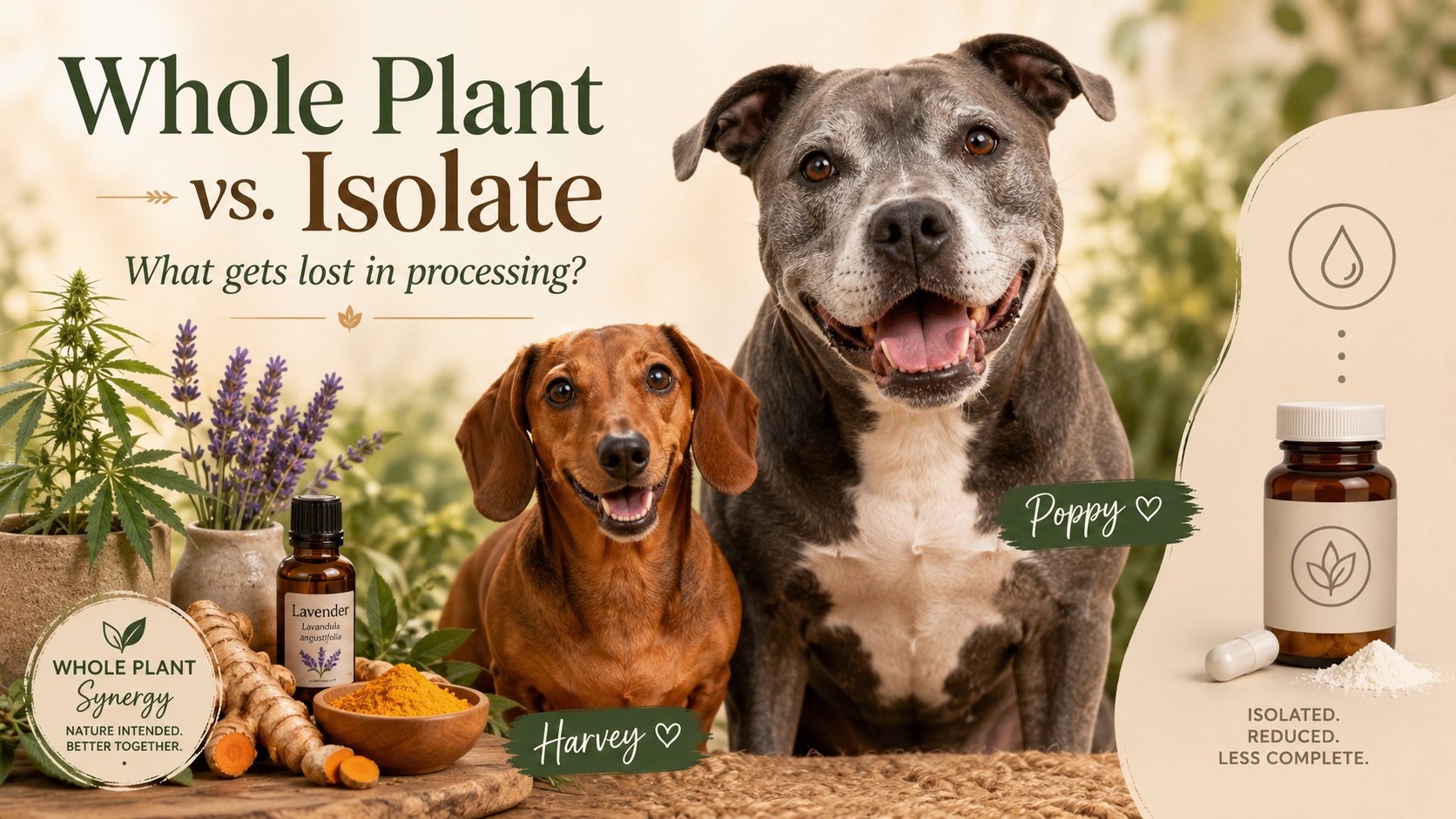
That does not mean every extract or isolated constituent is useless. It means I do not automatically believe that removing one interesting compound from a plant, concentrating it and putting a large number beside it creates a better product.
Sometimes it creates a useful therapeutic tool.
Sometimes it creates an expensive fragment of what nature originally provided.
See your vet for a diagnosis and then you and I can collaborate on a custom strategy for your dog’s health.
Why Supplement Labels Become Confusing
Pet parents are expected to make decisions based on terms such as:
Whole food
Whole herb
Extract
Full spectrum
Broad spectrum
Standardized extract
Isolate
Concentrate
Active constituent
Derivative
Bioavailable
Liposomal
Phytosome
Chelated
Synthetic
Nature-identical
Those words are not interchangeable.
An extract is not automatically an isolate. A concentrated product is not necessarily synthetic. A standardized herbal extract may still retain several compounds from the plant. A derivative may have been altered to behave differently from the original substance.
The front label normally skips those details and goes straight to phrases such as advanced formula, maximum strength and clinically developed.
Marketing gets the big font. The useful information is usually hiding on the back with a magnifying glass.
What Is a Whole-Food or Whole-Herb Ingredient?
A whole-food ingredient retains much of the naturally occurring mixture found in the original food.
A whole herb contains numerous plant constituents, which may include:
Fibers and polysaccharides
Pigments and phytonutrients
Aromatic compounds
Natural oils
Minerals
Enzymes
Antioxidants
Compounds researchers may not have completely identified
The value of the whole source may not come from one star ingredient. It may come from how its many constituents interact, influence absorption, work through several pathways or help balance one another.
This is often described as the whole-food matrix or whole-plant matrix.
Nature rarely delivers one nutrient completely alone. She normally sends coworkers.
You can see the same distinction when comparing naturally occurring nutrients with the vitamin and mineral premixes added to processed dog food.
Read How to Identify Synthetic Vitamins and Minerals in Dog Food.
What Is an Extract?
An extract is produced by using water, alcohol, glycerin, carbon dioxide or another method to pull certain constituents from a food, mushroom or herb.
Extraction is not automatically bad or unnatural. Herbal tinctures are extracts too.
A well-made extract may:
Make an herb easier to administer
Concentrate beneficial constituents
Improve consistency
Remove difficult-to-digest plant material
Capture compounds that are not easily obtained from the raw plant
Improve shelf stability
Make a therapeutic amount more practical
The important question is not simply, “Was this extracted?”
Ask:
What did the extraction retain, what did it remove and why?
A broad-spectrum or whole-spectrum extract attempts to preserve several constituents. A highly refined extract may narrow the plant down to one compound or one small group of compounds.
Those are very different products.
What Is a Standardized Extract?
A standardized extract is manufactured to contain a consistent percentage or amount of one or more marker compounds.
A turmeric extract, for example, may be standardized to a particular percentage of curcuminoids. A milk thistle extract may be standardized according to its silymarin content.
Standardization can be useful because it provides greater consistency between batches. When we are using an herb therapeutically, knowing what is actually in the product helps.
However, a standardized number does not tell us everything.
A product standardized for one compound may still retain a broad range of plant constituents—or it may have been heavily refined around that one marker. The manufacturer should tell us which.
Do not let one impressive percentage distract you from the rest of the label.
What Is an Isolate?
An isolate is a single constituent, or a narrowly defined group of constituents, separated from the broader plant, food or natural source.
Examples may include:
Curcumin isolated from turmeric
CBD isolated from hemp
Ascorbic acid used instead of a whole vitamin C-rich food
Individual amino acids removed from their original protein source
A purified plant polyphenol
An isolated aromatic molecule from an essential oil
An individual cannabinoid
A single mineral compound
An isolate offers concentration and specificity.
It does not provide the original whole food, whole herb or complete plant extract.
That does not automatically make every isolate harmful. It does mean we should stop pretending the isolate and the complete source are nutritionally or herbally identical.
They are not.
What Is a Derivative?
A derivative is a substance produced from another compound through processing, conversion or chemical modification.
Derivatives may be developed to:
Improve stability
Increase water or fat solubility
Extend shelf life
Increase absorption
Change where the compound travels in the body
Reduce irritation
Create a more consistent ingredient
Produce a proprietary or patentable formula
The resulting ingredient may behave differently from the substance it came from.
That may occasionally be the reason it was created. It may also bring different interactions, metabolism or safety considerations.
“Derived from turmeric” does not mean “the same as turmeric.”
What May Be Lost During Isolation?
When one compound is separated from a whole plant or food, the finished isolate may no longer contain:
Natural fibers
Polysaccharides
Volatile oils
Companion phytonutrients
Mineral relationships
Natural cofactors
Compounds that influence absorption
Constituents that broaden the plant’s activity
Constituents that may temper or balance stronger compounds
Researchers may understand one isolated constituent reasonably well while knowing much less about everything that was removed around it.
This is one reason I do not assume that a higher number represents an upgrade.
We can easily measure 500 milligrams of one isolate. It is much harder to put a number on the relationships among dozens of naturally occurring compounds.
Easier to measure does not automatically mean more useful to the body.
Curcumin and Turmeric: The Most Familiar Example
Turmeric is a whole root containing several curcuminoids along with turmerones, volatile oils, polysaccharides and other plant compounds.
Curcumin is one of its most studied constituents.
When curcumin is isolated, manufacturers can provide a much higher concentration than would naturally occur in a normal serving of turmeric. They may also use special delivery systems because basic curcumin is poorly absorbed and rapidly metabolized.
These formulations may include:
Piperine from black pepper
Phospholipids
Liposomes
Micelles
Nanoparticles
Other carrier complexes
These approaches may increase how much curcumin reaches circulation. Increasing the absorption of curcumin, however, does not restore everything removed from the turmeric root.
That leaves us with two separate questions.
Can a Formulation Help the Body Absorb More Curcumin?
Possibly. The result depends on the specific formulation, concentration and individual using it.
Does Better Absorption Make Curcumin Equivalent to Whole Turmeric?
No.
It may make the isolated compound more available. It does not turn it back into the whole herb.
For broad, food-first support, I generally prefer whole turmeric, golden paste or a quality whole-root preparation when it is appropriate for the dog.
A concentrated curcumin product may occasionally have a place when there is a clear reason to use a more targeted constituent. It should be understood as a therapeutic tool—not nature’s upgraded version of turmeric.
Read Turmeric Benefits and Golden Paste Recipe for Dogs for the practical discussion of using the whole herb.
Turmeric is also commonly included in mobility plans, but one herb should not be expected to do all the heavy lifting. Learn more in Does My Dog Need Joint Supplements?.
CBD: Full-Spectrum Hemp Versus CBD Isolate
CBD offers another clear example of what changes when one popular compound is separated from the rest of a plant.
Hemp naturally contains a much broader group of constituents, including:
CBD
Other cannabinoids
Terpenes
Flavonoids
Fatty acids
Additional plant compounds
Legally permitted trace amounts of THC in qualifying hemp products
A full-spectrum hemp extract retains a wider range of those naturally occurring constituents.
A CBD isolate is refined until almost everything except cannabidiol has been removed.
The isolate gives the manufacturer a very concentrated and predictable CBD ingredient. It also removes much of the hemp plant’s natural chemical complexity.
Once again, you gain more of one constituent but lose the surrounding plant matrix.
Why Full-Spectrum CBD May Behave Differently
The cannabinoids, terpenes and flavonoids in hemp may influence one another. This possible interaction is often called the entourage effect.
That term is sometimes used far too casually in marketing, but the underlying point is reasonable: a complex plant extract may behave differently from a single isolated cannabinoid.
Full spectrum does not automatically mean high quality. The product still needs appropriate sourcing, formulation and testing.
In my work, I generally prefer a quality full-spectrum CBD product when it is appropriate for the dog. I am not looking for CBD alone. I want the broader hemp profile, including the naturally occurring trace amount of THC permitted in a properly produced hemp product.
CBD isolate may provide cannabidiol, but it should not be presented as though it offers the complete plant chemistry of full-spectrum hemp.
For more on how CBD works within the dog’s larger regulatory system, read CBD and the Endocannabinoid System in Dogs.
Pet parents who have tried a questionable or poorly formulated product may also find Reasons Why CBD May Not Work for Your Dog helpful.
Full Spectrum, Broad Spectrum and Isolate
These three terms are often confused.
Full-Spectrum Hemp Extract : Generally retains CBD, additional cannabinoids, terpenes, flavonoids and a legally permitted trace amount of THC.
Broad-Spectrum Hemp Extract: Generally retains CBD and some additional hemp compounds, but the THC has been removed or reduced to a non-detectable level.
CBD Isolate: Contains isolated cannabidiol with most or all other hemp constituents removed.
A broad-spectrum product sits somewhere between full spectrum and isolate, but the exact chemical profile varies by manufacturer.
The certificate of analysis should show:
CBD concentration
THC concentration
Other cannabinoids detected
Contaminant testing
Pesticide screening
Heavy-metal screening
Residual-solvent testing
Microbial testing
A label that simply says “hemp oil” tells you very little. Hemp seed oil, full-spectrum hemp extract and CBD isolate are not the same product.
When CBD Isolate May Have a Place
CBD isolate may occasionally be considered when a completely THC-free product is required or when there is a specific reason to avoid other hemp constituents.
That does not make isolate my preferred form for most dogs.
It means a narrower product may serve a narrower purpose.
The isolate should earn its place in the plan rather than being chosen because THC-free packaging feels more reassuring.
Removing compounds is not automatically the same thing as improving safety or effectiveness.
Essential Oils: Concentrated Extracts, but Usually Not Isolates
Essential oils add another layer to this discussion because they are already highly concentrated botanical extracts.
Lavender essential oil is not the same as a lavender flower. Distillation captures many of the plant’s volatile aromatic compounds while leaving behind the plant’s water, fiber, minerals, proteins and many heavier constituents.
An essential oil is therefore not the whole herb.
However, a genuine complete essential oil is also not normally a single isolated compound.
An authentic essential oil may contain dozens—or sometimes hundreds—of aromatic constituents. Together, those compounds influence its aroma, activity, strength and tolerance.
For example, lavender essential oil may contain varying amounts of:
Linalool
Linalyl acetate
Terpinen-4-ol
Lavandulol
Other minor aromatic compounds
Linalool alone is not lavender essential oil.
Menthol alone is not peppermint essential oil.
1,8-cineole alone is not eucalyptus essential oil.
Thymol alone is not thyme essential oil.
Terpinen-4-ol alone is not tea tree essential oil.
An isolated aromatic compound may have useful actions, but it does not reproduce the complete chemistry of the oil from which it originated.
Whole Essential Oil Versus an Isolated Constituent
A manufacturer may isolate one aromatic constituent because it is:
Easier to standardize
Less expensive to manufacture
Strongly scented
Well studied
Useful for one targeted purpose
Easier to reproduce synthetically
Convenient for creating a consistent product
Increasing one constituent changes the chemical balance.
A complete essential oil may contain compounds that:
Complement one another
Broaden the oil’s activity
Influence penetration and absorption
Affect how the oil is metabolized
Temper the intensity of stronger constituents
Influence aroma and emotional response
Affect skin or respiratory tolerance
Once a single molecule is removed and used alone, those relationships are gone.
The isolated molecule may still be useful. It should not be treated as though it is the full essential oil.
A single constituent is a chemical tool.
An authentic essential oil is a complex aromatic extract.
For a broader discussion of why oil quality and practitioner knowledge count, read Essential Oils for Dogs: The Wellness Tool I’ll Never Be Without.
Synthetic Fragrance Is Not Essential Oil
This distinction also explains why synthetic fragrance and essential oils are not interchangeable.
A synthetic fragrance may be created from individual aroma chemicals designed to imitate the smell of lavender, citrus, peppermint or another plant.
It may smell similar without containing a meaningful amount of the botanical extract.
Labels may use vague terms such as:
Fragrance
Parfum
Natural fragrance
Lavender scent
Essential oil fragrance
Proprietary aroma blend
Some products contain a small amount of essential oil combined with synthetic fragrance chemicals, then market the entire product around the recognizable plant name.
Smelling like lavender does not make something lavender medicine.
Why Essential-Oil Quality Changes the Result
Even when the label identifies a real essential oil, the chemistry and quality may vary.
Ask:
Is the botanical species listed?
Is the plant part identified?
Was the oil distilled or cold pressed appropriately?
Was it extended with cheaper oils or carriers?
Were synthetic constituents added?
Was it tested for identity and adulteration?
Is batch-specific testing available?
Was it stored properly?
Has it oxidized with age, heat or air exposure?
Is it appropriate for the dog and intended route of use?
Two bottles labeled lavender may not be chemically identical.
Growing conditions, climate, soil, plant variety, harvest timing, distillation and storage all influence the finished oil.
Natural variation is not necessarily a flaw. It is part of using a genuine plant-derived substance.
Tea tree is one oil where adulteration and poor-quality products have created substantial confusion. Read Is Tea Tree Essential Oil Safe for Dogs? for a closer look at quality and appropriate use.
Chemotypes Show Why the Plant Name Is Not Enough
Some aromatic plants produce different dominant chemical profiles called chemotypes.
The botanical species may be the same, but one chemotype may contain a higher proportion of one primary constituent while another emphasizes a different group of compounds.
That can change:
Aroma
Strength
Primary actions
Irritation potential
Appropriate applications
Which dogs or conditions require more caution
This is another reason the plant name on the front of the bottle is not enough.
The chemistry affects how the oil should be used.
Does Whole or Full Spectrum Automatically Mean Safer?
No.
A whole herb can be contaminated. A full-spectrum CBD product can be poorly made. A complete essential oil can still be irritating, overly concentrated or completely wrong for a particular dog.
“Whole” does not automatically mean gentle.
“Natural” does not automatically mean harmless.
Quality and individual suitability still count.
For essential oils, the dog’s age, size, seizure history, respiratory condition, liver function, medications, skin condition, route of use, dilution and frequency of exposure all influence the plan.
A blend may contain several natural oils and still be a terrible choice for the dog standing in front of you.
For practical dilution guidance, read Safe Essential Oil Dilution for Dogs.
For home use, Diffusing Essential Oils Safely Around Dogs explains why room size, ventilation, oil quality and the individual animal need to be considered.
The Same Pattern Appears Across All Three Examples
Turmeric, CBD and essential oils may appear to be separate subjects, but the underlying issue is the same.
Turmeric
Whole turmeric contains curcuminoids, turmerones, volatile oils, polysaccharides and other compounds.
Curcumin isolate provides a concentrated group of constituents but not the complete root.
Hemp
Full-spectrum hemp contains CBD along with other cannabinoids, terpenes, flavonoids and a trace amount of THC.
CBD isolate provides cannabidiol without the broader hemp profile.
Essential Oils
A genuine essential oil contains a complex mixture of volatile aromatic compounds.
An isolated constituent provides one molecule without the oil’s complete chemistry.
In each example, manufacturers may increase consistency, concentration, absorption or shelf stability by narrowing the plant down to selected compounds.
That may produce a useful targeted tool.
It may also create something that is easier to measure, market and patent—but less complete. (you can’t patent nature!)
Nature’s Complexity Is Not an Inconvenience
One reason manufacturers prefer isolates is that whole plants are complicated.
Their chemical profiles may vary according to:
Soil
Climate
Plant variety
Harvest timing
Plant part
Growing practices
Extraction method
Distillation
Processing
Storage
That variability makes natural materials harder to standardize.
From a manufacturing perspective, isolating one compound solves a problem.
From a holistic perspective, that “problem” may also be part of the plant’s value.
The body does not use nutrients, herbs, cannabinoids and aromatic compounds in a laboratory vacuum. It responds according to digestion, metabolism, gut health, organ function, medications, diet and everything else the dog is exposed to.
Nature’s complexity is not always something we need to engineer away.
Whole Does Not Automatically Mean Better Quality
There is an important reality check here.
A contaminated or incorrectly identified whole herb is not better than a clean, properly tested extract simply because it is whole.
Whole-food and whole-herb products may still contain:
Pesticide residues
Heavy metals
Mold or harmful microbes
The wrong plant species
Very little of the expected constituents
Inconsistent potency
Undeclared fillers
Synthetic dyes
Poorly stored or degraded ingredients
I would rather use a clean, appropriately identified and tested extract than romanticize a bag of mystery powder.
The goal is not “whole at any cost.”
The goal is to use the least processed, most complete and highest-quality form capable of doing the job safely.
More Bioavailable Does Not Always Mean Better
Bioavailability describes how much of a substance becomes available for the body to use.
Improving bioavailability may be helpful. It may also increase:
Medication interactions
Side effects
Tissue exposure
The possibility of using more than the dog needs
The strength of a product assumed to be gentle
A traditional whole-herb preparation and an engineered high-absorption derivative may behave very differently.
When pet parents see enhanced absorption, they often hear better.
I hear, “This may act more strongly, so we need to know what else this dog is taking.”
Synthetic and Isolated Vitamins and Minerals
The same concern appears in dog food and multivitamins.
Synthetic or isolated vitamins and minerals are commonly used because they are inexpensive, stable and easy to measure.
Sometimes they are necessary to balance a formulated diet or correct a known deficiency. That can serve a legitimate purpose.
The problem begins when isolated nutrients are treated as though they always function exactly like nutrient-rich food.
Whole-food sources may provide:
Multiple forms of a nutrient
Enzymes and cofactors
Companion minerals
Antioxidants
Fat or fiber that affects absorption
Natural limits on concentration
Additional nutrients working alongside the primary one
An isolated nutrient may be supplied at a much higher level without those relationships.
This is why I ask whether we can solve the problem through food first, while still recognizing that a dog with a genuine deficiency or absorption problem may occasionally need targeted supplementation.
Read Does Your Dog Need a Multivitamin? before assuming every dog needs another scoop in the bowl.
Pet parents making food at home should also read Identifying Synthetic Vitamins and Minerals
Functional Mushrooms: Powder, Extract or Isolated Fraction?
Functional mushrooms offer another useful example.
Extraction can make beta-glucans and other mushroom constituents more accessible than simply feeding raw mushroom powder. A quality extract may therefore be preferable to an unextracted powder.
That does not mean every mushroom extract is equal.
The label should tell you:
Which mushroom species are included
Whether fruiting bodies, mycelium or both were used
Whether the mycelium was grown on grain
How the product was extracted
The verified beta-glucan content
Whether alpha-glucans from grain were measured
Whether heavy-metal and microbial testing were performed
Extraction may improve a mushroom product. Vague labeling can still leave you with an expensive jar of questions.
How to Evaluate an Extract, Isolate or Derivative
Turn the bottle around and ask:
Original source: Was the ingredient made from a food, herb, mushroom, hemp plant, algae or a laboratory-created compound?
Current form: Is it a whole-food concentrate, complete essential oil, full-spectrum extract, standardized extract, isolated compound or manufactured derivative?
What remains: Which naturally occurring plant compounds, cannabinoids, oils, terpenes, fibers or cofactors are still present?
What was removed: Were fibers, volatile oils, polysaccharides, cannabinoids, terpenes or companion phytonutrients stripped away?
What was added: Look for cellulose, starches, fillers, carriers, emulsifiers, flavors, sweeteners, preservatives, flow agents and proprietary absorption enhancers.
Reason for processing: Was the ingredient changed to improve concentration, consistency, stability, administration or absorption—or mainly to create a stronger marketing claim?
Quality testing: Look for identity, potency, pesticide, microbial, residual-solvent and heavy-metal testing.
Proof of testing: A certificate of analysis should match the batch you are purchasing. “Quality tested” without documentation is marketing fluff.
Need for this form: Could the same goal be met through food, the whole herb, a complete essential oil, a full-spectrum product or a broader extract?
Medication and supplement interactions: A concentrated or highly bioavailable ingredient may behave differently when combined with medications, herbs and other supplements.
Food First Does Not Mean Food Only
Food first means we begin with the foundation instead of building a tower of supplements on top of a diet that is not meeting the dog’s needs.
It does not mean refusing every concentrated or therapeutic ingredient.
A dog with a significant deficiency, chronic disease, poor absorption or urgent therapeutic need may require support that food alone cannot provide quickly enough.
The goal is to choose the least complicated option capable of doing the job.
Sometimes that is food.
Sometimes it is a whole herb.
Sometimes it is a quality extract.
Sometimes it is a full-spectrum plant product.
Occasionally, it may be a carefully selected isolate or derivative.
The difference is that we use it deliberately rather than assuming concentration means superiority.
How I Reconcile Whole-Plant Support With Targeted Products
My position is not that every isolate is bad and every whole plant is automatically better.
Biology refuses to be that tidy.
I generally work through the options in this order:
Can food or the whole plant meet the need?
Would a broad-spectrum or full-spectrum extract provide enough support?
Is there a clear reason to use a standardized constituent?
Is a concentrated isolate necessary?
What was removed during processing?
What was added to change absorption or stability?
Does the stronger product increase interaction risks?
Is this intended for short-term therapeutic use or long-term foundational support?
The whole source is normally my preferred starting point.
A quality extract may be the next logical step.
An isolate or derivative may occasionally be appropriate when there is a specific, defensible reason to use it.
That keeps us out of two ditches: rejecting every processed ingredient merely because it was extracted, or assuming the most concentrated and engineered product must be the best.
The Whole Dog Changes the Answer
Before choosing any supplement form, we need to consider:
Age, breed and size
Diagnosis
Duration and severity of symptoms
Diet history
Treats, chews, toppers and hidden extras
Stool and digestive history
Weight and muscle condition
Current medications and supplements
Liver, kidney and gallbladder function
Endocrine and immune conditions
Lab trends
Previous sensitivities or reactions
The actual goal of the product
TCVM helps identify patterns such as heat, dampness, stagnation, deficiency, digestive weakness, stress or inflammation.
Muscle testing may help guide tolerance and direction in sensitive or complicated dogs.
Experience helps recognize patterns, ask better questions and avoid wasting money on random product guessing.
As a Holistic Canine Health Practitioner, I help pet parents determine what can be supported through food, when a whole herb or full-spectrum product makes sense and when a more targeted ingredient may genuinely be useful.
When DIY Isn't Enough Already tried the basics? If this is happening with your dog and you're still stuck, I can help you figure out what deserves attention next.
Request a Discovery Callback →