

Slippery Elm, Marshmallow Root & Why I Reach for Digestive Oils First
If your dog has diarrhea, nausea, reflux, an irritated stomach or just seems uncomfortable after eating, you've probably come across slippery elm or marshmallow root for dogs while searching for natural digestive support.
Both can be useful. I use both. But neither one is automatically what I reach for first.
When someone asks, "What can I give my dog for an upset stomach?" I want to know a little more before choosing the remedy. Are we trying to soothe an irritated stomach or intestinal lining? Is the dog nauseated? Gassy? Crampy? Having diarrhea? Refusing food? Dealing with reflux or gulping? Those symptoms can overlap, but they do not necessarily need the same kind of support.
And very often, my own first reach is a digestive essential oil blend.
The reason is not especially complicated. I have my oils on hand. They travel well. I know them. I've seen them work. I can often use them without asking a nauseated dog to eat another thing — and I love oils.
See your vet for a diagnosis and then you and I can collaborate on a custom strategy for your dog's health.
A mildly upset stomach that passes quickly is very different from repeated vomiting, significant abdominal pain, blood, dehydration, weakness, a distended abdomen, inability to keep water down, or a dog who clearly feels awful. Pancreatitis, obstruction, toxin exposure, medication reactions, liver or gallbladder problems, kidney disease and other medical conditions can initially look like "just an upset stomach." When the dog is sick, painful or getting worse, I want diagnostics — not a contest to see how many natural remedies we can try first.
Slippery Elm vs. Marshmallow Root for Dogs: The Quick Answer
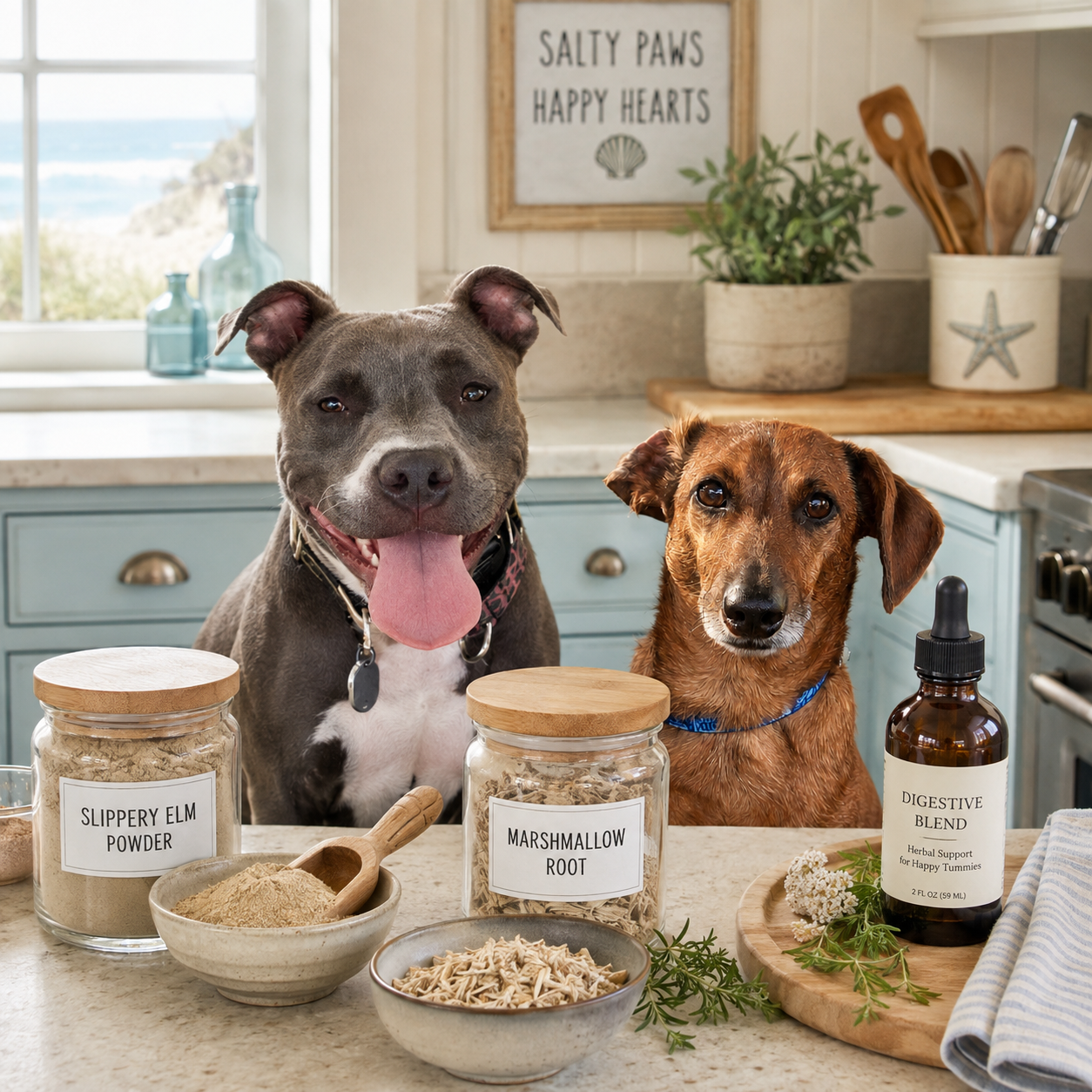
Slippery elm and marshmallow root are both used when the goal is to coat and soothe irritated digestive tissues. Herbalists call this a demulcent action, but you do not need to remember that word. Think slippery, soothing plant material that can help calm an irritated stomach or intestinal lining.
A digestive essential oil blend is a different tool. I may consider oils first when I am looking more broadly at nausea, gas, digestive discomfort, tension around digestion or a dog who will not willingly take another powder, slurry, capsule or bite of food.
None of these automatically "wins." The dog's symptoms and what I am trying to accomplish determine which tool makes sense.
What Does Slippery Elm Do for Dogs?
Slippery elm comes from the inner bark of the slippery elm tree, Ulmus rubra. When the powdered bark is mixed with water, it becomes slippery and gel-like. That coating quality is the reason slippery elm has become so popular for dogs with irritated digestive tracts.
When I am thinking about a dog with an irritated stomach lining, reflux-type discomfort, loose stool, colitis-type irritation or a gut that simply seems raw and unhappy, slippery elm may be one of the herbs I consider.
But there is an important distinction here: slippery elm is primarily helping us soothe irritated tissue. That is not necessarily the same thing as addressing why the dog is nauseated, why reflux keeps happening, why digestion is sluggish or why diarrhea keeps returning.
If your dog has recurring nausea, vomiting or stomach irritation, my article on gastritis in dogs goes deeper into what may be happening when the stomach itself is inflamed.
Why I'm More Thoughtful About Using Slippery Elm Now
Slippery elm also has a sustainability issue that I don't think pet parents hear enough about.
The tree is not currently considered globally endangered, but the medicinal part we use is the inner bark. Harvesting bark is very different from collecting berries, leaves or flowers that a healthy plant can readily replace. Slippery elm populations have also faced disease and other environmental pressures.
United Plant Savers currently lists slippery elm as an At-Risk medicinal plant and specifically raises concerns about continued dependence on wild-harvested bark. NatureServe currently ranks the species as Apparently Secure globally, so I would not call slippery elm "endangered." The more accurate concern is that medicinal demand and destructive bark harvesting deserve our attention.
That doesn't mean I have thrown slippery elm out of my herbal cabinet. It means I want a reason to use it instead of automatically reaching for it every time somebody says their dog has diarrhea.
What Does Marshmallow Root Do for Dogs?
Marshmallow root, Althaea officinalis, sometimes gets presented as the substitute you use when you don't have slippery elm. I think that sells marshmallow root short.
Marshmallow root is a useful digestive herb in its own right. Like slippery elm, it produces a slippery, soothing material when prepared properly, and I may consider it when a dog's stomach, esophagus or intestinal tissues seem irritated and sensitive.
In other words, if what I want is **coating and soothing support**, marshmallow root may do exactly the job I need. It also gives me another choice instead of putting unnecessary pressure on slippery elm simply because slippery elm has better name recognition.
And this is where I want dog moms to get away from the idea that there has to be one universally "best" natural remedy for dog digestion. There isn't. We choose the tool based on the job.
Slippery Elm vs. Marshmallow Root for Dogs
| What You're Wondering | Slippery Elm | Marshmallow Root |
|---|---|---|
| What part is used? | Inner bark of the tree | Root of the plant |
| What is the main job? | Coat and soothe irritated digestive tissue | Coat and soothe irritated digestive tissue |
| Why does it feel slippery? | It contains plant compounds that form a thick, gel-like material when hydrated | It also contains plant compounds that become soothing and slippery when prepared with water |
| When might I think about it? | Irritated stomach or intestines, reflux-type irritation, loose or irritated stool patterns | Irritated, sensitive or raw-feeling digestive tissues when soothing support is the goal |
| Does it fix the cause? | No. It can soothe tissue while we still determine why the irritation is happening | No. It can soothe tissue while we still determine why the irritation is happening |
| Anything else to consider? | Sustainability and sourcing deserve attention | A useful alternative when this type of soothing herbal support fits the dog |
| My practical view | Useful, but I don't reach for it automatically | Underrated and worth knowing about |
With both herbs, I also pay attention to medication and supplement timing. The same slippery coating action that makes these herbs useful is one reason I don't casually mix them into a medically complicated dog's bowl along with every medication and supplement being given that day. When a dog is taking prescription medication, timing is worth discussing with the veterinarian or practitioner involved in the case.
Why Do I Reach for Digestive Essential Oils First?
Now we get to the part that is very specifically me.
I have my oils with me. They live in my house. They travel well. A few small bottles can go in a bag without taking over the car, the kitchen or my luggage. I don't have to make a tea, mix a slurry, find a capsule or discover at the worst possible moment that the herb I wanted is sitting three states away in my pantry.
More importantly, essential oils are one of the modalities I know best. I have invested heavily in animal aromatherapy education and have spent years using oils with my own dogs and helping pet parents learn to use them more thoughtfully. I understand why I am choosing an oil or blend, what I am trying to support and when another tool would make more sense.
And yes, I simply love oils.
I don't think practitioners need to pretend every modality occupies exactly the same place in their toolbox. Nutrition is foundational to my work. I love herbs. I use homeopathy, Reiki, muscle testing and other tools when they fit. But essential oils have earned their place as one of my first reaches because they are familiar, practical, portable and useful in real life.
I wrote an entire article about this years ago called Essential Oils Are My First Reach. Apparently I still mean it.
What If My Dog Is Nauseated and Won't Eat?
This may be the biggest practical reason digestive oils stay near the top of my list.
When a dog feels nauseated, the last thing I necessarily want to do is keep turning food into a delivery system for remedies. Hide the powder in the food. Hide the capsule in another bite. Stir another supplement into the bowl. Eventually the dog starts looking at dinner like you're trying to poison him, and now we've created a second problem.
Sometimes the dog will not eat at all. Sometimes he refuses capsules. Sometimes I simply do not want to make his only acceptable food taste like the entire supplement cabinet.
Essential oils give me other options. Depending on the specific oil or blend, the dog and the situation, I may use an appropriately selected oil aromatically or topically. With oils and preparations that I know are appropriate for that route, I may also use a properly prepared application along the gums.
That does not mean every essential oil belongs on a dog's gums, that every digestive blend should be used internally, or that you should grab whatever smells minty from the cabinet and start experimenting. Oil quality, chemistry, concentration, route of application, dog size, age, medications, neurological history, liver and kidney health and the individual dog's sensitivity all belong in the decision.
If you're new to oils, start with my Essential Oils for Dogs resource page. I would much rather have pet parents understand how oils are used than copy a random recipe from social media.
Slippery Elm, Marshmallow Root or Digestive Oils: Which One Makes Sense?
This is where the comparison becomes much easier.
If the primary problem in front of me looks like irritated digestive tissue that needs soothing and coating support, slippery elm or marshmallow root may be exactly where my mind goes.
If I am looking at nausea, gas, digestive discomfort, appetite changes, digestive tension or a dog who is not going to cooperate with another oral supplement, a digestive essential oil blend may be my first reach.
And sometimes I use different tools at different points because the dog's needs change. What I want during the first hours of digestive upset may not be what I want several days later when we are thinking about recovery, rebuilding the diet or supporting the microbiome.
That is also why an article about "what can I give my dog for diarrhea?" can only take you so far. Diarrhea may come from a dietary indiscretion, stress, infection, food intolerance, medication, pancreatitis, intestinal inflammation, microbiome disruption or something else entirely. The symptom tells us where to look. It doesn't automatically tell us which jar to open.
Recurring Dog Stomach Problems Need a Bigger Conversation
If your dog has one mild digestive wobble and is back to normal quickly, you may never need to make this complicated. But when nausea, reflux, gulping, vomiting, diarrhea or poor appetite keep returning, I stop thinking only about the next soothing remedy.
I start looking at the bigger digestive picture: food history, treats and chews, medications, supplements, stool patterns, stress, previous antibiotic use, appetite changes, weight, lab trends, pancreatic health, liver and gallbladder clues and what the dog's gut has been doing over time.
If reflux or gulping is part of the picture, you may also want to read Why Stomach pH Matters for Dogs. Reflux is not automatically proof that a dog simply has "too much acid," and suppressing stomach acid is not always the entire answer.
For dogs with repeated loose stool, digestive sensitivity, antibiotic history or bigger gut-health problems, my article on prebiotics, probiotics and postbiotics for dogs explains why gut support is much bigger than adding a random probiotic.
And if the symptoms look like stomach inflammation specifically — nausea, vomiting, appetite changes or stomach discomfort — read Gastritis in Dogs. Sometimes naming which part of the digestive tract is unhappy changes the conversation considerably.
Sometimes the First Reach Should Be Your Veterinarian
There is also a point where we stop trying to win Most Natural Dog Mom of the Year.
A dog who is repeatedly vomiting, painful, dehydrated, weak, bloated, unable to eat or drink, passing blood, rapidly declining or clearly acting very differently from normal needs veterinary evaluation. An upset stomach can be simple. It can also be the first visible sign of something much bigger.
Natural support works best when we use it intelligently, not when we use it to avoid finding out what is wrong.
My Toolbox Has Favorites — Yours Probably Will Too
I think sometimes we make natural wellness harder than it needs to be because we feel like we should own every herb, every supplement and every remedy somebody mentions online.
You really don't need fifty things for an upset stomach.
You need to understand what a few useful tools actually do. You need to recognize when one fits the problem better than another. And you need to know when none of the things in your cabinet are the appropriate next step.
Slippery elm still has a place in my world. Marshmallow root absolutely has a place. I am simply more thoughtful now about why I am choosing one, particularly when slippery elm's sourcing and sustainability are part of the equation.
But if somebody asks what I personally reach for first when one of my dogs starts looking queasy, uncomfortable or generally unhappy with his stomach?
There's a pretty good chance I'm reaching for my oils.
They're here. They travel with me. I know how to use them. I don't necessarily need the dog to eat them.
And after all, the website isn't called The Well Oiled K9 by accident.
When DIY Isn't Enough Already tried the basics? If this is happening with your dog and you're still stuck, I can help you figure out what deserves attention next.
Request a Discovery Callback →