Can Dogs With Pancreatitis Have Omega-3
Understanding Fat, Camelina Oil, Algae Oil, EPA, and DHA
After a pancreatitis diagnosis, many pet parents become afraid of fat. (understatement)
Butter, fatty meat, skin, greasy treats, oils—everything starts looking like it is holding a tiny match near the pancreas.
That fear is understandable. Low-fat diets are commonly recommended during the initial management of pancreatitis, especially when the dog also has elevated triglycerides or does not tolerate fat well. But the long-term nutrition plan still needs to account for the individual dog, other health conditions, the type of fat, and the amount being fed.
Then another piece of advice enters the conversation:
“Your dog needs omega-3 to help with inflammation.”
Now the pet parent is stuck between two messages:
Avoid fat.
Add omega-3 oil.
That is often when camelina oil or algae oil gets recommended as a “safer plant-based alternative” to fish oil.
But plant-based does not mean fat-free.
And a product labeled omega-3 does not automatically provide enough EPA and DHA to accomplish the reason you are adding it.
The better question is not simply:
Fish oil or plant oil?
It is:
How much useful EPA and DHA does this product provide, and how much oil do I have to give to get it?
Why Pet Parents Become Afraid of Fat After Pancreatitis
Fat is often treated like the villain in every pancreatitis story.
There is some reason for the concern. High-fat foods, dietary indiscretion, and elevated triglycerides may contribute to risk or worsen management in certain dogs. Low-fat, highly digestible foods are therefore commonly used during recovery.
But “use a lower-fat diet” can quickly turn into:
My dog can never have fat again.
Every oil is dangerous.
Fish oil will cause another flare.
A plant oil must be safer.
The lower the fat, the better—for life.
That is too simple.
Fat is still an essential nutrient. It supports cell membranes, skin, hormones, the nervous system, vitamin absorption, and energy. The goal is not necessarily to remove every trace of fat forever.
The goal is to determine:
How much fat this dog can tolerate
Whether triglycerides are elevated
Whether the pancreatitis was acute, chronic, or recurrent
What other medical conditions are present
What type of fat is being added — fresh, raw, cooked, oil, processed, etc.
Whether that fat provides a meaningful benefit
How much total fat is already coming from food, treats, chews, toppers, and supplements
A dog recovering from an acute pancreatic crisis is not managed the same way as a stable dog who had one episode three years ago.
Same diagnosis. Different dog. Different plan.
Omega-3 Is Still Fat
Camelina oil, algae oil, fish oil, krill oil, flaxseed oil, and salmon oil are all oils.
They all add fat and calories.
Changing from a marine oil to a plant-based oil does not magically remove the fat from the spoon.
What changes is the fatty-acid profile.
That difference is important because the body does not use all omega-3 fatty acids in the same way.
Why ALA Is Not Enough When We Want EPA and DHA Benefits
ALA is a plant-based omega-3 found in camelina oil, flaxseed, chia, and hemp. It can contribute to overall fatty-acid intake, but it does not provide EPA and DHA directly.
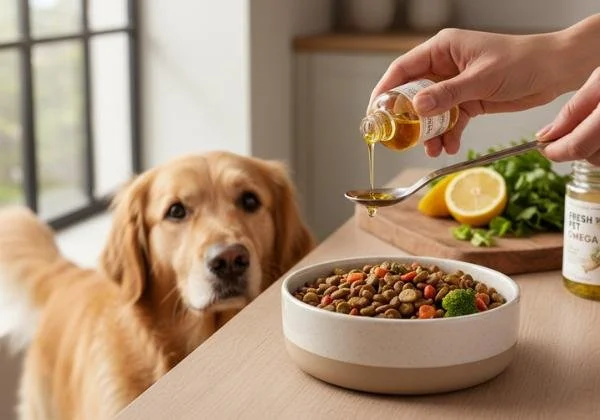
The dog must convert ALA through several metabolic steps before it becomes EPA. It then has to continue through additional steps before a small amount may become DHA.
That conversion is limited—especially the conversion into DHA.
This means an ALA-rich oil may increase the amount of ALA in the dog’s blood and tissues without producing enough EPA or DHA to provide the benefits pet parents are usually looking for from an omega-3 supplement.
ALA and EPA/DHA Are Not Interchangeable
ALA primarily provides a plant-based omega-3.
It may contribute to general fatty-acid balance.
It may support the skin and coat.
It gives the body material it can attempt to convert into EPA and DHA.
EPA and DHA are long-chain omega-3 fatty acids the body can use directly.
EPA helps influence inflammatory signaling within the body.
EPA and DHA support the production of specialized compounds involved in resolving inflammation.
DHA is also a major structural component of the brain, eyes, nervous system, and cell membranes.
The practical problem is that feeding more ALA does not reliably create meaningful amounts of EPA and DHA.
For a dog with pancreatitis, this becomes especially important. Camelina oil is still concentrated fat. Giving more camelina to increase the total “omega-3” number may add considerable oil while still failing to provide the EPA and DHA we were looking for.
In other words, the dog may receive the added fat without receiving the intended inflammatory support.
Algae Oil May Be Different—but Read the Label
Algae is often grouped with camelina under the broad label of “plant-based omega-3,” but they do not necessarily provide the same fatty acids.
Camelina oil primarily provides ALA.
It does not naturally provide meaningful amounts of direct EPA and DHA.
Some algae oils provide DHA directly.
These may support brain, eye, nervous-system, and cell-membrane health.
Many contain very little EPA.
Some algae oils provide both EPA and DHA.
These can be legitimate fish-free sources of long-chain omega-3.
Their usefulness depends on the actual milligrams of EPA and DHA provided—not simply the word “algae” on the bottle.
Read more about algae oil as a fish-free omega-3 option for dogs.
Look for the Finished Fatty Acids
When the goal is meaningful inflammatory, joint, skin, cardiovascular, neurological, or metabolic support, look for a product that clearly identifies:
Milligrams of EPA
Milligrams of DHA
Combined EPA and DHA
The amount of oil required to provide them
A concentrated fish or algae product may provide substantially more EPA and DHA in a much smaller volume than a weak fish oil, dilute algae product, or ALA-rich plant oil.
That is particularly valuable for a dog with pancreatitis. We are not trying to add as much oil as possible. We are trying to obtain the useful fatty acids with the least unnecessary fat.
For a full explanation of sources, labels, and concentration, read What Kind of Omega-3 Is Best for Dogs?.?
ALA is not worthless.
But ALA should not be presented as nutritionally interchangeable with EPA and DHA.
EPA and DHA: The Long-Chain Omega-3s
EPA stands for eicosapentaenoic acid.
DHA stands for docosahexaenoic acid.
EPA and DHA are commonly considered for:
Supporting a healthier inflammatory response
Joint and mobility support
Skin and allergy support
Cardiovascular health
Brain and cognitive health
Cell membrane function
Immune regulation
Triglyceride management as part of a larger veterinary plan
EPA and DHA are the long-chain omega-3 fatty acids most often used in canine research examining inflammatory, joint, skin, cardiovascular, metabolic, and neurological support.
When inflammation is the reason you are adding omega-3, I want to know how much EPA and DHA the dog is actually receiving.
Not just how much “omega” is printed on the front.
Why Camelina Oil Is Being Recommended for Pancreatitis
Camelina oil is increasingly suggested when pet parents are afraid to give fish oil.
It sounds appealing:
It is plant-based.
It provides “some” omega-3.
It is not made from oily fish.
It may seem gentler or less likely to upset the pancreas.
Camelina oil can be a perfectly reasonable dietary oil in some food plans.
But it is still oil, and its primary omega-3 is ALA.
Camelina Oil: What It Provides
Camelina is rich in ALA.
It may help improve the overall balance of plant-derived omega-3 and omega-6.
It may support skin and coat health.
It may have a place when a plant oil is needed within a balanced recipe.
Camelina Oil: What It Does Not Provide
It does not naturally provide substantial direct EPA and DHA.
The dog must convert the ALA.
That conversion is not an efficient or predictable substitute for feeding EPA and DHA directly.
It is not automatically lower in fat than fish oil.
Both are oils.
Both add dietary fat and calories.
It has not been proven to be a safer omega-3 specifically for dogs with pancreatitis.
Much of the canine camelina research has involved healthy dogs.
Tolerance in a healthy dog does not answer how an individual dog with pancreatic disease will respond.
This does not mean camelina is bad.
It means camelina may not accomplish what the pet parent thinks it is accomplishing.
When someone replaces fish oil with camelina because they want stronger inflammatory support, they may still be adding oil—but receiving very little direct EPA and DHA.
What About Algae Oil for Dogs With Pancreatitis?
Algae oil needs its own explanation because it is not the same as camelina oil.
Algae products are often marketed as plant-based, vegan, or fish-free. Unlike camelina, some algae oils can provide DHA and EPA directly.
Studies in dogs have shown that appropriately formulated algal oil can increase blood levels of EPA and DHA, demonstrating that those fatty acids can be bioavailable from an algae source.
That sounds promising—and it can be.
But not every algae product is the same.
Some Algae Oils Provide:
DHA with little or no EPA
DHA and EPA together
A very small amount of long-chain omega-3 per serving
A concentrated amount in a smaller volume
Algae blended with other carrier oils
The word algae does not tell you enough.
You still need to turn the bottle around and read the label.
A product may be fish-free and still fail to provide enough EPA and DHA for the intended purpose.
For a deeper explanation, read Algae Oil for Dogs: A Fish-Free Source of Omega-3.
The Problem With Choosing an Oil Based Only on Its Source
When a dog has had pancreatitis, pet parents understandably focus on where the oil came from:
Fish sounds fatty.
Seeds sound lighter.
Algae sounds clean and gentle.
But the pancreas does not read the marketing copy.
The body still receives a quantity of fat.
The more useful comparison is:
How much EPA does the product contain?
How much DHA does it contain?
How much total oil is required to provide that amount?
What other oils or ingredients are included?
Can the product be measured accurately for this dog?
Has the dog tolerated added oil before?
A dilute plant-based or fish-based oil may require a much larger serving to provide a meaningful amount of EPA and DHA.
A concentrated product may provide the same amount in a fraction of the oil.
That distinction can be especially important for a dog whose total added fat needs to be kept under careful control.
More EPA and DHA Does Not Always Require More Oil
This is one of the most important label-reading lessons for a pancreatitis dog.
Pet parents often assume that increasing EPA and DHA means giving more pumps, more capsules, or more teaspoons.
That is only true when the product is weak or dilute.
Consider two hypothetical products:
Product A: 300 milligrams of combined EPA and DHA per teaspoon
Product B: 1,200 milligrams of combined EPA and DHA per teaspoon
Product B provides four times as much EPA and DHA in the same volume of oil.
One-quarter teaspoon of Product B would provide the same combined EPA and DHA as one full teaspoon of Product A.
This is not a dosing recommendation. It is an example of why concentration changes the conversation.
For a fat-sensitive dog, a concentrated EPA-and-DHA product may allow us to provide the intended fatty acids with:
Less total oil
Fewer calories
A smaller serving volume
Less guesswork
Less need to keep increasing pumps of a weak product
Adding more and more of a low-concentration product may increase the total fat without ever delivering the amount of EPA and DHA the pet parent thought they were providing.
That is the worst of both worlds.
Can a Small Dog Use a Large-Dog Omega-3 Product?
Sometimes.
The words small dog and large dog on the front of the bottle do not determine whether the product is appropriate.
The concentration does.
A Large-Dog Product May Be Useful When:
It truly contains more EPA and DHA per teaspoon or milliliter.
A smaller measured amount may provide what the dog needs.
This may reduce the overall oil volume.
The product can be measured accurately.
A strong product is not helpful when the pump releases far more than a small dog needs.
The delivery method needs to allow precise measurement.
The remaining ingredients are appropriate.
Check carrier oils, flavorings, vitamins, herbs, and other additives.
A Large-Dog Product Is Not More Concentrated When:
It is the same formula in a larger bottle.
It uses a bigger pump.
The suggested serving is simply larger.
The EPA and DHA per teaspoon are identical.
“Extra strength” appears on the front but the supplement panel says otherwise.
Do not give a small dog the large-dog serving.
Use the label to compare EPA and DHA per unit of oil, not the dog picture on the bottle.
How to Read an Omega-3 Label
The front of the bottle is advertising.
The back of the bottle is where the useful information lives—usually in print small enough to qualify as an eye exam.
Find the EPA and DHA
Look for:
Milligrams of EPA
Milligrams of DHA
Combined EPA and DHA
Serving volume
Amount per teaspoon, milliliter, capsule, or pump
Do Not Use Total Fish Oil as the EPA-and-DHA Amount
A label may say:
1,000 milligrams of fish oil
2,000 milligrams of marine oil
3,000 milligrams of omega blend
That does not mean the product contains that amount of EPA and DHA.
Only part of the total oil may be EPA and DHA.
Compare Products Using the Same Unit
EPA and DHA per teaspoon
EPA and DHA per milliliter
EPA and DHA per capsule
EPA and DHA per pump
One pump from one brand may provide a completely different amount than one pump from another.
Look at the Whole Formula
Check for:
Additional seed or vegetable oils
Omega 3-6-9 blends
Vitamins A and D
Flavoring
Herbs
Antioxidants
Other active ingredients
Total mg of DHA and EPA per tsp or ml
Cod liver oil, for example, also provides vitamins A and D. It should not automatically be substituted for concentrated fish-body or algae oil without reviewing the complete diet.
Check Freshness and Storage
EPA and DHA are delicate fats that can oxidize when exposed to heat, air, and light.
Look for:
Testing for oxidation and freshness
Contaminant and heavy-metal testing
Clear storage directions
An expiration date
Packaging that protects the oil
A bottle size the dog will finish within a reasonable period
A giant economy bottle is not economical when most of it is old before a ten-pound dog gets through it.
For a broader guide to comparing sources and labels, read What Kind of Omega-3 Is Best for Dogs?.
Why EPA and DHA Are Worth Looking For
The goal is not to add oil simply because omega-3 sounds healthy.
The goal is to choose a source that provides enough of the fatty acids connected to the reason you are using it.
When the concern is inflammatory balance, I am usually evaluating direct EPA and DHA.
EPA and DHA help support:
Cell membrane structure
Healthy inflammatory signaling
The production of compounds involved in resolving inflammation
Joint comfort and mobility
Skin health
Cardiovascular function
Brain and nervous-system health
Metabolic and immune regulation
That does not mean every pancreatitis dog needs a high-dose omega-3 supplement.
It means that when we decide omega-3 belongs in the plan, the product should provide enough EPA and DHA to justify the added fat.
Otherwise, we may be adding oil without accomplishing the intended goal.
Does Every Dog With Pancreatitis Need Omega-3?
No.
The decision depends on the individual dog.
Before adding any oil, I would want to know:
Is the dog currently stable?
Is this an active flare or long-term planning?
Was the pancreatitis acute, chronic, or recurrent?
How much fat is already in the food?
Are triglycerides elevated?
Is there gallbladder or liver involvement?
Does the dog have diabetes, Cushing’s disease, hypothyroidism, or another metabolic condition?
Has added oil caused nausea, loose stool, pain, or appetite loss before?
What treats, chews, toppers, eggs, broths, and table scraps are being fed?
Does the diet already contain fish, algae, or EPA and DHA?
Why are we adding omega-3 in the first place?
How concentrated is the product?
The answer may be:
A concentrated fish-body oil
A concentrated algae oil
Whole fish within the food plan
A small amount of another marine source
Camelina for a specific nutritional reason
No added oil right now
The diagnosis alone does not choose the bottle.
During an Active Pancreatitis Flare
An active flare is not the time to experiment with several new oils and supplements.
Seek veterinary care when your dog has:
Repeated vomiting
Significant abdominal pain
Refusal to eat with weakness or nausea
Inability to keep water down
A tense abdomen
Repeated prayer position
Trembling, panting, or restlessness
Dehydration
Pale gums
Collapse
Rapidly worsening symptoms
Veterinary care may be needed for diagnosis, fluids, pain relief, nausea control, nutritional support, imaging, laboratory testing, and medication. Acute pancreatitis management commonly prioritizes stabilization and getting appropriate nutrition into the dog in a controlled way.
Once the dog is stable, we can revisit omega-3 as part of recovery or long-term planning.
Do Not Forget the Rest of the Bowl
Pet parents often become intensely focused on one teaspoon of oil while overlooking everything else contributing fat.
Review:
The primary food
Treats and training rewards
Dental chews
Bully sticks and recreational chews
Meat fat and poultry skin
Eggs
Cheese
Peanut butter
Coconut oil
MCT oil
Olive oil
Broth with fat left in it
Soft-chew supplements
Table scraps
Food given by other family members
A carefully chosen omega-3 product cannot compensate for a food plan that is still too rich for that dog.
Sometimes the tablespoon of oil gets blamed while the daily cheese committee continues meeting under the kitchen table.
Natural Pancreatic Support Goes Beyond Omega-3
Omega-3 may be one useful category, but it is not a complete pancreatitis plan.
Depending on the dog, I may also look at:
A balanced fresh-food strategy
Total fat and fat concentration
Meal size and feeding frequency
Protein digestibility
Digestive enzymes when appropriate
Microbiome support
Gut-lining support
Liver and gallbladder support
Minerals and electrolytes
Herbs
Homeopathy
Essential oils
CBD
Stress and nervous-system support
PEMF
Reiki and gentle bodywork
TCVM patterns involving digestive weakness, heat, dampness, deficiency, or stagnation
These are categories to consider—not instructions to start everything at once.
A recovering pancreas does not need a supplement avalanche.
Why Personalized Support Helps
Most pet parents answer the questions they are asked.
What they often need is someone who asks the questions they did not know to ask.
The right omega-3 decision changes with:
Age
Breed and size
Weight and muscle condition
Acute versus chronic disease
Frequency and severity of flares
Diet history
Fat tolerance
Stool quality
Nausea and appetite patterns
Triglycerides
Liver and gallbladder findings
Endocrine disease
Medications
Other supplements
The actual EPA and DHA on the label
Camelina oil is not automatically wrong.
Algae oil is not automatically enough.
Fish oil is not automatically dangerous.
The useful choice is the product that fits the dog, provides the fatty acids we are actually seeking, and does so without adding more oil than necessary.
Need Help With Your Dog’s Pancreatitis Plan?
This blog is the starting point.
A personalized plan looks at the full food bowl, hidden fats, laboratory trends, medications, previous flares, digestion, and whether omega-3 even belongs in the plan right now.
Submit an inquiry and let’s see what I can do to help. No obligation—the inquiry callback is offered at no cost to you.
For deeper pancreatitis resources, product education, Q&A, and support:
Learn more about the membership
Related Content
can dogs with pancreatitis have fish oil; omega-3 for dogs with pancreatitis; camelina oil for dogs with pancreatitis; algae oil for dogs; low-fat omega-3 for dogs; EPA and DHA for pancreatitis; is fish oil bad for dogs with pancreatitis.
When DIY Isn't Enough Already tried the basics? If this is happening with your dog and you're still stuck, I can help you figure out what deserves attention next. Want reliable education, live Q&A, and member resources? Explore Membership →
Request a Discovery Callback →