
Intuition and Healing: The Things We Somehow Know
I've been told there were healers in my family generations ago. Not doctors in the formal sense, but the people who knew which plants to gather, which herbs to use, what to put on a wound, and what to do when someone was sick or injured. I don't know their names, I don't know exactly what they knew, and unfortunately there is no handwritten family remedy book tucked away somewhere for me to inherit.
What I do have are stories. And as I've gotten older, and as my own work has taken me deeper into nutrition, herbs, essential oils, Reiki, muscle testing, animal communication, energy work and natural healing, I've wondered more than once whether some part of this was always going to find me.
See your vet for a diagnosis and then you and I can collaborate on a custom strategy for your dog's health.
That distinction is especially important in an article about intuition. I don't believe intuition replaces diagnostics, veterinary medicine or education. I do believe there are times when it makes us pay closer attention, ask a question we might not otherwise have asked, or recognize that there may be another piece of the story we haven't found yet.
My Grandmother Had a Remedy for Everything
My grandmother owned a general store that also sold fresh fish, and some of my clearest memories of her are tied to the remedies she kept around and used without much fanfare.
One of them was something we called Pine-Ol, a pine-oil liniment. That bottle apparently had a job description that included nearly everything. Bug bites, poison ivy, wounds, skin irritations—you name it, and Pine-Ol was probably coming out.
One day my uncle was scaling fish in the back of the store. I rounded the corner, hit the slippery floor and slid underneath the ice maker. A piece of metal hanging down caught my shin and gashed it badly. I still remember what happened next: out came the Pine-Ol. It was poured on my leg, and I was basically told, "You'll be fine."
Apparently there was no further discussion required.
For the record, I still have a divot in my leg and the scar to prove that Grandma's confidence did not necessarily amount to reconstructive surgery.
And no, I am not suggesting anyone hunt down an old bottle of pine liniment and start pouring it into an open wound. This was another generation, another time and a family story. What stayed with me was how normal reaching for a remedy seemed. There was no philosophical discussion about "natural medicine." Nobody called it holistic wellness. There were simply things people knew how to use, and when someone needed help, they used what they knew.
Then There Is the Story Nobody Can Quite Explain
Another family story has always fascinated me. My dad and his brother were badly burned when a radiator blew up on them. These were not minor burns. My dad's injuries were severe enough that he had to wear what has been described to me as basically a soft mesh "dress" because regular clothing couldn't be allowed to stick to his skin.
Someone in the family was called because that person apparently knew what to do.
I wish I had more details, but I don't. The story that survived is that this relative arrived with lotions, potions or some sort of preparations and "took the burn out." Nobody still alive seems to remember exactly what was used. There is no recipe, no ingredient list and no notebook describing what that person did. Was it herbal? A plant oil? A salve? Something completely ordinary to that person but extraordinary to everyone else? I have no idea.
What I do know is that my dad healed, and he had no scars.
I would give almost anything to know what was in those preparations.
How Much Knowledge Did We Lose?
That story makes me think about how much knowledge disappeared as generations changed. For most of human history, people learned this kind of thing from another person. Someone knew which plants to gather because someone before them had shown them. They knew what to dry, steep, grind, apply or avoid because that knowledge had been handed down.
Then families moved. Medicine advanced. Convenience changed the way people lived. Remedies that once had to be made could be purchased instead, and traditions that had once seemed ordinary became old-fashioned, unnecessary or simply forgotten. Sometimes the person who knew died before anyone realized how much information was going with them.
My family's mysterious burn preparation is a perfect example. Whatever that relative knew may be gone now, and I find that incredibly sad.
Maybe that's also part of why I feel so strongly about studying, documenting and teaching what I learn today. I don't want useful knowledge to live only inside one person's head and disappear when that person is gone.
And Then There Are the Things I Just Know
This is where the family stories start to feel much less distant from the work I do today.
There is knowledge you can study, experience you accumulate, and then there are those moments when something simply comes to you. A question pops into my head that I had not been consciously working toward. I feel strongly that I should ask about a particular symptom, food, medication, event, behavior or part of the dog's history. Sometimes I suggest looking at something that, on the surface, seems to have very little to do with the reason the pet parent contacted me.
And more than once I've heard, "How did you know that?"
I've also heard, "There's no way you could have known that."
Sometimes I can tell you exactly how I knew. I've seen the pattern before. Something in the history reminds me of another dog, a nutritional issue, a medication response, a gut pattern or a combination of symptoms I've learned to recognize over years of working with dogs.
Other times, I can't tell you where the question came from. It just did.
I don't feel the need to turn that into something theatrical or mystical, but I'm also long past dismissing it just because I can't immediately explain it. I've had enough of those moments to know that when the nudge is strong, I should at least listen to it.
Reiki Taught Me to Get Quiet Enough to Notice
My work with Reiki for dogs has probably made me even more aware of this kind of information. Reiki taught me to become quiet enough to notice what I am sensing instead of immediately trying to analyze everything.
Working with an animal in that space can feel very different from sitting with a checklist and moving symptom by symptom. Sometimes my attention keeps returning to an area of the body. Sometimes there is an impression, a word, an image or simply a feeling that something deserves another look.
That doesn't mean Reiki diagnosed anything. It means something got my attention, and that may give me another question to ask.
Muscle Testing Is Another Way I Ask Questions
Muscle testing can play a similar role for me, particularly when a dog is complicated, sensitive or there are several possible directions we could explore. I don't consider muscle testing a replacement for bloodwork, imaging, veterinary diagnostics or common sense. I use it as another tool for asking questions and helping narrow direction.
Sometimes it suggests that something is worth exploring further. Sometimes it points me away from something I had been considering. Sometimes it brings me right back to an issue that didn't seem especially important the first time I looked at the history.
It doesn't make the decision for me. It can help me decide where another question belongs.
Animal Communication Is Part of This Too
I am also certified in animal communication, although I don't work as a professional animal communicator or offer it as the center of what I do. Still, I can't pretend that ability doesn't come into my work.
Sometimes I simply know something.
I don't mean that I've worked it out logically or that the pet parent accidentally gave me enough clues to make a good guess. I mean a thought, an image, a feeling or a piece of information seems to arrive without any obvious reason for it to be there.
There have been enough occasions when someone has stopped me and said, "How did you know that?" or "There is absolutely no way you could have known that," that I've learned not to brush those experiences aside.
I don't always know how I knew, and I'm okay with that.
I don't need to declare every impression a message from an animal. I also don't need to explain every intuitive moment away as coincidence. Sometimes it may be animal communication. Sometimes it may be experience. Sometimes my brain may have picked up on tiny details before my conscious mind caught up. Sometimes I can only call it intuition.
Whatever the source, I treat that information the same way: not as proof and not as a diagnosis, but as a reason to pay attention and perhaps ask one more question.
Maybe Some of It Isn't Coming From Nowhere
I also think we underestimate what happens after years of studying and working with dogs. I've looked at a lot of food histories, digestive issues, lab work, supplements, medications, behavior changes, pain patterns and dogs who simply weren't thriving even though nobody could immediately explain why. At some point the brain begins making connections before you consciously work through every step.
That's pattern recognition, and experience absolutely plays a role in what I do. But I don't think pattern recognition explains every experience I've had either.
There have been times when nothing in my notes pointed directly toward what I suddenly felt compelled to ask. I wasn't following a decision tree, and I wasn't consciously remembering another case. The question simply showed up strongly enough that I asked it, and sometimes the answer has changed the entire direction of the conversation.
Maybe Reiki, muscle testing, animal communication and intuition are completely separate things. Maybe they overlap. Maybe becoming more aware of one makes you better able to notice the others. Maybe some of what we call intuition is the brain processing information faster than we can consciously explain it, and maybe animals communicate much more than most of us have been taught to believe.
I suspect there is more than one answer.
Intuition Doesn't Replace What We Know
This is important because being intuitive doesn't make me less interested in facts. Quite the opposite.
I want the bloodwork. I want the diagnosis. I want to know what the dog eats, what medications have been used, which supplements are being given, what the stool has been doing, whether appetite has changed, when the symptoms started and what happened before they started. I want to know about weight changes, behavior, stress, sleep, movement, pain, previous diagnoses and what has already been tried.
I want the whole dog.
My work as a Holistic Canine Health Practitioner brings together canine nutrition, aromatherapy, herbs, homeopathy education, Reiki, muscle testing, animal communication and years of working directly with dogs and their people.
One part of that work is analytical. I gather information, compare patterns and look for reasonable explanations. Another part is quieter. It's the nudge that says, Ask about that. Go back to what she said earlier. Look at the gut. Ask when this really started. Something here doesn't fit.
Sometimes I know exactly why that thought occurred to me, and sometimes I don't. Either way, I don't treat the thought as the answer. I treat it as a reason to ask a better question.
Intuition may point me toward the question. Education helps me understand the possibilities. Diagnostics help us determine what can actually be measured. Muscle testing may help guide direction. Reiki and animal communication may give me another perspective. Experience helps me decide which pieces deserve more attention and which ones probably don't.
That is one of the harder parts of whole-dog work to describe because it isn't always a straight line from symptom A to recommendation B. Sometimes the clue we need is sitting three steps to the side.
And sometimes, for reasons I cannot completely explain, I just know to look there.
Pet Parents Have This Too
I cannot tell you how many times someone has said to me, "I know the vet says everything looks okay, but he's just not himself."
I take that seriously, not because it automatically means there is a hidden disease, but because you live with your dog. You know how he normally walks into the kitchen, how excited she gets for dinner, where he sleeps, whether she follows you upstairs and what that face looks like on a normal day. You notice the tiny things long before they become a neat little symptom that fits on a medical form.
When a pet parent tells me something feels different, my instinct is to get curious. When did it change? What happened around the same time? Has appetite shifted? Stool? Weight? Sleep? Thirst? Mobility? Behavior? Interest in food? Recovery after exercise? Tolerance for touch?
Your intuition isn't the diagnosis. It may simply be the reason you look closer.
Maybe This Is Why I Ended Up Here
When I look at the subjects I've been drawn to over the years, I sometimes have to laugh. Herbs. Essential oils. Food as part of wellness. Homeopathy. Reiki. Energy work. Animal communication. Looking for patterns rather than isolating one symptom from everything else.
Somewhere generations ago, there were apparently people in my family gathering plants and making remedies because someone needed healing.
And here I am.
I have access to education they never had, veterinary diagnostics they couldn't have imagined and research from around the world sitting on a computer in front of me. Yet some part of what I do still feels remarkably old: observe the individual, listen carefully, pay attention to patterns, use what nature offers when appropriate, and don't assume the most obvious answer explains the whole picture.
Maybe that is intuition. Maybe it's inherited curiosity. Maybe it comes from years of learning and watching. Maybe abilities really do travel through family lines. And perhaps some of what we are drawn toward has an even older history than that. I don't pretend to know exactly how any of it works. I've simply experienced enough in my own life that I'm no longer willing to dismiss something just because I can't explain it.
I don't know, and I'm comfortable leaving room for that.
I probably have a little more comfort with the unexplained than some people do. I've experienced past-life regression myself, and whether someone interprets those experiences spiritually, psychologically or somewhere in between, mine certainly left me more open to the possibility that who we are—and what we're drawn to—may have roots we don't completely understand.Was I Called to This?
I don't know whether healing instincts run through families, but I do think some kinds of knowing do.
Maybe what gets passed down isn't a mysterious gift at all. Maybe it's curiosity, observation, compassion and the willingness to stay with a problem long enough to notice what other people overlook. Maybe watching one generation care for another teaches us things long before we realize we're learning them.
Or maybe there is something deeper that we simply don't fully understand yet.
What I know is that I believe there is more to healing than chasing symptoms one at a time. I believe the body gives us clues. I believe animals communicate far more than most people realize, and I believe food, plants, environment, stress, emotions and relationships can all be part of the bigger picture. I also believe good veterinary medicine and good diagnostics belong in that same picture.
Those ideas don't have to compete with one another.
If you've ever looked at your dog and thought, something isn't right, don't be too quick to talk yourself out of it. You don't need to diagnose the problem yourself, and you definitely don't need to buy six remedies at midnight because somebody in a Facebook group sounded very confident. Pay attention. Write down what you're seeing. Look for patterns. Get the diagnostics that need to be done. And if the pieces still don't add up, keep asking better questions.
Sometimes healing begins with knowing the answer. Sometimes it begins because somebody knew there was another question worth asking.
As for whether I was called to this, inherited it, stumbled into it or somehow found my way back to something my family had been doing for generations, I still don't know.
But I'm a believer.
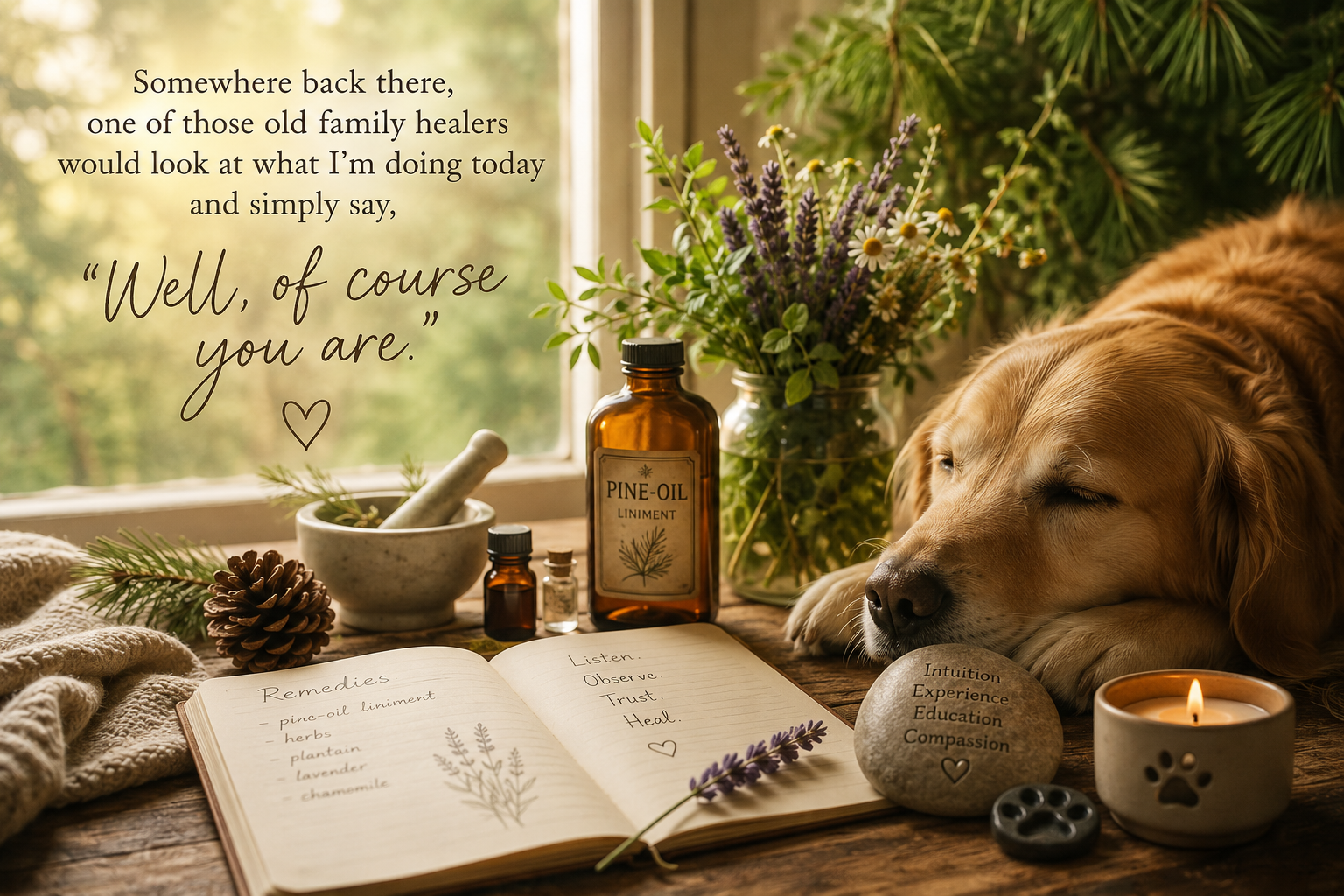
And sometimes I like to imagine that one of those old family healers could see what I'm doing today, look at me like the answer had been obvious all along, and say, "Well, of course you are."