

What Is Your Dog’s Element? How TCVM Connects Behavior, Food and Health
In Traditional Chinese Veterinary Medicine, dogs may show patterns associated with five elements: Wood, Fire, Earth, Metal and Water.
Five Element Theory gives us another way to look at your dog's personality, behavior, physical tendencies, food needs, seasonal changes and response to stress.
Your dog is not expected to fit neatly into one little box. Most dogs show a combination of patterns, although one constitutional element may stand out more strongly.
Which of the Five Elements Sounds Like Your Dog?
Wood Dog
Think: driven, confident, intense, athletic.
May become frustrated, reactive, tight, hot or itchy when out of balance.
Organs: Liver & Gallbladder
Emotion: anger/frustration
Explore Wood →Fire Dog
Think: social, joyful, expressive, enthusiastic.
May become overstimulated, restless, needy or unable to settle.
Organs: Heart & Small Intestine
Emotion: joy/excitement
Explore Fire →Earth Dog
Think: nurturing, loyal, food-loving, steady.
May become worried, clingy, sluggish or digestively sensitive.
Organs: Spleen & Stomach
Emotion: worry
Explore Earth →Metal Dog
Think: orderly, sensitive, independent, routine-oriented.
May struggle with grief, change, skin, lungs or elimination.
Organs: Lung & Large Intestine
Emotion: grief
Explore Metal →Water Dog
Think: thoughtful, cautious, observant, independent.
May become fearful, depleted, weak, cold or easily overwhelmed.
Organs: Kidney & Bladder
Emotion: fear
Explore Water →Not Sure Which Element Your Dog Is?
That is actually the fun part. Look at your dog's normal personality—not just how they behaved during one terrible vet appointment or the day the Amazon driver committed the unforgivable crime of approaching your porch.
Consider how your dog normally responds to people, change, stress, food, activity, fear, frustration and new situations.
Take the 5 Element Theory QuizFive Element Theory for Dogs at a Glance
| Element | Personality | Organs | Season | Emotional Theme | Patterns You May Notice |
|---|---|---|---|---|---|
| Wood | Driven, bold, athletic, decisive | Liver & Gallbladder | Spring | Anger, frustration, flexibility | Reactivity, tension, red/itchy flare-ups, tendon or ligament issues |
| Fire | Social, expressive, playful, excitable | Heart & Small Intestine | Summer | Joy, connection, excitement | Restlessness, overstimulation, sleep disruption, difficulty settling |
| Earth | Nurturing, steady, loyal, food-oriented | Spleen & Stomach | Late summer / transitions | Worry, nurturing, grounding | Digestive problems, dampness, yeast patterns, clinginess, low muscle tone |
| Metal | Orderly, sensitive, thoughtful, routine-oriented | Lung & Large Intestine | Fall | Grief, boundaries, letting go | Skin dryness, respiratory sensitivity, constipation, difficulty with change |
| Water | Cautious, observant, thoughtful, resilient | Kidney & Bladder | Winter | Fear, courage, reserves | Fear, urinary concerns, hind-end weakness, aging changes, reduced stamina |
These are TCVM patterns—not diagnoses. A fearful dog does not automatically have kidney disease, and a frustrated dog does not automatically have liver disease. The useful information comes from looking at repeated clusters of personality, behavior and physical signs.
Why is one dog chronically itchy, restless and reactive while another dog with the same diagnosis is tired, chilly and reluctant to eat?
Why does one anxious dog pace, pant and bark at everything while another hides, freezes or refuses to leave your side?
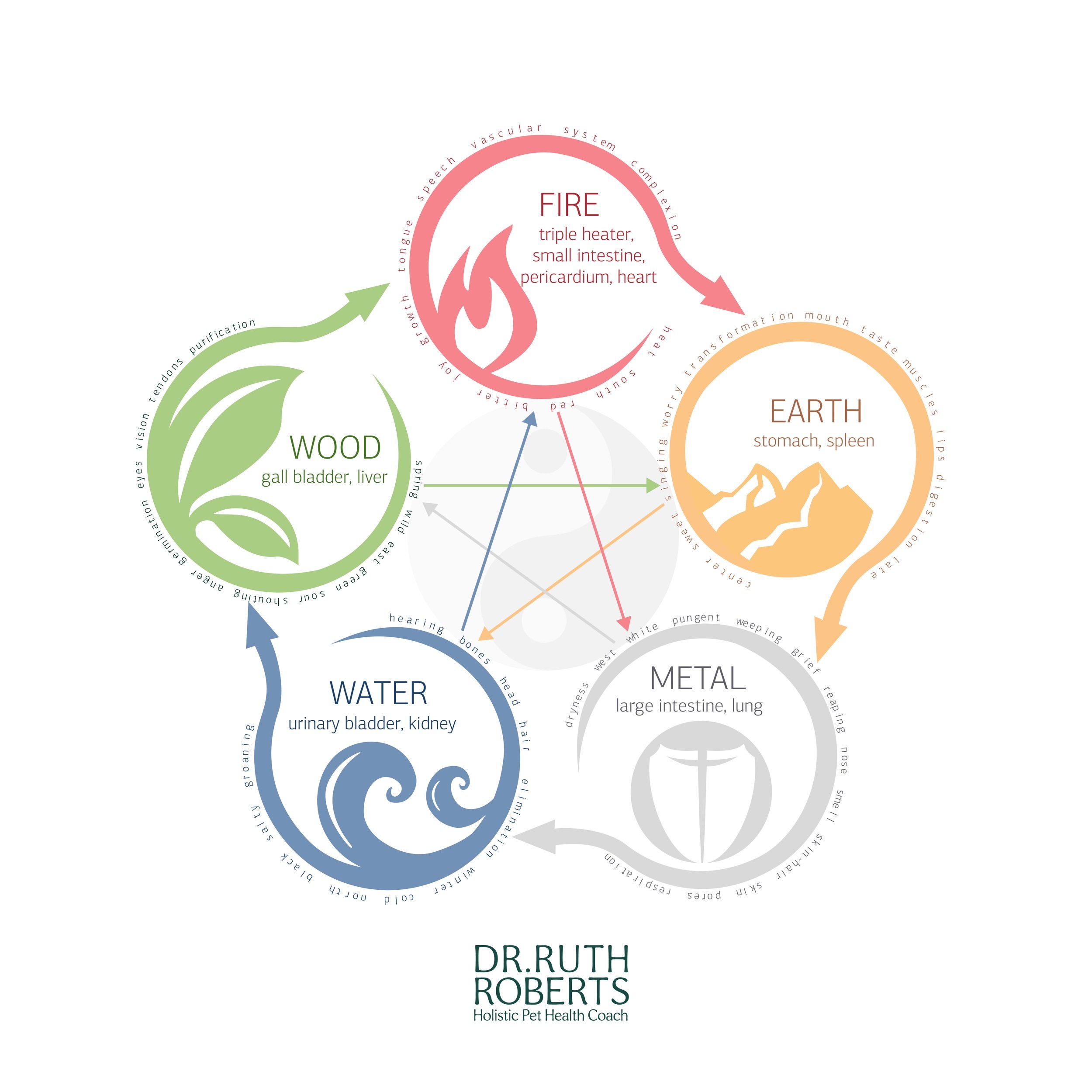
5 Element Theory for Pet - Dr. Ruth Roberts, DVM
Traditional Chinese Veterinary Medicine gives us another way to understand these differences. Rather than looking only at the diagnosis, TCVM asks a bigger question:
What pattern is this individual dog showing?
That pattern may offer clues about your dog’s digestion, temperature, emotions, behavior, physical vulnerabilities, food needs and response to stress.
See your vet for a diagnosis and then you and I can collaborate on a custom strategy for your dog's health.
What Is Traditional Chinese Veterinary Medicine?
Traditional Chinese Veterinary Medicine, or TCVM, is the animal-focused application of Traditional Chinese Medicine.
It looks at the dog as an interconnected system rather than treating the skin, stomach, joints, kidneys and behavior as completely separate departments that never speak to one another.
TCVM includes several primary modalities:
Food therapy
Chinese herbal medicine
Acupuncture
Acupressure and Tui-na bodywork
Lifestyle and seasonal support
TCVM is often used alongside conventional veterinary care. Western diagnostics are extremely valuable for identifying infections, injuries, organ disease, tumors, endocrine disorders and other serious conditions. TCVM then gives us another lens for recognizing the broader pattern surrounding that diagnosis.
Two dogs can have the same Western diagnosis and still present very differently.
One dog with allergies may be hot, red, frantic and intensely itchy. Another may have dry skin, low energy, digestive weakness and recurring infections.
Same diagnosis. Different dog. Potentially different support.
You can read more about why I keep talking about TCVM and asking so many questions.
What Is Five Element Theory?
Five Element Theory is one of the frameworks used in Chinese medicine to understand relationships within the body and the natural world.
The Five Elements are:
Wood
Fire
Earth
Metal
Water
Each element is traditionally associated with certain organs, seasons, tissues, emotions, personality tendencies and physical patterns.
Your dog is not literally made of wood or secretly carrying a tiny campfire in their chest. The elements are descriptive patterns.
They help us organize what we observe.
Most dogs are not purely one element. A dog may have a primary constitutional tendency while also showing imbalances involving several other elements.
Yin, Yang and the Five Elements
Yin and Yang describe complementary forces within the body.
Yin is associated with qualities such as:
Coolness
Moisture
Rest
Nourishment
Stillness
Yang is associated with:
Warmth
Activity
Movement
Stimulation
Expansion
Health requires an appropriate relationship between the two. A dog can show excessive heat, insufficient warmth, dryness, dampness, stagnation, depletion or a combination of patterns.
The Five Elements interact in a similar way. They nourish, regulate and influence one another.
This means a problem rarely stays politely contained in one system.
Digestive weakness may affect energy and immune resilience. Chronic fear may affect sleep, appetite and elimination. Liver stagnation may show up as tension, digestive upset, itchy skin or frustration.
That is the whole-dog piece many pet parents have been missing.
The Five Elements and Their Organ Systems
In TCVM, organs include their physical functions but also represent broader energetic systems.
| Element | Primary Organ Systems | Season | Common Emotional Theme |
|---|---|---|---|
| Wood | Liver and Gallbladder | Spring | Anger, frustration and flexibility |
| Fire | Heart and Small Intestine | Summer | Joy, connection and excitement |
| Earth | Spleen and Stomach | Late summer and seasonal transitions | Worry, overthinking and nurturing |
| Metal | Lung and Large Intestine | Fall | Grief, boundaries and letting go |
| Water | Kidney and Bladder | Winter | Fear, courage and reserves |
These associations are not veterinary diagnoses.
A fearful dog does not automatically have kidney disease. An angry dog does not automatically have liver disease. Please do not diagnose your dog’s organs based on a rough afternoon at the groomer.
Instead, we look for clusters of repeated physical and emotional patterns.
The Wood Element: The Driven, Intense or Easily Frustrated Dog
Wood is associated with the Liver and Gallbladder, spring, movement, planning, flexibility, tendons, ligaments and the smooth flow of Qi.
A balanced Wood dog may be:
Confident
Athletic
Purposeful
Decisive
Focused
Driven
Adaptable
An imbalanced Wood pattern may look more like:
Reactivity
Frustration
Irritability
Aggressive responses
Barrier frustration
Tight muscles
Tendon or ligament injuries
Red or itchy skin
Red eyes
Seasonal spring flare-ups
Digestive upset during stress
Wood dogs often need appropriate movement, structure and an outlet for their intensity. However, repeatedly exhausting them is not always the answer. Sometimes that simply creates a very fit dog who remains frustrated and dysregulated.
Food choices, inflammation, pain, sleep, liver support, gut health and nervous-system regulation may all need consideration.
Learn more about the Wood Element in dogs, including spring allergies, liver patterns, reactivity and tendon health.
The Fire Element: The Social, Expressive or Overstimulated Dog
Fire is associated with the Heart and Small Intestine, summer, circulation, joy, connection and the Shen—the emotional and spiritual aspect of the dog.
A balanced Fire dog may be:
Affectionate
Social
Playful
Expressive
Engaging
Enthusiastic
Deeply connected to their people
When Fire becomes excessive or depleted, you may notice:
Restlessness
Overexcitement
Difficulty settling
Sleep disruption
Excessive panting
Heat intolerance
Separation distress
Emotional highs and lows
Stress-related digestive upset
Constant attention seeking
A dog who appears tired but cannot switch off
Fire dogs can light up the room. They can also burn through their emotional battery like a toddler at a birthday party.
Support may involve cooling nutrition, appropriate social balance, calmer routines, better sleep, heart support, digestive support and work that helps settle the Shen.
Read more about the Fire Element, summer heat, emotional regulation and heart support for dogs.
For dogs struggling with nervousness, hyperarousal or an unsettled Shen, you may also find Calming the Shen in Dogs helpful.
The Earth Element: The Nurturer With a Sensitive Stomach
Earth is associated with the Spleen and Stomach, digestion, nourishment, muscle condition, stability and the ability to transform food into usable energy.
In TCVM, the Spleen is not viewed exactly as it is in Western anatomy. The Spleen system represents a much broader digestive and energetic role.
A balanced Earth dog may be:
Steady
Loyal
Nurturing
Food motivated
Easygoing
Grounded
Comforting to others
Earth imbalance may show up as:
Chronic digestive upset
Loose stool
Mucus in the stool
Poor appetite
Nausea
Excessive lip licking
Gulping
Low energy
Poor muscle condition
Weight gain or difficulty losing weight
Worry or clinginess
Repetitive behaviors
Difficulty coping with change
Dampness, congestion or recurring yeast patterns
Earth dogs often need consistency, digestible nutrition and fewer random extras.
Yes, I am looking at the treats, chews, toppers, table scraps, supplements and mysterious handful of “just a little something” added to every meal.
When digestion is weak, piling more products into the bowl is not always helpful. Sometimes the smarter strategy is to simplify, improve food quality and rebuild digestive function.
The Metal Element: The Sensitive Dog Who Struggles to Let Go
Metal is associated with the Lung and Large Intestine, fall, skin, respiration, immune boundaries, grief and the ability to release what is no longer needed.
A balanced Metal dog may be:
Orderly
Sensitive
Independent
Reliable
Thoughtful
Calm
Comfortable with routine
An imbalanced Metal pattern may involve:
Grief after loss or change
Withdrawal
Difficulty adapting
Skin dryness
Coat changes
Respiratory sensitivity
Recurring cough
Constipation
Irregular elimination
Lower immune resilience
Sensitivity to environmental changes
A need for predictable space and boundaries
Metal patterns may become more noticeable after the loss of another animal, a family change, relocation, boarding, illness or a major disruption in routine.
Behavior may be part of the picture, but we should also consider pain, lung health, skin health, hydration, bowel function and immune status.
The Water Element: The Fearful Dog or the Dog Running on Empty
Water is associated with the Kidney and Bladder, winter, aging, reproduction, bones, hearing, willpower, fear and the body’s deeper reserves.
A balanced Water dog may be:
Thoughtful
Careful
Observant
Persistent
Quietly confident
Independent
Resilient
Water imbalance may show up as:
Fear
Noise sensitivity
Freezing or hiding
Hypervigilance
Separation anxiety
Urinary issues
Weakness in the back end
Aging changes
Hearing loss
Reduced stamina
Difficulty recovering from stress
Restlessness at night
A dog who startles easily
A dog who seems depleted rather than merely tired
Fear is traditionally associated with the Kidney system, but that does not mean every fearful dog needs a kidney supplement.
The dog may be in pain. They may have a trauma history. They may be under-socialized, sleep deprived, nutritionally depleted, overwhelmed by their environment or experiencing neurological, sensory or endocrine changes.
The pattern helps us ask better questions. It does not replace the questions.
Read more about Water Element dogs, fear, aging, winter support and Kidney patterns.
Can TCVM Help Us Understand Dog Behavior?
Behavior does not happen in a vacuum.
A reactive dog may also be:
Itchy
Inflamed
In pain
Nauseated
Sleep deprived
Constipated
Experiencing reflux
Struggling with hormonal changes
Living with chronic digestive upset
Reacting to a food or medication
Depleted after illness
Losing hearing or vision
Overstimulated day after day
TCVM helps us look for relationships among these clues.
For example:
A hot, red, explosive dog may lead us to explore Wood or Fire patterns.
A worried dog with loose stool and poor appetite may show an Earth pattern.
A fearful senior with hind-end weakness may lead us to look more closely at Water.
A grieving dog with skin or respiratory changes may show Metal characteristics.
Training, structure and environmental management are still important. But asking a dysregulated or physically uncomfortable dog to simply “behave better” is not much of a plan.
The Five Elements and Food Therapy for Dogs
TCVM food therapy considers more than calories, protein and fat.
Foods may also be described as:
Warming
Cooling
Neutral
Moistening
Drying
Moving
Nourishing
This does not mean choosing food based only on color.
The original version of this article suggested that green foods belong to Wood, red foods belong to Fire and black foods belong to Water. Color associations exist within Five Element Theory, but actual food therapy is more nuanced.
A red tomato does not automatically become the ideal food for a Fire dog. A black food is not automatically “Kidney medicine.” The individual food, preparation method, energetic temperature, health condition and overall recipe all need consideration.
A hot, itchy, panting dog may benefit from more cooling or neutral foods. A frail senior who seeks warmth and struggles with stiffness may need more warming and nourishing support.
Preparation also changes food energetics. Raw, lightly cooked, baked and slow-cooked foods do not affect every dog in exactly the same way.
You can learn more in TCVM Food Energetics for Dogs: Warming, Cooling and Neutral Foods.
I also discuss how different proteins may influence behavior and energetic patterns in dogs.
How Natural Support May Be Chosen Through a TCVM Lens
Once we understand the dog’s diagnosis and broader pattern, several categories of support may be considered.
Nutrition and Fresh Food
Food may be adjusted to support hydration, digestion, body temperature, inflammation, weight, muscle condition and organ function.
The goal is not to feed five colorful ingredients and declare the elements balanced. We still need a complete and appropriate diet.
Herbs
Herbs may be selected according to patterns such as:
Heat
Dampness
Dryness
Stagnation
Blood deficiency
Yin deficiency
Yang deficiency
Spleen Qi weakness
Shen disturbance
Chinese herbal formulas are designed around patterns, not simply product labels that mention a symptom.
This is why two “calming” formulas may have very different effects in two anxious dogs.
Learn more about how herbal energetics are used to support the individual dog.
Essential Oils
Essential oils may be selected for their physical, emotional and energetic qualities.
Depending on the dog, we may consider oils for:
Grounding
Cooling
Warming
Digestive support
Emotional flow
Nervous-system regulation
Muscle and joint comfort
Respiratory comfort
Seasonal support
There is no “Wood oil” or “Water oil” that automatically fixes the element. Selection should still reflect the dog’s complete presentation, preferences, sensitivities and current medications.
Read more about using essential oils as part of a whole-dog anxiety plan.
Acupuncture, Acupressure and Bodywork
Acupuncture and acupressure work with points located along meridians. Tui-na, massage, Reiki, PEMF and other forms of bodywork may also support relaxation, circulation, mobility and nervous-system regulation when appropriately chosen.
You may find Understanding Meridians in Dogs helpful if the concept of energy pathways is new to you.
Why Your Dog’s Individual Pattern Changes the Plan
Before choosing foods, herbs, oils or supplements, I want to know more than the diagnosis.
I look at:
Age
Breed and size
How long the symptoms have been present
Frequency and severity
Whether the dog runs hot or cold
Diet history
Treats, chews, oils, toppers and table scraps
Current medications and supplements
Lab results and trends
Other diagnoses
Stool history
Appetite and nausea
Weight and muscle condition
Sleep
Stress patterns
Pain and mobility
Skin and coat
Gut, liver, gallbladder, kidney, endocrine and immune clues
Seasonal changes
Emotional and behavioral changes
TCVM helps identify patterns such as heat, dampness, stagnation, deficiency, digestive weakness, stress and inflammation.
Muscle testing may help guide tolerance and direction in sensitive or complicated dogs.
Experience helps recognize patterns, ask better questions and avoid wasting time on random product guessing.
When to Work With a TCVM Veterinarian
A veterinarian trained in TCVM may be especially valuable when your dog needs:
Acupuncture
A formal TCVM pattern diagnosis
Prescription Chinese herbal formulas
Support for complicated or serious disease
Integration with prescription medications
Ongoing monitoring of organ function
Pain management
Neurological or mobility support
Conventional and Chinese veterinary medicine do not need to compete.
Western medicine is extremely useful for diagnostics, emergency stabilization, surgery, infection control and serious disease management.
TCVM can add another layer by looking at constitution, food energetics, seasonal patterns, emotional health and the relationships among symptoms.
The best care often comes from using the strengths of both.
When Your Dog Needs Prompt Veterinary Care
Five Element Theory should never delay veterinary attention.
Contact your veterinarian promptly for:
Difficulty breathing
Collapse
Seizures
A swollen or painful abdomen
Inability to urinate
Repeated vomiting or diarrhea
Blood in vomit, urine or stool
Pale, blue or yellow gums
Sudden weakness or paralysis
Severe pain
Refusal to eat accompanied by illness or lethargy
Sudden behavior changes
Signs of heatstroke
Suspected poisoning
Rapidly worsening symptoms
A sudden personality change is medical until proven otherwise.
Your Dog Is More Than a Diagnosis—or an Element
Five Element Theory is not about squeezing your dog into a personality quiz.
It is about noticing patterns.
Your dog may be a bold Wood type who becomes fearful when pain develops. A social Fire dog may develop Earth weakness after chronic digestive problems. A Water-type senior may also show Metal grief after losing a companion.
Everything influences everything else.
That is why I rarely look at behavior without discussing health, or health without discussing food, stress, sleep, stool, medications and environment.
Your dog’s body is not a collection of unrelated symptoms. It is a conversation.
My role is to help you hear more of it, understand what may be connected and build a strategy that fits the dog standing in front of us—not an imaginary average dog from the internet.
Explore the Five Elements
Wood Element Dogs: Spring, Liver, Reactivity and Tendon Support
Fire Element Dogs: Summer, Heart Energy and Emotional Balance
Ready to Look at Your Dog’s Bigger Picture?
You do not need to become a TCVM practitioner to benefit from this way of thinking.
You simply need to become curious about patterns.
If your dog has several symptoms that seem unrelated—or the generic recommendations have not gotten you very far—we can look at the diagnosis, food, digestion, behavior, medications, lab trends, constitution and lifestyle together.
That is where personalization becomes far more useful than buying the next supplement with a convincing label.
No dosing is provided in this article because I do not know your dog’s diagnosis, weight, medications, organ function, diet, tolerance or what else you may already be using. Natural does not mean one-size-fits-all, and combining several individually reasonable products can create a plan that is anything but reasonable.
Statements in this article have not been evaluated by the FDA. This information is provided for educational purposes only and is not intended to diagnose, treat, cure or prevent disease. It does not replace veterinary examination, diagnosis or treatment.
When DIY Isn't Enough Already tried the basics? If this is happening with your dog and you're still stuck, I can help you figure out what deserves attention next.
Request a Discovery Callback →