
Raindrop Technique for Dogs: Whole-Body Support During Stress, Illness and Recovery
I bring Raindrop into many of the conversations I have with dog moms.
Not because I believe every dog needs the same oils or that Raindrop cures every condition.
I bring it up because illness rarely affects only the body part named in the diagnosis.
Pain changes how a dog moves. Stress changes digestion and sleep. A frightening veterinary experience may change how the dog responds to touch. Medication, anesthesia, confinement and disrupted routines may leave a dog medically stable but still unable to settle back into himself.
Sometimes the original problem has been treated, yet the dog remains physically tight, emotionally guarded, exhausted, restless or disconnected.
That is where I often begin thinking about Raindrop.
See your vet for a diagnosis and then you and I can collaborate on a custom strategy for your dog's health.
Raindrop Is Not One Oil for One Symptom
Most essential-oil articles are organized around individual problems.
Lavender for calming. Copaiba for physical comfort. Helichrysum for selected first-aid situations. Frankincense for grounding and whole-body support.
There is value in understanding individual oils, but dogs do not experience illness one symptom at a time.
A dog recovering from surgery may be sore, frightened, constipated, sleeping poorly and resistant to touch.
A dog who has been sick for several weeks may be physically depleted, emotionally flat and carrying tension through his entire body.
A dog who experienced a painful grooming appointment may recover from the skin problem but become defensive the next time someone reaches toward him.
Raindrop brings several supportive elements together in one intentionally layered experience:
Carefully selected essential oils
Aromatic exposure
Vita Flex work through the paws
Gentle feathering movements
Light work along the spine
Intentional touch
Rest and integration
The dog’s ability to participate, move away or ask for more
This combination is why I do not view Raindrop as something used only for a sore back.
It is one way I support the whole dog when stress, discomfort, illness and recovery are affecting several layers at once.
What Is Raindrop Technique?
Raindrop Technique was originally developed for people and combines essential oils with Vita Flex and light touch along the feet and spine.
A canine Raindrop session should not be the full human technique copied onto a smaller body.
Dogs process scent differently. Their skin, hair coat, body size, health history and ability to metabolize aromatic compounds vary tremendously. They also cannot tell us verbally that an oil feels too warm, the aroma is too strong or an area is painful.
The technique must therefore be adapted.
Depending on the dog, I may use:
The traditional sequence with canine-appropriate modifications
Only selected oils from the sequence
Greater dilution
Aromatic introduction before topical use
Vita Flex without completing the spinal portion
Reiki or light energetic work instead of physical contact
A shorter session
A longer period of quiet integration
No Raindrop at all until the dog is more stable
Completing every step is not the goal.
Supporting the dog in front of me is the goal.
Why the Spine Is Central to the Technique
The spine is more than the row of bones running down your dog’s back.
It protects the spinal cord and sits within a network of muscles, fascia, connective tissue and nerves involved in movement, posture, sensation and communication throughout the body.
Dogs commonly carry tension through the back when they are painful, frightened or compensating for weakness elsewhere.
A dog with abdominal discomfort may round the back. A dog with a sore leg may shift weight and strain other muscles. An anxious dog may brace the shoulders, tighten the neck and remain physically prepared to react.
Neurological disease can also show up as changes in behavior, pain, tremors, weakness, poor coordination or altered movement. That is one reason new neurological signs require veterinary evaluation rather than being assumed to be muscular tension.
Gentle work along the spine does not realign every vertebra, send oils directly into each organ or correct an undiagnosed neurological disorder.
What it may offer is supportive sensory input, muscular relaxation, a quieter period of touch and an opportunity for the dog to release some of the guarding held through the body.
The response may then appear broader than the area being touched.
The dog may stretch, sigh, sleep, walk more softly or become more willing to engage.
The Oils Are Intended to Work Together
The traditional Raindrop sequence uses several essential oils and blends rather than applying one bottle to one spot.
Each oil contributes different aromatic and topical properties. The order is intended to create a progression through the session rather than a random pile of oils.
The broader intention may include:
Preparing the dog for touch
Supporting a calmer emotional state
Creating a cleansing aromatic environment
Addressing muscular tension
Supporting physical comfort
Encouraging rest
Allowing the dog time to integrate the experience
This is where synergy becomes important.
Synergy does not mean that more oils automatically produce more healing.
It means the oils are selected because they complement one another and the direction of the session.
A seizure-prone dog, a frail senior and a healthy adult dog receiving seasonal wellness support should not automatically receive the same sequence at the same intensity.
Oil quality, botanical species, medications, organ function, neurological history and the dog’s individual response all influence the plan.
Vita Flex and the Paws
Vita Flex is part of the traditional Raindrop approach and involves a rolling or pressing motion applied to selected points, commonly beginning at the feet.
With dogs, the paws offer a way to begin away from the spine and observe how the dog feels about contact.
Some dogs relax immediately when the paws are handled gently. Others have a long history of nail trims, injuries or restraint and are very protective of their feet.
That response tells me something.
A dog who pulls away is not failing the session. He is communicating.
Sometimes I begin near the paws without touching them directly. Sometimes I use Reiki first. Sometimes cooperative-care work needs to happen before paw handling becomes comfortable.
The technique should not teach the dog that his signals will be ignored.
It should become another opportunity for the dog to experience touch with more safety and choice.
The Nervous System Is Part of Every Recovery
A dog can be medically stable and still remain in a state of physical and emotional alert.
Pain, nausea, confinement, unfamiliar smells, disrupted sleep and repeated handling can keep the nervous system activated even after the immediate crisis has passed.
Pain can increase stress responses, while fear and anxiety can also complicate pain management and recovery. Veterinary pain guidance recognizes that reducing stress and improving the animal’s environment can be part of effective pain care.
This is one reason I pay attention to what happens after the appointment, surgery or illness.
Can the dog sleep deeply?
Does he remain watchful?
Is he startled by ordinary sounds?
Does he repeatedly change positions?
Has he become clingy, irritable or resistant to touch?
Is he physically exhausted but unable to settle?
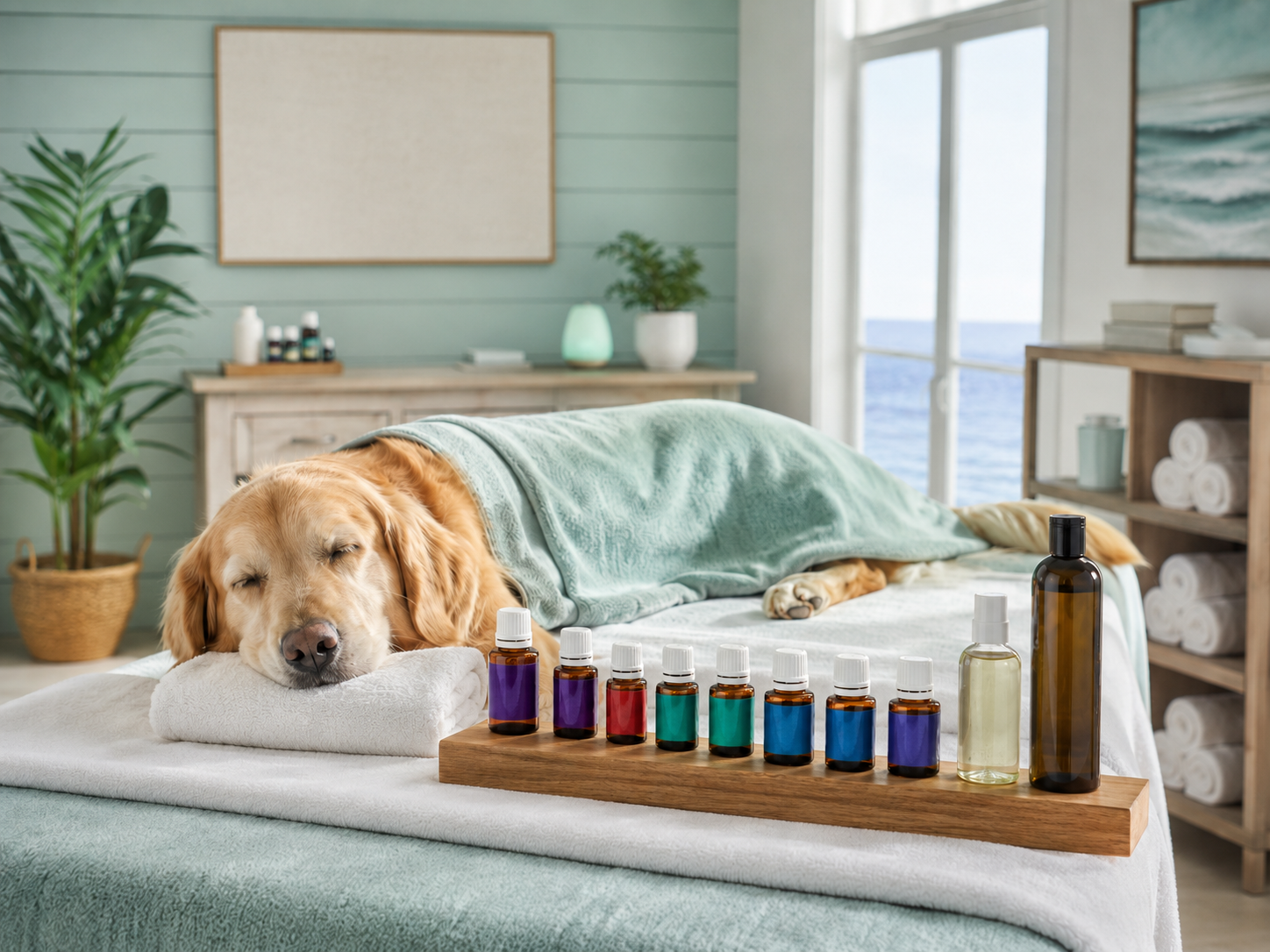
A Raindrop session creates a protected period in which the dog is not being asked to perform, obey, tolerate a procedure or prove that he feels better.
The aroma, predictable sequence, gentle touch and quiet environment may help the dog begin moving from constant vigilance toward rest.
Canine evidence for the complete Raindrop Technique is not available. Limited canine aromatherapy research has found that ambient lavender exposure was associated with less movement and vocalization during travel, but that does not establish that Raindrop treats anxiety or nervous-system disease.
What I am describing is supportive care based on the individual dog, the properties of the oils, the touch experience and what I have observed in practice.
Raindrop During Illness and Recovery
I may consider an adapted Raindrop approach when a dog is stable but needs broader support after:
Illness
Injury
Surgery or anesthesia
Antibiotics or other intensive medication
Prolonged digestive problems
Stressful veterinary treatment
Boarding or hospitalization
Physical overexertion
Emotional trauma
Repeated grooming or handling stress
A period of poor sleep
A significant household change
A chronic condition that has affected comfort and quality of life
This does not mean Raindrop treats the diagnosis.
A dog recovering from pancreatitis still needs a pancreatitis-appropriate food and medical plan.
A dog recovering from surgery still needs pain control, incision monitoring and activity restrictions.
A dog with an infection still needs appropriate diagnosis and treatment.
Raindrop may help support the dog living through those experiences.
That dog may need rest, muscular release, emotional reassurance, a calmer nervous system and a positive experience of touch in addition to the medical treatment.
Why I Think About Raindrop When a Dog Is “Not Himself”
Sometimes there is no dramatic symptom.
The dog simply has not returned to normal.
He may be eating again but remains withdrawn.
The wound may be healing, but he is not sleeping well.
The medication has ended, but his body still feels tight and his digestion is unsettled.
The veterinarian may be satisfied with the lab results, yet the dog mom knows her dog is still not fully back.
This is often the gap between stabilization and recovery.
Conventional veterinary care may diagnose the disease, stop the vomiting, repair the injury, control pain or perform the surgery.
Raindrop and other complementary modalities may help support:
Rest
Emotional decompression
Muscular comfort
The dog’s response to touch
Nervous-system settling
Gentle circulation and movement
Reconnection after fear or withdrawal
The transition back into normal routines
These approaches do not have to compete.
The dog may benefit from both good medical care and thoughtful support for the recovery experience.
Cleansing and Detoxification: What I Mean
Raindrop is often described as cleansing or detoxifying.
Those words can become vague very quickly, so I want to explain how I use them.
The liver, kidneys, lungs, digestive tract, lymphatic system and skin perform the body’s ongoing processing, circulation and elimination work.
Raindrop does not take over those functions. It does not medically detoxify a poisoned dog, reverse organ failure or replace treatment for toxin exposure.
When I use Raindrop during seasonal cleansing or recovery, I am supporting the conditions under which the body does its own work.
That may include:
Deeper rest
Less muscular guarding
Gentle movement
Circulatory support
Lymphatic movement
Reduced environmental stress
Aromatic and topical plant support
Better tolerance of touch
A quieter nervous-system state
A dog who is sleeping, breathing comfortably and no longer physically braced is in a different recovery state from a dog who remains tense and vigilant.
That is the kind of whole-body support I am looking for.
Raindrop and the Lymphatic System
The lymphatic system helps move fluid, immune cells and cellular waste through the body.
Unlike the cardiovascular system, it does not have one central pump driving circulation. Normal muscle movement, breathing and physical activity contribute to lymphatic flow.
Illness, pain, reduced mobility and crate rest may all reduce how much a dog moves.
Gentle touch and comfortable movement may therefore be incorporated into a broader recovery plan. I do not claim that Raindrop drains disease or forces toxins from the body.
I use it as one way of encouraging relaxation, movement and whole-body engagement when those things are appropriate for the individual dog.
Dogs with swelling, suspected blood clots, heart disease, active infection, cancer or unexplained fluid accumulation need veterinary guidance before massage or lymphatic-style work is added.
Raindrop and Emotional Release
Dogs may carry an experience forward even after the body has healed.
A dog who was restrained while in pain may become defensive about handling.
A dog who had repeated ear treatments may begin avoiding hands near his head.
A dog who spent several days hospitalized may come home clingy, restless or emotionally flat.
The dog is not holding a grudge.
He has learned an association.
Touch predicted pain. The clinic predicted separation. The grooming table predicted restraint.
Raindrop does not erase those memories, but a slow, choice-based session may help the dog experience touch differently.
Nothing painful happens.
His signals are noticed.
The session pauses when he needs it to pause.
He is allowed to move away.
The aroma, environment and touch begin to predict safety rather than another procedure.
This can complement behavioral work such as cooperative care, desensitization and counterconditioning.
Essential oils and energy work may help lower the dog’s emotional load. Behavioral work helps him develop a different expectation and better coping skills.
Both pieces belong together.
Reiki Within a Raindrop Session
Reiki and Raindrop fit together naturally in my work.
Some dogs settle into hands-on contact. Others need the session to begin several feet away.
Reiki allows support without restraint or physical pressure.
I may use it before introducing the oils, during a pause in the technique or after the physical portion is finished.
The dog may move closer, turn his body toward me, sigh or fall asleep. He may also choose to remain across the room.
His choice guides the session.
This is especially helpful with dogs who are sore, medically fragile, fearful of touch or emotionally overwhelmed.
What I May Notice During or After Raindrop
Every dog responds differently.
Pet parents may notice:
Deeper sleep
Stretching or shaking off
Softer posture
Less guarding
Easier movement
Seeking contact
Greater willingness to be touched
A calmer demeanor
Increased engagement
Temporary tiredness
Thirst
A need to eliminate
Emotional softness or vulnerability
These observations are not guaranteed outcomes, and every post-session change should not automatically be called detox.
Vomiting, diarrhea, marked weakness, respiratory changes, skin irritation, neurological signs or worsening pain should not be dismissed as a healing reaction.
They may indicate intolerance, illness or a problem that needs veterinary attention.
A supportive technique should not require the dog to become significantly sicker before becoming better.
When I Modify the Technique
No two canine Raindrop sessions should be assumed to look identical.
I may modify the oils, dilution, duration, areas of application and amount of physical contact based on:
Age
Breed and size
Coat and skin condition
Seizure or neurological history
Respiratory health
Liver and kidney function
Medications
Current symptoms
Recent surgery
Pain level
Emotional state
Prior oil exposure
The dog’s response during the session
A healthy adult receiving seasonal wellness support has different needs from a senior recovering from anesthesia.
A dog with an unstable medical condition should not receive a strong full-body aromatic session simply because Raindrop is considered natural.
When Raindrop Should Wait
Raindrop is not emergency care.
It should not delay veterinary evaluation when a dog has:
Difficulty breathing
Collapse or profound weakness
Suspected bloat
Uncontrolled bleeding
Major trauma
Heatstroke
Repeated vomiting
Severe abdominal pain
Active seizures
Sudden neurological changes
Suspected poisoning
An unstable surgical complication
A deep or infected wound
It may also need to be postponed or significantly modified when the dog has an acute fever, severe skin irritation, known oil sensitivity, uncontrolled pain or clearly refuses the interaction.
The dog’s “no” is enough information to stop.
Raindrop as Seasonal Wellness Support
I do not reserve Raindrop only for sick dogs.
It may also be incorporated into seasonal wellness and longevity support for dogs who are medically stable.
I may use it during periods focused on:
Antioxidant support
Lymphatic movement
Liver support
Kidney support
Environmental exposure
Mobility
Senior wellness
Emotional recovery
Seasonal changes
Stressful travel or household transitions
This does not mean one Raindrop session cleans every organ.
It means the session may complement the dog’s larger food, hydration, movement, supplement and wellness strategy.
The oils and technique are one piece of the plan—not the entire plan.
Raindrop Is Also a Relationship
There is another part of Raindrop that is difficult to capture in a bottle description.
You are paying attention to the dog for an extended period without asking him to do anything for you.
You notice where he tightens, where he softens, which aroma draws him closer and which one makes him turn away.
You feel where the body is guarded.
You notice whether the breath changes when your hands reach a particular area.
You learn something about how the dog experiences touch.
For a dog who has spent weeks being examined, medicated, confined or handled because something was wrong, this can become a very different kind of interaction.
The dog is not a diagnosis during the session.
He is an active participant.
Do Not Wait for the Crisis to Learn Your Remedies
The middle of the night, when your dog is shaking, vomiting or bleeding, is not the best time to open six browser tabs and begin learning natural first aid.
Your supplies should already be in the house.
You should know what belongs in a minor first-aid situation, which oils or homeopathic remedies you are comfortable using and which signs mean the remedies stay in the cabinet while you head to the emergency clinic.
My Remedies Class helps pet parents build a practical home kit and understand how essential oils, homeopathy and other supportive tools may fit into common first-aid and recovery situations.
Inside the Well Oiled K9 Membership, we continue that education with seasonal wellness guidance, live discussions and practical help understanding how these modalities fit into the larger health picture.
The goal is not to replace your veterinarian.
The goal is to be better prepared, notice problems sooner and know how to support your dog before, during and after veterinary care.
Related Content
Why I Use Raindrop for More Than One Diagnosis
Raindrop is not simply one remedy for one symptom.
It is one of the ways I support the entire dog when illness, stress, pain and recovery affect the body as a connected whole.
I may begin because a dog is physically tense, unable to settle or recovering from a difficult experience.
What I know from working with dogs is that the response is not always limited to one muscle or one concern. Pet parents may notice deeper rest, softer movement, easier touch, emotional release or a dog who simply appears more comfortable in his own body.
It makes it a flexible, layered support modality that can be adapted to the dog, the timing and the larger health plan.
As a Holistic Canine Health Practitioner, Certified Animal Aromatherapist, CARE Raindrop Practitioner and Reiki Master, I help pet parents determine whether Raindrop is appropriate, which parts of the technique fit the individual dog and how it can work alongside veterinary care, nutrition, behavior support and other complementary modalities.
Contact Dana to discuss Raindrop and whole-dog recovery support.
Raindrop Technique for dogs | canine Raindrop Technique | Raindrop therapy for dogs | essential oils for dog recovery | essential oils after dog surgery | natural support for sick dogs | Raindrop for senior dogs | Raindrop for dog anxiety | Raindrop for dog pain | canine aromatherapy | essential oils for dog stress | holistic recovery for dogs | Reiki and Raindrop for dogs | Vita Flex for dogs | essential oils along dog spine | essential oils after antibiotics | natural support after anesthesia | Raindrop for emotional trauma in dogs | essential oils for whole-body support | Raindrop Technique benefits | dog nervous system support | dog recovery after illness | seasonal wellness for dogs | dog first-aid remedies | natural first-aid class for dog owners |
When DIY Isn't Enough Already tried the basics? If this is happening with your dog and you're still stuck, I can help you figure out what deserves attention next.
Request a Discovery Callback →