

How to Introduce Essential Oils to Your Dog: Scent Imprinting & Positive Association
ESSENTIAL OILS FOR DOGS • GETTING STARTED
Before you ever reach for an essential oil during a thunderstorm, stressful car ride, vet visit or anxious moment, introduce the aroma when your dog is already calm.
This is one of the most overlooked parts of using essential oils with dogs.
We tend to buy an oil because we want it to help with something: fear, nervousness, travel, grooming, storms, separation, restlessness or another emotional concern.
Then the first time the dog smells it is often right in the middle of the thing we are trying to help.
I would rather introduce that aroma before we need it.
Your dog has an extraordinary sense of smell, and scent is closely tied to memory and emotional response. A gentle introduction gives your dog an opportunity to experience a new aroma during an ordinary, peaceful moment rather than automatically connecting it with stress.
Why Introduce an Essential Oil Before You Need It?
Think about how quickly a familiar smell can bring back a memory for you. Dogs live in an even richer scent world.
When a new aroma is repeatedly present while your dog is relaxed, comfortable and safe, that scent can become part of the environment associated with that state.
This is what I mean when I talk about scent imprinting or building a positive scent association.
We are not forcing the dog to like an oil. We are not trying to make an oil magically create an emotion.
We are simply being thoughtful about the first experiences the dog has with that aroma.
The mistake I want you to avoid: introducing a completely unfamiliar aroma for the very first time while your dog is already frightened, frantic or overwhelmed.
Start With Your Dog in a Calm, Ordinary State
Pick a boring moment.
Seriously.
Your dog is lying beside you. You are reading. You are watching television. You are sitting outside together. Maybe your dog is getting ready for a nap.
Nothing dramatic is happening.
That is a much better time to introduce a new aroma than five minutes after thunder starts cracking over the house.
Your goal during the first introductions is simply:
- let your dog notice the aroma,
- keep the experience low-pressure,
- observe the response, and
- allow the scent to become familiar.
How to Introduce an Essential Oil to Your Dog
STEP 1
Choose One Oil
When you are first learning how your dog responds to essential oils, keep it simple.
Introduce one oil rather than opening several bottles at once. If your dog becomes interested, relaxed, alert or completely uninterested, you will have a much better idea which aroma produced that response.
STEP 2
Let the Aroma Come to Your Dog
You do not need to stick an essential-oil bottle under your dog's nose.
Their nose is considerably better than yours.
Open the bottle while sitting near your dog and allow the aroma to exist in the space.
You can also let your dog investigate the cap or bottle from a comfortable distance rather than pushing it toward the nose.
Many dogs will lean in for more information. Others may simply notice it and go back to what they were doing.
Both responses give you information.
STEP 3
Watch What Your Dog Does
I want you watching the dog—not staring at the bottle wondering whether the oil is supposed to be calming.
Your dog may:
- move closer,
- sniff and remain nearby,
- soften through the face and body,
- settle more deeply,
- lick or move the mouth,
- turn away,
- walk away,
- become more alert, or
- show very little reaction at all.
Do not decide in advance what your dog is supposed to do.
Observe.
STEP 4
Keep the First Sessions Short
More is not necessary.
A dog's olfactory system is receiving far more information from an aroma than ours is.
A brief introduction gives your dog enough time to notice the scent without making the experience overwhelming or turning it into an event.
Introduce it again later during another calm moment.
STEP 5
Build Familiarity Before the Stressful Event
If you eventually want to use an aroma around thunderstorms, travel, grooming, veterinary visits or another predictable stressor, give your dog several neutral or positive experiences with that scent first.
Now the aroma is not brand new when you actually need it.
It already belongs to your dog's normal world.
Do Not Turn the Introduction Into a Test
Dog parents sometimes get very focused on finding out whether an oil “works.”
That is not what this first introduction is about.
You are learning about your dog's response to an aroma.
That is useful information all by itself.
One dog may be very interested in lavender. Another may barely acknowledge it.
One dog may settle beautifully around frankincense. Another may consistently move away.
Dogs are individuals.
That is exactly why I do not believe every dog needs the exact same oil simply because a chart or social-media post says that oil is “for anxiety.”
Your Dog's Response Matters
I teach dog parents to pay attention to what the dog tells us.
If your dog repeatedly moves away from an aroma, I would not keep following them around the house with it.
If your dog becomes curious and chooses to remain nearby, that tells us something too.
Sometimes a dog's response is obvious. Sometimes it is subtle.
And sometimes the dog simply does not seem particularly interested.
You do not have to manufacture a response.
What Am I Watching For?
During a simple scent introduction, pay attention to the whole dog.
- Does the body soften or become more tense?
- Does your dog stay nearby or create distance?
- Does breathing appear to change?
- Does your dog settle?
- Does your dog become more alert?
- Does your dog return to investigate again?
- Does the dog walk away and remain away?
These observations help you learn your dog's preferences and responses instead of assuming every oil affects every dog in exactly the same way.
Why This Matters for Emotional Support
Let's say your dog struggles during thunderstorms.
You buy an essential oil specifically because you want to support a calmer emotional response.
If the very first time your dog experiences that aroma is while thunder is booming, the barometric pressure is changing, you are rushing around shutting windows and your dog is already shaking, that aroma has entered the picture during a very intense emotional state.
I would rather the scent already be familiar.
Introduce it on quiet days. Let it become part of calm evenings. Allow the dog to experience it without anything bad happening.
Then, when you bring that same aroma into a stressful situation later, it is not another brand-new stimulus piled on top of everything else.
Scent Imprinting Is Not About Forcing Relaxation
This distinction matters.
We are not trying to overpower your dog's nervous system with fragrance.
We are building familiarity.
The dog's response still matters. The situation still matters. The underlying cause of the fear or anxiety still matters.
Essential oils can become one useful part of the emotional-support toolbox, but the introduction itself should be simple and uneventful.
What About Self-Selection?
Closely related to introduction is the idea of allowing a dog to show interest in—or move away from—an aroma.
That deserves its own discussion because self-selection goes beyond simply introducing an oil for the first time.
Read: Self-Selection — Let Your Dog Choose →
Introduction Is Only the Beginning
Learning how to introduce an essential oil is the first step.
The bigger education is learning:
- why you might choose one oil over another,
- how different oils fit different emotional or physical goals,
- how I combine oils with herbs, homeopathy and other natural remedies,
- how to observe your dog's response,
- when a simple home remedy is reasonable, and
- when the situation needs a much more individualized approach.
That is much more useful than memorizing a list of “10 essential oils every dog owner should have.”
Want to Learn How I Actually Use Essential Oils & Natural Remedies?
This article gives you the starting point: how to introduce an aroma thoughtfully.
The Well Oiled K9 Remedies Class goes much deeper. We talk about essential oils, herbs, homeopathy, natural first aid and how I think through which type of remedy makes sense for the situation in front of me.
Annual Well Oiled K9 members receive the Remedies Class as part of their membership, along with the member resource library, guides, reference materials, live Q&A and a place to ask questions as you put what you are learning into practice.
In other words, you do not have to rely on one blog post, a Pinterest chart and crossed fingers.
Explore the Remedies Class & Membership →Educational Use: The Well Oiled K9 provides holistic pet-health education and coaching. Information on this page is educational and is not intended to diagnose, treat, cure or prevent disease or replace veterinary diagnosis, treatment or emergency care.
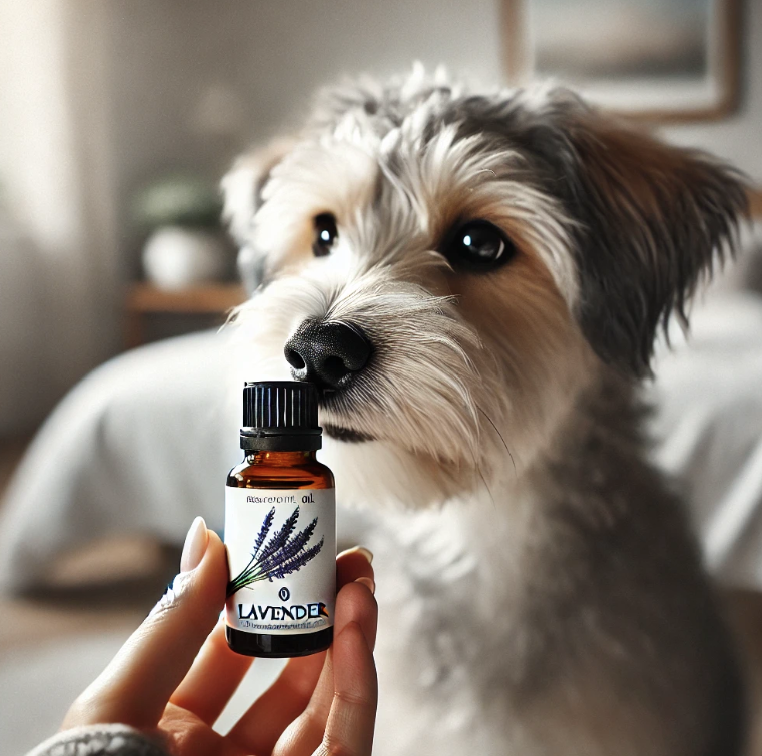
Imprinting Essential Oils With Dogs — let them sniff the cap or the bottle with the cap slightly open. Their noses are powerful.
When DIY Isn't Enough Already tried the basics? If this is happening with your dog and you're still stuck, I can help you figure out what deserves attention next.
Request a Discovery Callback →