

How Much Essential Oil Should I Use on My Dog?
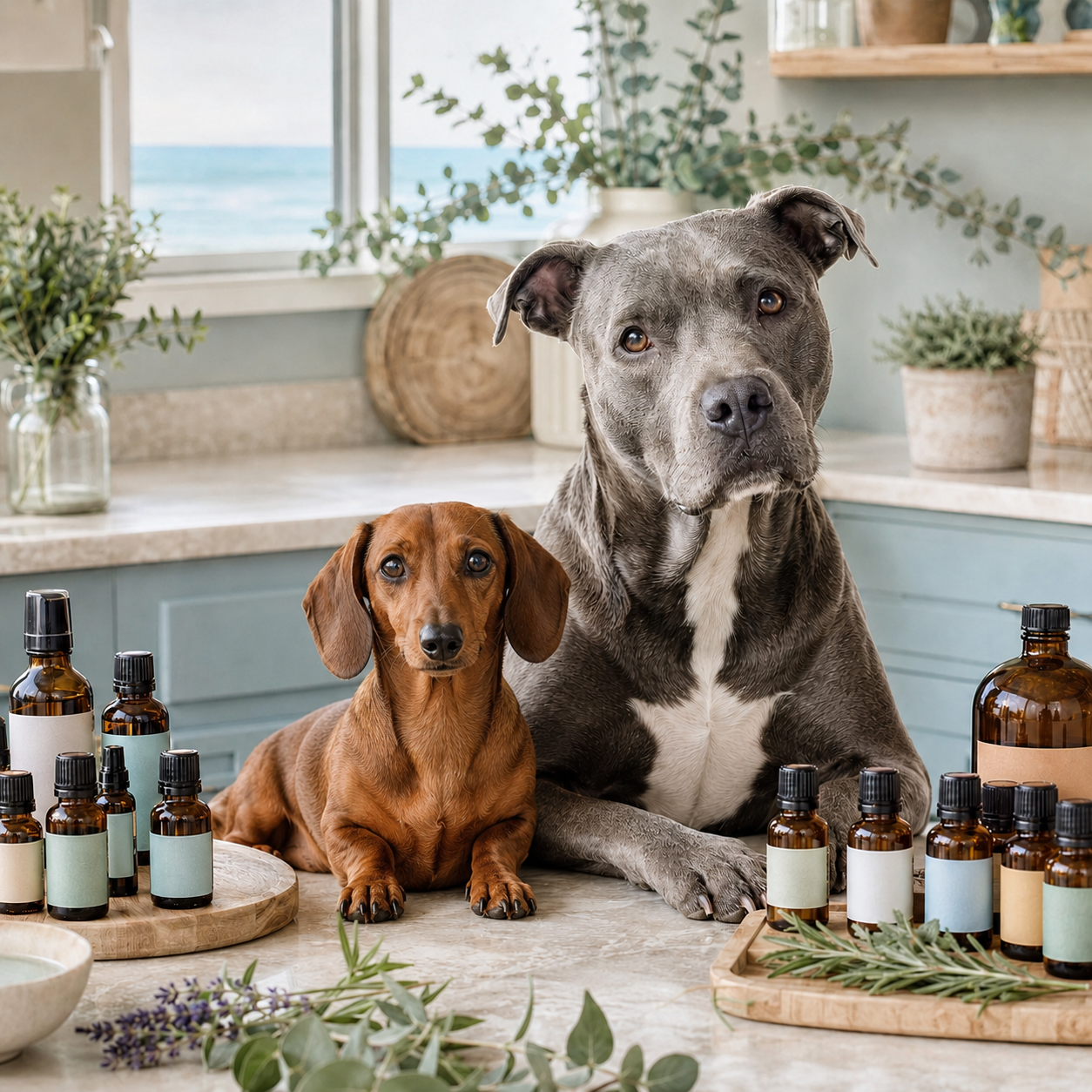
These are some of the most common questions I receive from dog moms who want to use essential oils but are afraid of doing something wrong. Or they think of it like traditional dosing of medications — with a very specific measurement and frequency.
“How much essential oil should I use on my dog?”
“How often can I apply it?”
“Where do I put it?”
“Which oil should I choose?”
These are some of the most common questions I receive from dog moms who want to use essential oils but are afraid of doing something wrong.
You may have already asked these questions in a Facebook group and received 37 different answers.
No wonder you are confused.
The answer really is: It depends.
I know. You wanted a simple recipe.
There is still a practical framework you can follow. Once you understand how the oil, dog, purpose, route, and frequency fit together, essential oils become much easier to use.
Why There Is Not One Universal Essential Oil Dose for Dogs
A 10-pound senior dachshund with several health concerns may need a different approach than a healthy 70-pound adult dog recovering from a long hike.
A dog needing occasional calming support may not use the same oil, amount, or application method as a dog receiving ongoing joint, digestive, skin, respiratory, or immune support.
Before choosing an oil, I consider:
The dog’s age, breed, size, and overall health
What we are trying to support
Whether the concern is occasional, acute, chronic, or recurring
How long the problem has been present
Current medications, supplements, herbs, and other remedies
Liver, kidney, respiratory, neurological, or endocrine concerns
Seizure history
Skin condition and sensitivity
Previous experience with essential oils
The quality and intended use of the oil
Whether we are using it aromatically, topically, orally, or sublingually
How the dog responds after the first few uses
Weight is part of the decision, but it is not the only consideration.
Two dogs can be the same weight and have the same diagnosis but still need different oils and different approaches.
This is why Facebook one-liners often fall short. Most people are answering from their own dog’s story. Their suggestion may have worked beautifully for that dog and still be completely wrong for yours.
The internet loves simple answers. The body does not always cooperate.
Start Low and Slow—Then Adjust
When introducing an essential oil, I often begin with:
One essential oil rather than a complicated blend
One drop with an appropriate carrier
One method of application
A reasonable period of observation
An adjustment based on the dog’s response
Starting low does not mean you must always stay low.
It gives you a clear place to begin while you learn how your dog responds. From there, the amount, frequency, carrier, and application method can be adjusted according to the dog, oil, and purpose.
Some dogs may do well with one diluted drop. A larger dog or a more intensive wellness application may eventually use more. Some oils need more carrier because of their chemistry. Other gentle oils may be used differently.
A broad dilution chart can help you understand the basic idea, but it cannot account for every dog and every oil. You can read more in How to Dilute Essential Oils for Dogs.
Confidence Comes From Actually Using the Oils
Many dog moms begin with essential oils feeling nervous.
They hold the bottle six feet away from the dog, use half a whiff, and then watch the dog like they are waiting for a second tail to appear.
That nervousness usually changes once they understand what they are doing and begin seeing results.
Maybe the dog settles more easily during a storm. Maybe stiffness after a long walk improves. Maybe the dog handles a car ride, grooming appointment, or stressful change with less over-arousal. Maybe an oil becomes part of the dog’s regular digestive, joint, skin, emotional, or immune-support routine.
That is how confidence grows:
You learn why the oil was selected.
You understand how it can be used.
You begin with a sensible amount.
You see how your dog responds.
You begin recognizing which oils your dog prefers.
You learn when to repeat the application.
You see positive results.
You become more comfortable making everyday decisions.
Eventually, you stop feeling as though every essential oil decision requires an emergency meeting.
Working with an experienced mentor can shorten the learning curve considerably. Instead of guessing from contradictory posts, you have someone who can explain the reasoning, answer questions, and help you recognize what your dog is communicating.
Books provide information.
A mentor helps you apply that information to the dog standing in front of you.
How Can Essential Oils Be Used With Dogs?
Essential oils may be used aromatically, topically, orally, or sublingually.
These routes are not interchangeable. The best method depends on the oil, dog, and reason you are using it.
Aromatic Use and Diffusion
Aromatic use is often an easy way to introduce an essential oil.
You can diffuse essential oils in several ways.
Using an Essential Oil Diffuser
A water-based diffuser distributes the aroma through the room.
You do not need to turn your living room into an essential oil fog bank.
Begin with a small amount and use intermittent diffusion when appropriate. Your dog’s nose is far more sensitive than yours, so a subtle aroma may be plenty.
A diffuser may be useful for:
Evening calming routines
Nervous system regulation
Difficulty settling
Emotional recovery
Respiratory comfort
Creating a familiar routine
Supporting several dogs or people in the same room
The dog should be able to move away from the diffuser when possible. That does not mean we expect something bad to happen. It simply allows the dog to choose the amount of aromatic exposure that feels comfortable.
Using a Bandana
A lightly scented bandana provides passive diffusion without running a diffuser.
Place the appropriately prepared oil on the bandana, allow it to absorb, and then loosely place the bandana on the dog.
The oil does not need to sit directly beneath the dog’s nose. Your dog can smell the treat bag before you have even opened the cabinet. Subtle works.
A bandana may be convenient during:
Car rides
Veterinary visits
Grooming appointments
Training sessions
Thunderstorms
Fireworks
Travel
Changes in routine
The bandana can be removed once the situation has passed or the dog no longer needs it.
Using Yourself as the Diffuser
Sometimes you are the diffuser.
Apply an appropriate oil to yourself and allow the dog to share the aroma naturally while resting beside you.
This is especially useful when your dog mirrors your emotions. Supporting your own nervous system may change your breathing, tension, body language, and energy while also giving the dog gentle aromatic exposure.
One oil. Two nervous systems. That is a pretty good return on the investment.
Topical Use
Topical use places the essential oil on the dog’s skin or coat.
Possible areas may include:
Along the spine
Chest
Shoulders
Lower back
Feet or paw area when appropriate
A specific muscle group
Another area selected for the dog’s individual plan
For many routine applications, I begin with one drop of essential oil combined with an appropriate carrier.
Possible carrier oils include:
Fractionated coconut oil
Olive oil
Jojoba oil
Another carrier selected for the dog and purpose
The carrier helps distribute the essential oil over a larger area. It can also slow absorption and make the application easier to spread.
Where you apply the oil should connect to why you are using it.
Randomly rubbing every oil between the shoulder blades is not a complete wellness strategy.
Avoid casual application directly into the eyes, nose, ear canal, or other highly sensitive areas. Unidentified lumps, open wounds, significant skin problems, and serious injuries should be properly evaluated rather than covered with random oils.
Oral Use
Oral use means the essential oil is swallowed.
It may be given through:
A properly prepared capsule
Food
An edible carrier
A product specifically designed for internal use
Another individualized protocol
Not every oil or every bottle is intended for oral use.
Quality, purity, labeling, chemistry, medications, organ function, and the dog’s full health picture need to be considered.
When the oil and product are appropriate, oral use may be a valuable option. I do not believe we need to automatically fear internal essential oil use. I do believe we need to understand what we are using and why.
Natural does not mean pouring freely and hoping for the best.
Education gives you the confidence to recognize the difference between appropriate internal use and random internet dosing.
Sublingual or Gumline Application
Sublingual use involves placing a properly selected and prepared oil under the tongue or along the gumline.
This route allows quick contact with the mouth’s mucous membranes.
It may be useful when:
A faster response is desired
The dog will not take a capsule or food
The dog is already familiar with essential oil use
The oil and purpose fit this route
The dog needs to be comfortable and cooperative.
Do not wrestle with a frightened dog or squirt oil into the back of the mouth. That is not a wellness routine. That is Tuesday night chaos with a fragrant aftertaste.
Sublingual or gumline use is best learned through education and individualized direction so you understand the oil, amount, preparation, and intended frequency.
Which Essential Oil Should I Choose for My Dog?
Instead of asking, “Which oil is good for dogs?” ask:
What am I trying to support in this dog?
There are hundreds of essential oils, and many have overlapping uses. The following chart provides general examples—not a full protocol.
System or PurposeEssential Oils Commonly ConsideredGeneral Use PatternCalming and nervous system supportLavender, Frankincense, Cedarwood, Vetiver, Roman ChamomileMay be used situationally or as part of an ongoing routineEmotional grounding and recoveryFrankincense, Lavender, Cedarwood, Bergamot, VetiverOften incorporated into daily routines or used around stressful eventsMuscles, joints, and physical recoveryCopaiba, Frankincense, Marjoram, Lemongrass, HelichrysumMay be used regularly or during periods of increased physical needDigestive comfortGinger, Peppermint, Cardamom, FennelOften used temporarily or as needed, depending on the underlying concernSkin comfort and cleansing supportLavender, Frankincense, Helichrysum, German Chamomile, Tea TreeMay be used short term or within an ongoing skin planRespiratory comfortFrankincense, Myrtle, Ravintsara, Eucalyptus radiataOften selected for seasonal or temporary supportOutdoor and seasonal supportCedarwood, Geranium, Lemongrass, CitronellaCommonly used during outdoor seasons or before exposureGeneral wellnessFrankincense, Copaiba, Lavender, LemonMay become part of a regular wellness routineFirst-aid supportLavender, Helichrysum, Frankincense, Tea TreeUsually chosen for a specific situation and limited periodImmune and cleansing supportFrankincense, Lemon, Tea Tree, Thyme, OreganoThe gentler oils may be used regularly; stronger oils are commonly used more intentionally or temporarily
Even within the same category, the oils are not identical.
A restless dog who cannot turn their brain off may need something different from a shut-down dog who is fearful and withdrawn.
A dog with occasional gas may not need the same digestive support as a dog with a chronic gastrointestinal condition.
Eucalyptus radiata is not the same as grabbing any bottle labeled “eucalyptus.” Plant species, chemistry, quality, and how the oil was produced all influence the choice.
For more examples, visit 25 Common Essential Oils and Their Uses for Dogs.
Some Essential Oils Can Be Used Daily
Essential oils are not only for emergencies.
Some may be used regularly—even daily—when the oil, quality, amount, route, and dog are a good match.
Oils commonly considered for ongoing use may include:
Lavender for calming, skin, and general comfort
Frankincense for emotional grounding and whole-body wellness
Copaiba for muscles, joints, and physical comfort
Cedarwood for emotional regulation, skin, and outdoor support
Gentle citrus oils for environmental, emotional, or seasonal support
Regular use might include:
Diffusing during an evening routine
Applying a diluted oil before exercise
Using an oil as part of ongoing mobility support
Using a bandana during training or travel
Applying oils during massage, Reiki, PEMF, or bodywork
Creating a familiar calming ritual
Supporting the dog through household changes
Incorporating oils into an established wellness routine
The plan may continue for weeks, months, or longer when it continues to help and remains appropriate for that dog.
You do not need to stop using an oil merely because an arbitrary number of days has passed.
We reassess based on the dog, the purpose, and the results.
An oil used twice a day during a difficult period may later be used once a day, several times a week, or only when the dog needs additional support.
That is not failure. The plan is adjusting with the dog.
To understand why I consider essential oils such a useful everyday wellness tool, read Essential Oils for Dogs: The Wellness Tool I’ll Never Be Without.
Some Essential Oils Are Better for Temporary or First-Aid Use
Other oils are selected for a shorter period or a specific situation.
These may be used for:
First-aid support
Occasional digestive discomfort
An insect bite or minor skin concern
Temporary respiratory support
Physical recovery after unusual strain
Fireworks, travel, boarding, or another stressful event
Seasonal outdoor exposure
A focused short-term wellness plan
Some oils have stronger chemistry and are not automatically chosen for casual, indefinite daily use.
That does not make them bad oils. It means they have a job.
You probably would not leave an ice pack strapped to your knee for six months because it helped after you twisted it.
The ice pack served its purpose.
Essential oil use can work the same way. Some oils become familiar members of the daily routine. Others come out of the cabinet when a particular situation calls for them.
Learning the difference is one of the reasons education is so valuable.
How Often Can I Use Essential Oils on My Dog?
Frequency depends on the reason for use.
An oil used for one stressful car ride may only be needed around that event. An oil incorporated into a longer wellness plan may be used consistently and then adjusted as the dog improves.
Questions to consider include:
Is the concern happening now, or are you supporting the dog preventively?
Is this a daily wellness oil or a temporary first-aid oil?
How long does the benefit appear to last?
Is the dog improving between applications?
Are you using several products containing the same oils?
Does the application still produce the response you want?
Are you supporting the source of the problem or repeatedly covering a symptom?
Has the dog’s health or medication list changed?
Using an oil more frequently because it is not producing the desired result is not always the answer.
Sometimes the oil is wrong. Sometimes the route is wrong. Sometimes food, pain, inflammation, gut health, medication, stress, or another health condition is driving the symptom.
Sometimes the dog needs veterinary diagnostics rather than another drop of oil.
The bottle cannot answer those questions. Someone needs to look at the whole dog.
Let Your Dog Participate in the Choice
Dogs frequently show preferences for particular aromas.
Your dog may:
Move closer to the oil
Sniff with interest
Relax
Sigh
Lick their lips
Stretch out
Become sleepy
Turn their body toward the oil
Walk away after enough exposure
A dog walking away does not automatically mean the oil is unsafe.
The dog may have had enough. They may not need that oil at the moment. They may prefer a different oil or route.
Self-selection can provide useful information, especially when several oils might fit the same general concern.
It does not replace education or veterinary diagnostics, but it helps the dog participate in the process.
Learn more in How to Let Your Dog Self-Select Essential Oils.
Observation Does Not Mean Expecting Something Bad to Happen
I want dog moms to observe their dogs.
I do not want them frightened every time they open an essential oil bottle.
In my experience, significant problems are uncommon when high-quality essential oils are selected appropriately and used in sensible amounts.
Most dogs do very well with essential oils.
Observation simply helps you determine:
Whether the dog likes the aroma
Whether the oil creates the desired response
How long the benefit lasts
Whether the amount or method needs to change
Whether another oil may be a better fit
Whether the dog has received enough for now
The goal is not to hover over your dog looking for trouble.
The goal is to become familiar enough with your dog that you recognize what helps.
If your dog experiences persistent skin irritation, digestive upset, coughing, unusual agitation, or another unexpected response, pause and reassess.
Any dog can be sensitive to an ingredient, just as dogs can react differently to foods, supplements, shampoos, medications, or environmental products.
That possibility does not need to dominate the essential oil conversation.
Choose well. Use common sense. Pay attention. Move forward.
Seek veterinary care for significant breathing changes, repeated vomiting, collapse, serious neurological symptoms, poisoning, major trauma, or another medical emergency.
Essential oils can complement veterinary care. They do not replace diagnosis, stabilization, imaging, laboratory testing, pain control, fluids, surgery, or emergency treatment when those are needed.
Quality Changes the Conversation
There is a large difference between a high-quality essential oil produced for wellness use and a cheap fragrance oil manufactured to make the laundry room smell like a lavender cupcake.
The label may say “pure,” “natural,” or “therapeutic,” but those words do not automatically tell you:
Where the plant was grown
Which botanical species was used
Whether pesticides or synthetic chemicals were involved
How the plant was distilled
Whether the oil was diluted, altered, or extended
Whether the company tests each batch
Whether the company can provide meaningful sourcing information
Whether the product was designed only for fragrance
Before choosing a company, read Questions to Ask Your Essential Oil Company.
The quality of the oil is one reason two people may report completely different experiences using a bottle with the same name on the label.
Reference Books Are Helpful—But They Do Not Know Your Dog
Good books can help you learn essential oil chemistry, botanical names, safety considerations, application methods, and potential uses.
Reference books to consider include:
The Animal Desk Reference II: Essential Oils for Animals by Melissa Shelton, DVM
Essential Oil Safety: A Guide for Health Care Professionals by Robert Tisserand and Rodney Young
Holistic Aromatherapy for Animals: A Comprehensive Guide to the Use of Essential Oils and Hydrosols With Animals by Kristen Leigh Bell
The Chemistry of Essential Oils Made Simple by David Stewart, PhD
You may notice that reference books do not always agree.
Authors can follow different schools of aromatherapy. They may use different product standards, routes, dilution practices, and philosophies.
One book may focus heavily on aromatic and topical use. Another may include oral applications. One may use conservative human aromatherapy limits. Another may reflect veterinary aromatic medicine or the French model.
Read more than one perspective.
A book can teach you about lavender. It cannot examine your dog, review medications, evaluate the diet, notice muscle tension, or ask about the strange stool that happens every third Tuesday.
Use books as educational tools—not as a replacement for individualized guidance.
Education Turns a Collection of Bottles Into a Useful Toolbox
Many people own essential oils but rarely use them.
They bought a kit, read five contradictory posts, became afraid of doing something wrong, and placed the bottles in a cabinet.
That is an expensive air-freshener collection.
Education changes that.
Once you understand the basic framework, you begin seeing how versatile essential oils can be.
The same collection may provide options for:
Emotional wellness
Skin support
Digestion
Mobility
Respiratory comfort
Outdoor protection
First aid
Household cleaning
Low-tox living
Everyday wellness routines
The more you use the oils appropriately, the more comfortable you become.
You begin to:
Recognize which oils your dog responds to best
Understand which methods fit your routine
Know when a single oil is enough
Stop throwing five remedies at one symptom
Identify which oils belong in the regular wellness routine
Recognize which oils are better for temporary support
Adjust frequency as the dog’s needs change
Become less dependent on random internet advice
Confidence does not come from memorizing every oil in a reference book.
It comes from learning, using the oils, seeing the results, and having an experienced mentor available when the situation is not as simple as a chart made it sound.
Learn With a Mentor and an Educational Community
A good mentor does more than tell you which bottle to grab.
They help you understand:
Why an oil may fit the dog
Which application method makes sense
Whether it is intended for ongoing or temporary use
How to recognize a useful response
When to adjust the plan
How the oil fits with food, medications, supplements, herbs, and other remedies
When the concern needs veterinary evaluation
How to build a collection you will actually use
My remedies education and membership programs help dog moms gain confidence using essential oils, herbs, homeopathy, first-aid remedies, food, and other natural wellness tools.
Members have access to education, the remedies class, community discussions, Q&A, live support, and help finding the appropriate guide or next step.
The goal is not for you to need permission every time you reach for lavender.
The goal is to teach you enough to make confident everyday decisions and recognize when you need more personalized direction.
Learn More About The Well Oiled K9 Membership
Need help choosing oils or building a personalized wellness plan for your dog?
Submit an inquiry and let’s see what I can do to help. No obligation—the inquiry callback is provided at no cost.
Suggested Reading
Essential Oils for Dogs: The Wellness Tool I’ll Never Be Without
How to Dilute Essential Oils for Dogs
25 Common Essential Oils and Their Uses for Dogs