
Are Plug-In Air Fresheners Safe for Dogs?
Why I Worry More About Everyday Fragrance Than High-Quality Essential Oils
Why I choose Essential Oils In My Home With Dogs
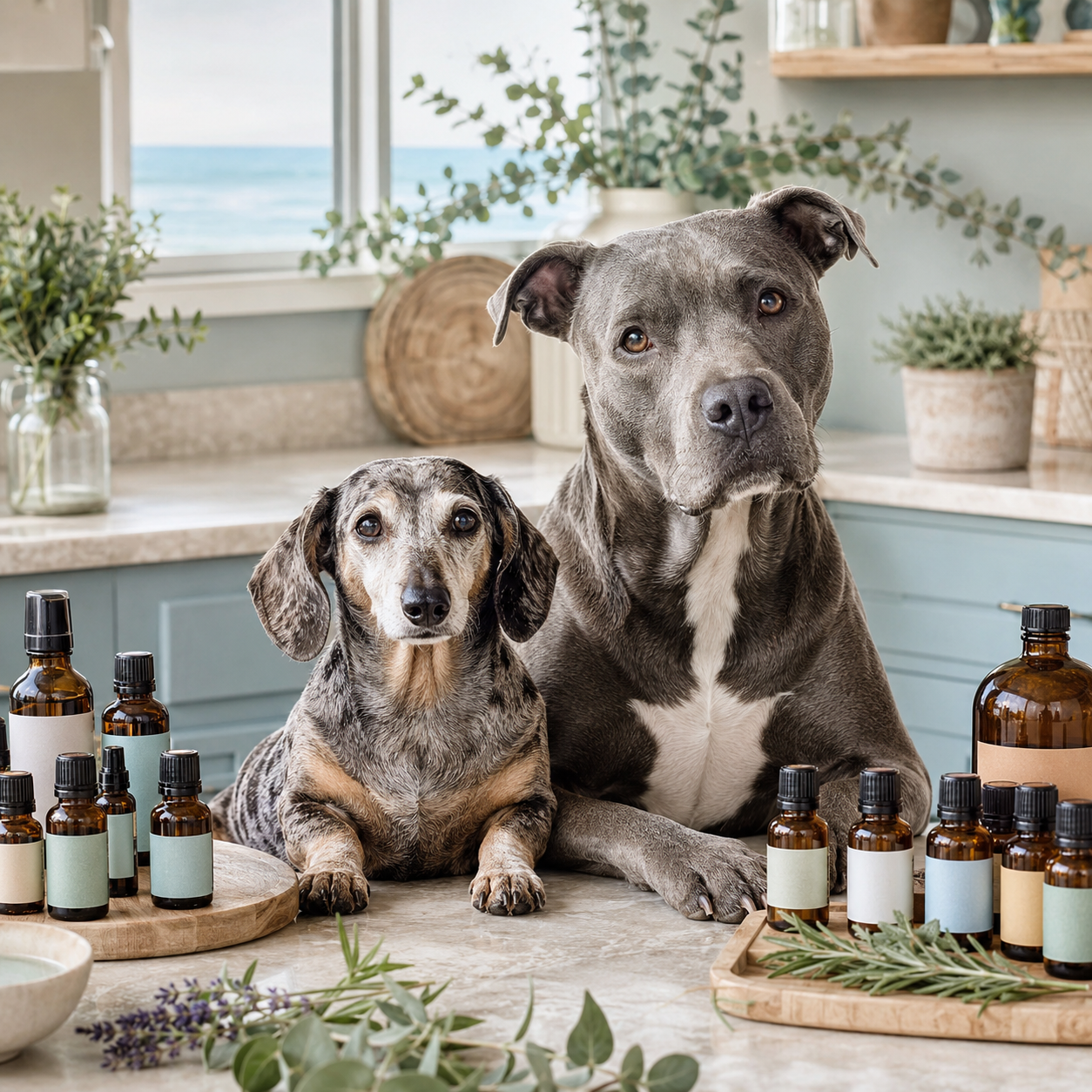
Dog moms are warned to fear one drop of Lavender, yet nobody asks what is coming from the plug-in beside the dog bed, the detergent used on the blankets, the fabric spray on the couch or the scent beads coating every towel in the house.
Apparently, a carefully selected essential oil is terrifying—but “Fresh Mountain Breeze Explosion” running twenty-four hours a day gets a free pass.
That makes very little sense to me.
I am not suggesting that every household fragrance product is toxic. I am also not suggesting that every essential oil is appropriate for every dog. Neither statement would be honest.
I am asking why we scrutinize the intentional use of a known essential oil while rarely questioning the collection of fragranced products surrounding our dogs every day.
Your Dog Is Living Much Closer to These Products Than You Are
Your dog is not experiencing your home from five feet above the floor.
They are:
Sleeping on freshly washed bedding
Lying directly on carpets and furniture
Walking across cleaned floors
Licking product residue from their paws
Breathing near plug-ins placed close to floor level
Pressing their nose into blankets treated with detergent, scent boosters and fabric softener
Living in the room while candles, wax melts and fabric sprays are being used
You may smell a pleasant fragrance when you walk into the room. Your dog may spend the next eight hours sleeping directly beside its source.
That difference in exposure is worth considering.
The Household Fragrances Hiding in Plain Sight
When pet parents think about fragrance exposure, they usually picture perfume or an air freshener.
The actual list may be much longer:
Plug-in air fresheners
Automatic room sprays
Fabric refresher sprays
Carpet powders
Scented candles
Wax melts
Laundry detergent
Scent boosters
Fabric softener
Dryer sheets
Floor cleaners
Disinfecting sprays
Furniture cleaners
Trash bags with added fragrance
Grooming sprays
Scented dog shampoo
Odor-control products used on dog beds
One product may not be the issue.
The bigger question is what happens when several fragranced products are used throughout the home, every day, around a dog who cannot walk outside and choose fresher air.
What Are VOCs?
Many household products release volatile organic compounds, commonly called VOCs. These are compounds that evaporate into the air at normal indoor temperatures.
The Environmental Protection Agency reports that VOCs are emitted by thousands of household products and that concentrations of many VOCs are routinely higher indoors than outdoors. Air fresheners, cleaning products, fragrances, paints, personal-care items and other common products may all contribute to the total indoor load.
That does not mean every VOC is automatically dangerous. Essential oils also contain naturally occurring volatile compounds. The word “volatile” simply means the compound can evaporate into the air.
The questions we need to ask are:
Which compounds are present?
How concentrated are they?
How long is the dog exposed?
Is the room ventilated?
Is the product also settling on surfaces?
Is the dog inhaling, touching or licking the residue?
Is the dog already struggling with respiratory, skin, liver, neurological or inflammatory issues?
The internet loves a simple good-versus-evil argument. Biology is rarely that cooperative.
What Does “Fragrance” Actually Mean?
When a household product lists “fragrance,” that word may represent a formulation rather than one clearly identified ingredient.
Unlike food products, manufacturers of many chemical household products are not generally required to list every ingredient on the container or make the full formulation publicly available. The EPA’s Safer Choice program requires participating manufacturers to provide greater ingredient transparency, including fragrance information.
This does not prove that an undisclosed ingredient is harmful. It does mean you may not have enough information to fully evaluate what you are repeatedly using around your dog.
“Natural fragrance” is not necessarily a complete ingredient list either.
And “unscented” does not always mean the same thing as fragrance-free. An unscented product may use fragrance ingredients to mask the odor of its other ingredients. When possible, look specifically for fragrance-free products with transparent labeling.
Laundry Products Deserve More Attention
Laundry products are one of the most overlooked sources of repeated exposure.
Your dog may spend twelve hours a day touching:
Bedding washed in scented detergent
Blankets coated with fabric softener
Towels dried with dryer sheets
Furniture covers washed with scent boosters
Your clothing and pajamas
The fragrance is designed to remain on the fabric. That is why you can still smell “ocean breeze” days after the laundry was washed.
Now think about the dog with itchy skin, recurrent paw licking, watery eyes, sneezing, restlessness or a history of sensitivities. Laundry products may not be the sole cause, but they belong on the list of questions.
Switching food for the sixth time while washing the dog’s bedding in heavily fragranced detergent may be missing part of the picture.
Are Plug-In Air Fresheners Safe for Dogs?
A plug-in used according to its label is not automatically a poisoning emergency.
The part I question is the assumption that continuous fragrance exposure is harmless or necessary simply because the product is sold for household use.
Plug-ins may run:
All day and all night
In small rooms with closed windows
Beside dog beds
Near food and water bowls
At the exact height where a dog is breathing
A dog may also avoid a room, move away from the diffuser, sneeze, lick their lips, become restless or act differently without the pet parent connecting the behavior to the scent source.
Sometimes the first reasonable step is not another supplement.
Unplug the thing and see what changes.
Is Febreze Safe for Dogs?
The ASPCA Animal Poison Control Center considers Febreze fabric freshener products safe for use around dogs and cats when used according to label directions. Wet contact may still cause minor skin irritation or stomach upset if the product is licked.
That is different from saying every dog benefits from repeated exposure or that spraying fabrics is necessary in a sensitive dog’s home.
“Not expected to cause poisoning when used correctly” and “the best choice for this particular dog” are two different questions.
Avoid spraying products directly on your dog, dog bedding while occupied, food bowls, toys or surfaces your dog may lick before they are dry.
Why High-Quality Essential Oils Are a Different Conversation
A pure essential oil and a synthetic fragrance product are not interchangeable simply because they both have a smell.
With a high-quality essential oil, I am looking for:
The botanical identity of the plant
Appropriate plant species and plant part
Reliable sourcing
Purity and testing
Proper storage
A clear reason for choosing that oil
An application method appropriate for the individual dog
Control over how much, how often and for how long it is used
I am not trying to make the entire house smell like Lavender all day.
I may be considering an essential oil as one part of support for:
Nervous-system regulation
Situational stress
Emotional recovery
Skin comfort
Digestive comfort
Muscle and joint support
Seasonal outdoor support
Healthy respiratory function
Whole-body wellness
The oil is selected for a purpose—not because I wanted the living room to smell like a fake pine forest in December.
Natural Does Not Automatically Mean Safe
This point is important because honesty builds trust.
Essential oils are concentrated. The oil, quality, amount, frequency, route of use and individual dog all change the plan.
Problems are more likely when:
A dog drinks oil from a bottle or diffuser
Undiluted oil is spilled onto the coat or skin
Large amounts are used in a poorly ventilated room
A strong oil is selected without considering the dog
Low-quality, adulterated or fragrance oils are mistaken for pure essential oils
Multiple products are stacked without looking at the total exposure
The dog has health issues that should influence oil selection
Veterinary poison resources confirm that essential-oil reactions vary according to the oil, dose, route, formulation and concentration.
That does not justify declaring every essential oil dangerous.
It just means education should come before random guessing.
When DIY Isn't Enough Already tried the basics? If this is happening with your dog and you're still stuck, I can help you figure out what deserves attention next.
Request a Discovery Callback →