Why My Answer Is Often “It Depends”
—and Why I Need You to Collaborate With Me
No two dogs are the same, and no two dogs arrive at the same diagnosis by exactly the same path. That is why so many of my answers begin with two words that occasionally make pet parents want to throw something at me:
It depends.
I understand the frustration you feel when I say that.
However, when your dog is itchy, vomiting, having seizures, refusing food, limping, anxious or something just seems off and you have a theory, you want someone to tell you what to do. Right now. Preferably yesterday.
But the fastest answer is not always the best answer, and sometimes the most responsible thing I can do is slow the process down long enough to ask better questions.
The final answer may actually be simple. Change one food. Remove one supplement. Add digestive support. Address pain. Stop doing something that is creating more work for the body.
But arriving at the right simple answer can be complicated.
If I toss out the first remedy that comes to mind and later realize we missed an important part of the picture, Imma feel like @#!^. I do not want to do that.
So be frustrated with me if you must. Roll your eyes when I answer your question with three more questions. But understand that I am aiming for a better outcome than, “Take two of these and call me with an update.”
The Diagnosis Is a Category, Not a Plan
More than a few times every week, I am asked some version of:
“My dog has pancreatitis. What should I feed him?”
“What supplement should I use for allergies?”
“What oil can I use for anxiety?”
“What should I give my dog for seizures?”
“Which probiotic is best for diarrhea?”
Those questions sound specific, but they really are not specific enough to create a responsible plan.
A pancreatitis diagnosis does not tell me whether this was one isolated episode or the fifth flare this year. Or how many years you’re attempted to control these flares. It does not tell me whether the dog is actively vomiting, recovering, refusing food, losing weight, experiencing reflux or cycling through recurring digestive problems.
It does not tell me what the dog was eating, which medications are involved, what the bloodwork shows, what supplements have already been tried or whether there are other conditions affecting what I would choose.
A dog who vomited once after getting into the trash is not the same as a dog who vomits yellow bile three mornings a week.
A dog who had one loose stool after a food change is not the same as a dog who has had mucus, urgency, diarrhea and temporary improvement for two years.
A dog who trembled during one severe thunderstorm is not the same as a dog who scans the sky every afternoon, startles at normal household sounds and cannot settle at night.
The duration, frequency and severity of a condition change how I think about it.
I need to know:
How long has this been happening?
How often does it happen?
How severe is it when it happens?
What happens before, during and afterward?
Is the dog improving, declining or cycling through the same problem?
What else changed around the time this started?
A diagnosis gives us a category. It does not give us your dog’s plan.
I Need the Whole Dog—Nose to the Tip of the Tail
You may come to me asking about an ear infection, but I also want to know about your dog’s digestion, skin, paws, appetite, thirst, sleep, behavior, mobility and medical history.
You may not think those things are related. That is okay. I do not expect you to automatically recognize every possible connection.
You live with your dog every day. Gradual changes become normal, often seen as just aging. A symptom that seems unrelated may not even occur to you until I ask about it.
Recurring ear infections may exist alongside digestive trouble, food reactions, yeast, paw licking or repeated antibiotic use. Anxiety may be influenced by pain, poor sleep, digestive discomfort, hormonal changes, past trauma or a nervous system that struggles to regulate. Mobility changes may affect behavior, appetite and sleep long before you see an obvious limp.
I also need to know about conditions your dog had in the past, even when they appear to be under control today.
A history of pancreatitis may affect which foods and fats I consider now. A seizure history changes how carefully I choose herbs, essential oils, detox support and even certain supplements. Previous liver or kidney concerns may change how much support the body can reasonably handle. Reactions to vaccines, medications, flea and tick products, foods or supplements still belong in the story.
The body has a history. It does not erase that history because the latest bloodwork looks better or because the obvious symptom went away.
This is what looking at the whole dog actually means. It is not simply replacing a medication with an herb and calling it holistic. It means considering the whole health history, the current symptoms, the patterns, the lifestyle and the accumulated burden on the body—from the nose to the tip of the tail.
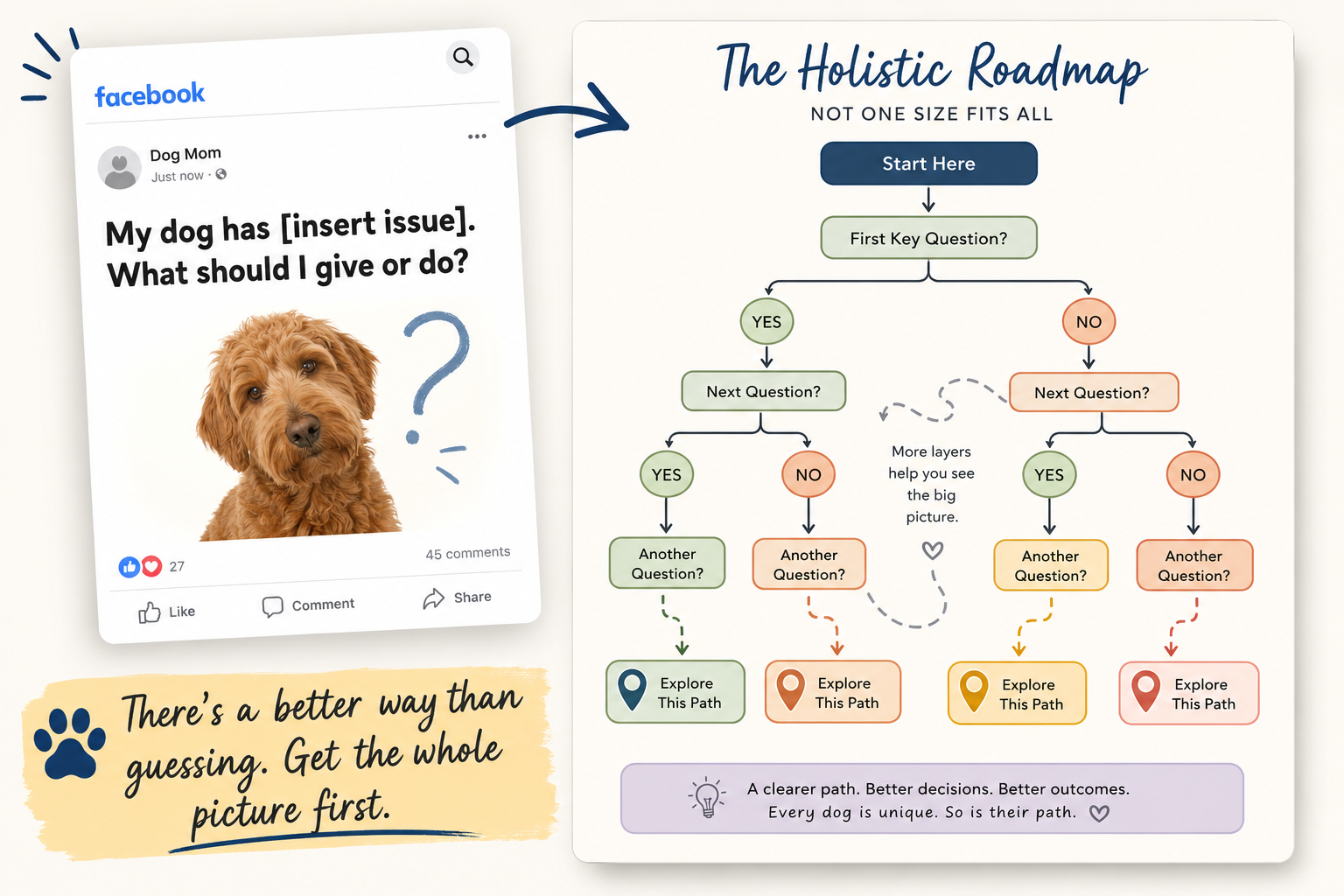
My Brain Works Like a Giant Yes-or-No Flow Chart
When you ask me a question, my brain does not reach into a filing cabinet and pull out “The Pancreatitis Protocol” or “The Allergy Supplement List.”
It starts running through a giant yes-or-no flow chart.
Is this acute or chronic? Is the dog currently stable? Is there pain, vomiting, diarrhea, reflux, appetite loss or weight loss? Has this happened before? What was happening immediately before the symptoms began? What medications and supplements are being used? What has already been tried? What helped? What made things worse? What appeared to do absolutely nothing?
Every answer changes the next question.
Then, once we make a change, every reaction from your dog—progress, a setback or no change at all—helps determine the next step.
No change is still information. Improvement is information. A flare is information.
Those responses help us decide whether to:
Continue what we are doing
Adjust the dose, timing or frequency
Pause and allow the body to settle
Remove something that may be causing problems
Simplify the plan
Choose a different modality entirely
This process may not happen after the first question. I almost always need more information, and sometimes I need to noodle on the answer.
That is not indecision. It is me trying to choose the best next step instead of the fastest answer.
I Am Not Just Checking Boxes
My recommendations are informed by education, research and experience, but I am not simply checking boxes on a form and allowing a computer to spit out a protocol.
Experience matters. Pattern recognition matters. Instinct matters. Intuition matters.
After years of working with dogs, listening to pet parents and watching how dogs respond, I often notice when part of the story does not quite fit. A detail mentioned in passing may change my direction completely. Something that looks minor on paper may feel significant once we place it into the larger picture.
Intuition does not replace veterinary diagnostics, testing or common sense. It helps me recognize which questions may need to be asked next and which part of the story deserves a closer look.
I may also look at the dog through several different lenses.
Traditional Chinese Veterinary Medicine: I may consider patterns of heat, cold, dampness, deficiency, stagnation, organ relationships, emotional balance and how symptoms fit together rather than viewing them as isolated problems.
Iridology: I may use observations from the eyes as another piece of information about constitutional tendencies or areas that may deserve closer attention. It is not a diagnosis by itself. It is one more clue.
Nutrition: I may look for food intolerances, deficiencies, excesses, poor digestion, inadequate moisture, inappropriate fat levels or a diet that simply does not suit that dog.
Behavior and nervous-system regulation: Anxiety, reactivity, inability to settle, sleep disruption and changes in behavior may tell me there is pain, discomfort, stress or nervous-system dysregulation involved.
Medical history and diagnostics: Bloodwork, imaging, medications, diagnoses and veterinary observations give us important information about what is happening medically and what requires veterinary management.
No single lens tells the entire story. The value comes from using them together and deciding what deserves priority.
Choosing the Right Modality—Not Just the First One
I have access to a lot of tools:
Fresh food and nutritional changes
Supplements
Herbs
Homeopathy
Essential oils
Mushrooms
CBD
Bodywork
Reiki and energy work
PEMF, red light and cold laser
Ozone
Microbiome support
Testing and diagnostics
Nervous-system and behavior support
That does not mean your dog needs all of them.
It also does not mean I should automatically reach for the first modality associated with the symptom.
A dog with digestive symptoms may need a food change, but pain, medication effects, stress or nervous-system dysregulation may be the more immediate problem.
A dog with anxiety may benefit from herbs or essential oils, but perhaps we first need to identify pain, improve sleep, address digestive discomfort or reduce the dog’s overall stress load.
A detox product may be useful eventually, but it may be completely wrong for a dog who is depleted, dehydrated, actively inflamed, constipated or unable to eliminate efficiently.
Sometimes the product is not wrong. The timing is wrong.
Sometimes the modality is not wrong. It simply is not the priority.
My job is not to prove how many tools I know how to use. My job is to choose the most appropriate next step for the dog standing in front of me.
Why Quick Facebook Answers Make Me Nervous
Facebook rewards fast answers. Moms are happy to run grab the next suggested product.
Shoot, I’ve even had moms buy products while I was on the phone with them before I could even collect my thoughts and map the implementation strategy.
Good health work requires better questions.
Someone asks what supplement to use, and twenty people immediately share what worked for their own dog. Most are genuinely trying to help, and personal experiences can absolutely give us ideas.
But they may know nothing about the dog’s:
Age, breed and weight
Diet and treats
Medications and supplements
Bloodwork and diagnoses
Previous reactions
Digestive history
Seizure history
Liver or kidney function
Pain level
Environment and daily routine
Those details can change everything.
A product that helped one dog may be inappropriate for another. A food that settled one dog’s digestion may flare another. An herb, mushroom, essential oil, probiotic or detox product may be useful at one stage and completely wrong at another.
“What worked for your dog?” may provide a possibility.
It cannot replace evaluating the dog in front of us.
Even in My Own Group, I Worry
This does not happen only in other Facebook groups.
Even in my own group, I see someone ask a question. I share a blog that offers food for thought. I ask a few follow-up questions—and then I hear nothing back. Nada.
And I worry.
Did they understand which suggestion might apply to their dog? Did they choose one thoughtful next step, or did they order six products and change the entire diet overnight? Did the dog improve? Did symptoms worsen? Are they still guessing?
My blogs are starting points. They explain possibilities, help you recognize patterns and give you better questions to ask.
They are not instructions to implement every suggestion in the article.
A blog cannot know your dog. A guide cannot watch how your dog responds. A Facebook comment cannot reassess the plan three days later when your dog develops diarrhea, refuses breakfast or appears more uncomfortable.
That requires communication.
I Am Becoming More Firm About Requiring Collaboration
Strict may not be exactly the right word, but I am becoming far more firm about the difference between asking me a general question and asking me to help create a plan.
You are welcome to ask questions. But when a dog has a chronic, recurring, severe, complicated or confusing condition, I may no longer be willing to keep tossing isolated suggestions into a Facebook thread.
That is not because I am withholding information, and it is not because every question is secretly a sales pitch for a consultation.
It is because the best work happens when we collaborate.
Collaboration means:
Giving me the whole history, including details you think may be unrelated
Answering my follow-up questions
Telling me what has already been tried
Sharing what helped, what caused a setback and what did nothing
Updating me when the dog improves, declines or changes
Making thoughtful changes instead of adding five things at once
Being willing to adjust the plan as your dog responds
It does not mean asking for a protocol, disappearing with the answer and returning three months later after trying twelve other things from the internet.
I cannot evaluate a process I am not allowed to see.
And frankly, I no longer want to pretend that a quick answer is enough when I know it may not be.
A Consultation Is Where the Best Work Happens
No, I am not simply being pushy about consultations.
A consultation gives us enough time to discuss the duration, frequency and severity of the condition. We can review the whole health history, current diet, medications, supplements, testing, behavior, environment, lifestyle and previous reactions.
It gives me the opportunity to ask questions you may not have known were important. It also gives me time to think, work through that internal flow chart and choose the modality—or combination of modalities—that makes the most sense now.
That is where the best work is going to happen for your dog.
It gives you a clearer path and greater peace of mind. And yes, it gives me greater peace of mind too.
I do not want to throw a suggestion into the universe and wonder whether it was understood, whether it fit the dog or whether eight other products were added alongside it.
This is not about creating the largest possible protocol.
It is about choosing the right next step.
“It Depends” Is Not a Weak Answer
I know “it depends” can be frustrating when you want immediate direction, but it is not a weak answer. It is often the most responsible one.
The solution may eventually be very simple. One food change. One supplement. Removing something that is no longer serving the dog. Supporting digestion before we try anything more complicated.
But we still have to arrive at that answer thoughtfully.
Your dog deserves more than the first remedy that comes to mind. You deserve guidance that considers the whole picture.
So when I pause, ask for more information or tell you I cannot responsibly answer based on one symptom, I am not trying to make the process harder.
I am trying to help us miss less.
Because the internet is full of answers.
The problem is that most of them are answering the question without knowing the dog.
To explore education, detailed guides and ongoing conversation, visit https://welloiledk9.com/membership.
For individualized help evaluating the whole dog and choosing the next step, begin with the questionnaire at https://welloiledk9.com/questionnaire.