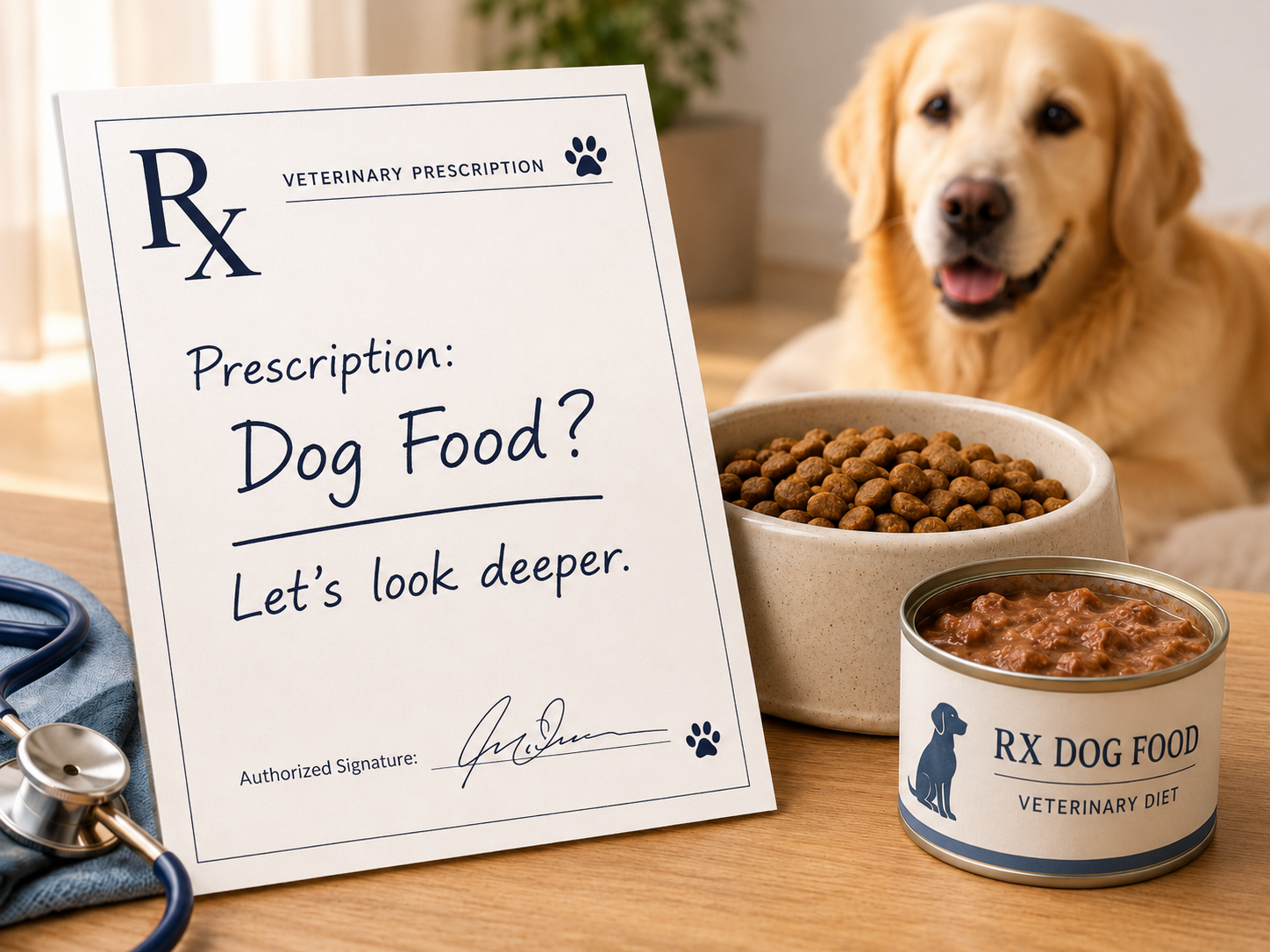
My Vet Recommended Prescription Dog Food. Do I Really Have to Feed It?
Your vet runs bloodwork, gives you a diagnosis and then says:
“We need to put her on a prescription diet.”
And there you are, already scared because your dog has kidney disease, pancreatitis, diabetes, bladder stones, liver disease, chronic gut problems, allergies, cancer—or maybe several things happening at once.
Then someone you trust to care for your dog tells you what to feed.
Of course you take the recommendation seriously.
And this is where a lot of dog moms get stuck.
You read the ingredients and think, I don't really want to feed this.
But the next thought is even louder:
What if I don't do what my vet told me and I make my dog worse?
I know that feeling.
I know what it feels like to be sitting on the other side of a scary diagnosis, trying to make the right decision for a dog you love while wondering whether questioning a recommendation means you are somehow doing the wrong thing.
It doesn't.
Asking questions about food does not mean ignoring your veterinarian.
And choosing fresh food does not mean ignoring the diagnosis.
My Position on Prescription Dog Food Is Strong
I do not like prescription kibble. I would not feed it to my own dogs, and my goal is not to leave a sick dog eating highly processed food simply because a diagnosis is printed on the bag.
I want dogs eating fresh food.
I want moisture in the bowl. I want recognizable ingredients. I want quality protein, appropriate fats, thoughtfully selected carbohydrates when they belong there, and nutrients chosen around the individual dog.
Therapeutic nutrition can be extremely important. Therapeutic nutrition and prescription dog food are not the same thing.
When a veterinarian recommends a prescription diet, I want to understand exactly what they are trying to accomplish nutritionally.
Then I want to determine how we can accomplish that with better food.
See your vet for a diagnosis and then you and I can collaborate on a custom strategy for your dog's health.
We need veterinarians.
We need diagnostics. We need lab work. We need imaging. We need medication when medication is appropriate. We need surgery when surgery is necessary. We need emergency stabilization, pain control and ongoing monitoring.
I am not trying to eliminate your veterinarian from the picture. I want better nutrition added to the picture.
You Are Not “Going Against Your Vet” By Asking About Better Food
This is important enough for its own section.
Pet parents sometimes feel like they have only two choices:
- Do exactly what the veterinarian suggested, including feeding the prescribed food forever.
- Ignore conventional veterinary care completely and figure everything out themselves.
Those are not your only choices.
Your veterinarian may be exactly right that your dog's diet needs to change.
Where I may disagree is what that diet needs to look like.
A veterinarian may tell us we need to reduce phosphorus, control fat, adjust fiber, alter a mineral, change protein exposure or influence the urinary environment.
Excellent. That gives us useful information.
Now I want to ask:
Can we meet that therapeutic goal using fresh, moisture-rich, less processed food?
That is not rejecting veterinary medicine.
That is collaborating around the dog's actual medical needs while making a different nutritional choice.
Why I Still Won't Choose Processed Food Just Because My Dog Is Sick
This is the part where my own experience influences my position.
A diagnosis does not make me suddenly care less about food quality.
Quite the opposite.
If a dog's kidneys, pancreas, liver, gut, immune system or other organs are already struggling, I do not want highly processed food becoming the nutritional foundation simply because the formulation was designed around that condition.
Most dry prescription diets are still cooked, processed, extruded, dried, coated, packaged and designed to remain shelf-stable.
That does not mean they cannot manipulate a nutrient successfully.
It means nutrient manipulation alone is not enough for me to call a food ideal.
What I know from years of working with dogs, studying canine nutrition and looking at health through a whole-dog lens is that I want the body working with:
- fresh food
- natural moisture
- quality protein
- appropriate fats
- recognizable ingredients
- appropriate vitamins and minerals
- food selected around the actual dog
I don't believe your dog is going to thrive because we found the perfect dry brown pellet for her disease.
Hill's Science Diet vs. Hill's Prescription Diet
Dog moms use these names interchangeably all the time, so let's clear it up.
Hill's Science Diet and Hill's Prescription Diet are different Hill's product lines.
Hill's Prescription Diet is the therapeutic line commonly recommended through veterinary practices for diagnosed medical concerns.
Hill's Science Diet is Hill's everyday retail food line.
But I know what people type into Google:
- Is Hill's Science Diet prescription dog food?
- What can I feed instead of Science Diet?
- What is an alternative to Hill's Prescription Diet?
- Do I have to feed Hill's k/d?
- What can I feed instead of Hill's i/d?
- Is there an alternative to Hill's z/d?
- My dog won't eat Hill's prescription food—what do I do?
Regardless of which Hill's product brought you here, my broader nutritional preference remains the same:
I prefer properly formulated fresh food over making dry processed food the foundation of a dog's diet.
What Is Prescription Dog Food Actually Trying to Do?
The valuable part of the veterinary recommendation is understanding the nutritional target.
A therapeutic food might be trying to:
- lower phosphorus
- control dietary fat
- change protein quantity or source
- alter fiber
- control sodium
- alter specific minerals
- influence urinary conditions
- reduce exposure to intact proteins
- change carbohydrate levels
- manage calories
I want that information.
The bag itself is not sacred.
Why Moisture Is One of the Biggest Reasons I Prefer Fresh Food
Moisture gets overlooked in a lot of dog-food conversations.
Fresh meat and whole foods naturally bring water into the bowl.
Dry kibble does not.
Yes, dogs drink water.
But I would much rather have part of a dog's fluid intake arriving naturally with meals—especially in senior dogs and dogs dealing with kidney disease, urinary concerns, constipation, poor appetite or chronic illness.
Fresh and gently cooked foods can also be more aromatic and appealing, which becomes very important when a sick dog doesn't feel like eating.
Why Not Just Feed Canned Prescription Dog Food?
This is a fair question.
Canned prescription food absolutely provides more moisture than dry prescription kibble.
If those were my only two choices and hydration were a concern, that additional moisture would be an advantage.
But canned prescription food is still a commercially processed therapeutic product designed around a broad disease category.
Moisture solves one problem.
It does not automatically answer my concerns about food quality, processing, protein sources, ingredient choices, individualization or whether we can create a better fresh-food strategy.
I don't want to stop at “wet is better than dry.” I want to ask whether we can do better than both.
Prescription Food Comes Up With Far More Than Kidney Disease
The prescription-food conversation happens across many of the conditions I work with.
- Kidney disease — phosphorus, moisture, calories, protein quality and muscle preservation may all need attention.
- Pancreatitis — fat tolerance, digestibility, calories and the dog's individual history change the strategy.
- Cancer — appetite, muscle, calories, quality protein, fats, carbohydrate choices, gut health and treatment tolerance become part of a much bigger conversation.
- Allergies, itching and yeast — I want to look beyond another bag and consider food history, gut health, microbiome, inflammation and environmental triggers.
- IBD, IBS and chronic digestive problems — reflux, diarrhea, EPI, PLE, poor digestion and recurring GI upset need more than a generic “sensitive stomach” label.
- Diabetes — consistency, calories, carbohydrate choices, fiber, body condition and glucose patterns need to work together.
- Liver and gallbladder disease — the actual diagnosis, lab trends, digestion, bile flow and individual nutrient needs can change the diet significantly.
- Urinary crystals and bladder stones — stone type, moisture, minerals and urinary environment all need to be considered.
- Heart disease — sodium may be part of the picture, but so are calories, muscle, quality protein, omega-3s and appetite.
- Senior dogs — older dogs often have several diagnoses at once, plus muscle loss, hydration concerns, digestion changes and reduced appetite.
This is why I do not want the diagnosis becoming the dog's entire nutritional identity.
Cancer Is Absolutely a Nutrition Conversation
There may not be one universal prescription cancer food, but I absolutely want nutrition considered when a dog has cancer.
I may be looking at:
- appetite
- weight and muscle preservation
- quality protein
- appropriate fats
- carbohydrate choices
- fresh antioxidants and phytonutrients
- gut health
- inflammation
- medications
- treatment tolerance
- what the dog will actually eat
If a body is fighting serious disease, food quality becomes more important to me—not less.
Read more in What Can I Feed My Dog With Cancer?
Allergies, Yeast and Gut Health Need More Than Another Bag
These dogs often end up on the food merry-go-round.
Chicken.
Salmon.
Lamb.
Hydrolyzed.
Prescription GI.
Another “sensitive stomach” formula.
Meanwhile the dog is still licking paws, growing yeast, getting ear infections, having loose stool or throwing up yellow foam at 5 a.m.
Food may absolutely be part of the problem.
But I also want to look at:
- gut health
- microbiome balance
- previous medications
- protein exposure
- environmental allergens
- chemicals and fragrances
- treats and chews
- stress
- inflammatory patterns
Read Could Your Dog's Gut Be Causing Itching, Yeast & Diarrhea? and Dog Allergies: Symptoms, Causes & What to Do Next.
What I Look At Before Replacing Prescription Dog Food
I want your dog off processed prescription food, but I want to do it intelligently.
That means understanding why the food was prescribed before replacing it.
| Health Concern | What I May Need to Consider | Where Generic Advice Falls Short |
|---|---|---|
| Kidney Disease | Phosphorus, moisture, protein quality, calories, sodium, potassium, omega-3s and muscle condition | A random homemade recipe can completely miss the nutritional targets we are trying to control. |
| Pancreatitis | Fat amount, fat source, digestibility, calories and tolerance | Fresh food can still be far too fatty for a pancreatic dog. |
| Cancer | Appetite, calories, muscle, protein, fats, carbohydrates, digestion and treatment tolerance | There is no single “cancer diet” appropriate for every dog. |
| Allergies / Yeast | Food history, proteins, gut health, microbiome, inflammation and environmental triggers | Changing bags repeatedly may never address why the symptoms keep returning. |
| Chronic Gut Problems | Digestibility, fat, fiber, protein, microbiome, stool, nausea and gut lining | IBD, reflux, EPI, PLE, diarrhea and pancreatitis are not the same nutritional problem. |
| Diabetes | Meal consistency, carbohydrate load, calories, fiber, weight and glucose patterns | Major food changes need to make sense alongside glucose management. |
| Urinary Stones | Stone type, hydration, minerals and urinary environment | Different stones can require very different strategies. |
| Liver / Gallbladder | Diagnosis, lab trends, bile flow, digestion, protein tolerance and individual mineral concerns | “Liver diet” is far too broad without knowing what is happening. |
| Senior / Multiple Diagnoses | Muscle, hydration, calories, cognition, digestion, medications and organ function | One disease-specific bag may target one issue while ignoring several others. |
Do Not Throw the Prescription Food Away Tonight Just Because I Hate It
Strong opinions still require common sense.
If your dog just came home with acute pancreatitis, uncontrolled diabetes, significant kidney abnormalities, urinary stones or another serious medical problem, this is not the moment for nutritional improv night.
I don't want you reading half this article, tossing the Hill's bag and replacing it with ground beef and sweet potatoes because they look healthier.
I want to understand what your veterinarian was trying to control.
Maybe it was phosphorus.
Maybe it was fat.
Maybe it was a mineral.
Maybe it was protein exposure.
Maybe it was fiber or urinary chemistry.
The processed food is not sacred. The nutritional target is.
Once we understand that target, we can build the better plan.
Can Fresh Food Replace Prescription Dog Food?
In many cases, I believe properly formulated fresh food is the better nutritional direction.
But properly formulated is important.
Fresh chicken and vegetables are fresh.
They are not automatically an appropriate kidney diet.
A beautiful raw beef meal is fresh.
It may still be much too fatty for a particular pancreatitis dog.
Sardines are real food.
That does not mean I add them freely to a diet where phosphorus needs to be tightly controlled.
There is a difference between feeding fresh and formulating therapeutic fresh nutrition.
That difference is where I can help.
Learn more about my customized dog food and fresh-food planning.
I Am Not Anti-Vet. We Need the Vet.
I want this very clear: I am not suggesting you stop seeing your veterinarian because I disagree with prescription food.
I want the veterinarian involved.
I want the diagnosis.
I want the bloodwork and urinalysis.
I want imaging when it is needed.
I want appropriate medication, pain control, surgery, emergency care and stabilization when the dog needs them.
And I absolutely want follow-up testing so we can see whether what we are doing is actually helping.
What I do not believe is that accepting veterinary diagnostics means I must also accept processed food as the best long-term nutrition.
Those are two separate decisions.
I want pet parents comfortable asking their veterinarian:
- Why are you recommending this particular food?
- What nutritional variable are we trying to change?
- What lab values are we watching?
- Is this intended to be temporary or lifelong?
- What would tell us it is working?
- Can I meet these nutritional goals using a properly formulated fresh diet?
You do not need to pick a fight with your veterinarian.
You need information.
Then you can make an informed decision about how you want to feed your dog.
The Diagnosis Is Only Part of the Food Plan
As a holistic pet health coach, Holistic Canine Health Practitioner and canine nutritionist, I look beyond the diagnosis printed at the top of the chart.
I may consider:
- age
- breed and size
- duration of symptoms
- severity and frequency
- food history
- treats, chews, toppers, oils and scraps
- medications
- supplements
- lab trends
- other diagnoses
- stool history
- weight and muscle condition
- appetite
- nausea
- gut health
- liver and gallbladder clues
- kidney function
- endocrine issues
- immune and inflammatory patterns
- stress and nervous-system patterns
TCVM can help identify patterns such as heat, dampness, stagnation, deficiency, digestive weakness and inflammation.
Muscle testing may help guide tolerance and direction in sensitive or complicated dogs.
Experience helps me recognize patterns, ask better questions and avoid wasting months throwing random food and supplements at the dog hoping something sticks.
Fresh Food Is the Foundation, But It May Not Be the Whole Strategy
Depending on the dog, I may also consider support involving:
- microbiome support
- probiotics
- digestive support
- gut-lining support
- omega-3 fats
- minerals and electrolytes
- herbs
- homeopathy
- essential oils
- medicinal mushrooms
- CBD
- liver and gallbladder support
- TCVM pattern support
- PEMF
- Reiki
- massage or bodywork
- stress and nervous-system support
That is deliberately not a protocol or shopping list.
Your dog does not need everything.
And adding eight supplements to processed food while leaving foundational nutrition untouched is rarely where I want to begin.
When Veterinary Care Comes First
Please do not let a food disagreement delay necessary medical care.
See your veterinarian promptly if your dog has:
- repeated vomiting
- severe diarrhea
- blood in vomit or stool
- abdominal pain
- collapse or extreme weakness
- difficulty breathing
- pale gums
- jaundice
- significant dehydration
- difficulty or inability to urinate
- seizures
- rapid or unexplained weight loss
- significant appetite loss
- worsening kidney, liver, pancreatic, cardiac or endocrine disease
Vet first when your dog needs medical care.
Then let's use what we learn to build a better nutritional plan.
You're Allowed to Want Something Better Than the Bag
If you walked out of the veterinary office carrying Hill's Prescription Diet, Royal Canin, Purina Veterinary Diets or another prescription food and your gut is telling you, “There has to be a better way to feed my dog,” I understand.
You also do not need to choose between blindly feeding it forever and trying to formulate a medical diet from Google tonight.
Bring me the diagnosis, lab work, current food, medications, supplements, symptoms and history.
I can help you understand what the prescription food was trying to accomplish, what I see in the bigger picture and what a fresher nutritional strategy may look like for your dog.
Sometimes that means a customized fresh recipe. Sometimes a whole-food therapeutic diet can provide a useful bridge. Sometimes we transition in stages while the veterinarian continues monitoring labs.
We are not eliminating your vet.
We are building better nutrition around the medical information your vet helps us obtain.
Because the goal isn't simply to get rid of the prescription bag.
The goal is to feed your dog better and support the whole dog for the long haul.
Request a Discovery Callback Explore Customized Dog FoodPrescription Dog Food Questions Dog Moms Ask Me
I'm scared to stop the prescription food my vet recommended. What should I do?
I understand that fear.
Your veterinarian diagnosed a medical problem and recommended a food for a reason. I do not want you ignoring that reason.
I want to understand what the therapeutic diet is designed to accomplish, review the diagnosis and lab work, and then determine whether we can meet those nutritional needs with a properly formulated fresh-food strategy.
Choosing better food does not require eliminating your veterinarian from your dog's care.
Am I going against my vet if I don't want to feed prescription dog food?
No. You can value your veterinarian's diagnosis and medical expertise while still asking questions about nutrition.
The useful conversation is: What is this prescription food trying to change? What labs are we monitoring? Can those therapeutic nutritional goals be achieved with a fresh-food diet?
I want collaboration, not an either-or fight between veterinary care and fresh nutrition.
Is Hill's Science Diet the same as Hill's Prescription Diet?
No. Hill's Science Diet and Hill's Prescription Diet are separate product lines.
Hill's Prescription Diet is the therapeutic line commonly recommended through veterinary practices. Hill's Science Diet is the everyday retail line.
I include terms like “Hill's Science Diet prescription dog food” because that is how many pet parents search for it.
Why don't you recommend prescription dog food?
My concern is not that therapeutic nutrition has no value. It absolutely can.
My concern is using highly processed food as the long-term nutritional foundation when I believe we can often meet the same therapeutic goals using fresher, moisture-rich, more individualized food.
I want to preserve the nutritional strategy—not the processed bag.
Why is moisture important in dog food?
Fresh food naturally brings water into the meal instead of relying entirely on the dog's drinking behavior.
I especially value dietary moisture in senior dogs and dogs with kidney concerns, urinary problems, constipation, poor appetite and chronic illness.
Moisture is one of the major reasons dry food is not my preferred foundation.
Why not feed canned Hill's Prescription Diet instead of dry?
The added moisture is absolutely an advantage over dry kibble.
But canned prescription food is still a commercially processed therapeutic food.
More moisture does not automatically resolve my concerns about processing, ingredient quality, protein sources or individualization.
I would rather ask whether we can meet the therapeutic nutritional goals with a fresher whole-food diet.
Does my dog have to stay on prescription food forever?
Not automatically.
Some medical conditions require lifelong therapeutic nutrition. That does not necessarily mean lifelong prescription kibble.
The diagnosis, lab trends and nutritional goals should guide the plan.
Can I feed homemade food instead of Hill's Prescription Diet?
Potentially, yes.
But the homemade food needs to address the reason Hill's Prescription Diet was recommended.
A generic homemade recipe is not automatically appropriate for kidney disease, pancreatitis, diabetes, urinary stones, liver disease or serious GI disease.
Can dogs with kidney disease eat fresh food instead of prescription kidney food?
Fresh food can be formulated for kidney disease, but phosphorus, protein quality, moisture, calories, sodium, potassium, omega-3s, appetite and muscle preservation may all need consideration.
This is not a situation where I recommend grabbing a random internet recipe.
Can dogs with cancer eat fresh food?
Nutrition is one of the areas I look at closely in a dog with cancer.
Appetite, muscle maintenance, quality protein, fats, carbohydrate choices, gut health, inflammation and treatment tolerance may all influence the food strategy.
There is no universal cancer diet for every dog.
Can fresh food help dogs with allergies, yeast or gut problems?
Fresh food can be an important part of the strategy, but I also want to understand why the symptoms are recurring.
Food history, protein exposure, microbiome health, medications, environmental triggers, treats, chews and inflammatory patterns may all belong in that conversation.
Can dogs with pancreatitis eat fresh food?
Many can, when the diet is appropriately formulated.
Fat amount, fat source, digestibility, calories, protein and the dog's history and tolerance all need to guide the plan.
Fresh does not automatically mean low fat.
What if my dog refuses to eat Hill's Prescription Diet?
First determine whether nausea, pain, dehydration, reflux, medication effects, dental pain or disease progression may be affecting appetite.
If a medically compromised dog suddenly stops eating, address that with your veterinarian.
Then we can talk about a more appealing food strategy that still respects the nutritional needs of the diagnosis.
Can I add fresh food or toppers to prescription kibble?
Sometimes, but enough toppers can significantly change phosphorus, fat, minerals, calories or protein exposure.
I would rather make additions intentionally or transition toward a properly formulated fresh-food plan than dismantle the therapeutic strategy one topper at a time.
What is a natural alternative to Hill's Prescription Diet, Royal Canin or Purina Veterinary Diets?
There is no one product that replaces every prescription diet.
Depending on the dog, the alternative might involve a customized fresh recipe, gently cooked food, appropriate raw food, or a whole-food therapeutic diet.
The diagnosis, labs, symptoms, medications and nutritional target determine what makes sense.
Ready to Talk About Getting Your Dog Off Prescription Food?
If you want to feed your dog better but are scared to make the wrong move because of kidney disease, cancer, pancreatitis, allergies, gut disease, diabetes, urinary problems, liver disease or another diagnosis, that is exactly when personalized help makes sense.
You do not have to choose between your veterinarian and fresh food.
We need the veterinarian's medical information. Then we use that information to make smarter nutritional decisions.
Request a Discovery CallbackEducational information only. I am not a veterinarian and do not diagnose disease, prescribe medication or replace veterinary care. Dogs with diagnosed medical conditions should receive appropriate veterinary diagnostics and monitoring. Nutrition plans should take the dog's diagnosis, laboratory findings, medications, symptoms and individual needs into account.