The Trust Technique, Trauma, and the Time It Really Takes to Build Confidence
I took the Trust Technique class, and it makes sense. I do not formally practice the Trust Technique exactly as the official program was created, and I am not presenting myself as a Trust Technique practitioner. But as I worked through the material, I realized that many of its underlying principles are already woven into nearly everything I teach. My work with dogs has never been only about getting them to perform a particular behavior. I am much more interested in what is happening underneath that behavior. Why can’t the dog get into the car? Why does he panic when Mom reaches for the leash? Why does she begin trembling before anyone has touched her nails? Why does a dog who appeared perfectly settled suddenly become anxious when someone picks up the keys, puts on a particular pair of shoes or walks toward the front door?
Those reactions are not usually about stubbornness, disobedience, manipulation or a dog trying to control the household. They are often about the dog’s nervous system deciding that something feels unsafe, even when we know there is no immediate danger. That is where the Trust Technique naturally overlaps with my work. Whether I am talking about trauma, fear, reactivity, separation anxiety, car rides, veterinary visits, grooming or cooperative care, I keep coming back to the same basic principles: slow yourself down, reduce the pressure, stop focusing only on finishing the task and begin paying closer attention to what the dog is communicating. Break difficult experiences into manageable pieces, repeat those pieces until they become familiar and help the dog discover that the situation can have a different outcome instead of repeatedly pushing them through the same old fear response.
Nutrition, herbs, mushrooms, essential oils, bodywork and other forms of nervous-system support can absolutely be part of this process. They may help lower the dog’s overall stress load, support physical comfort and make learning more accessible, but none of them can replace what happens between the dog and the human during a difficult moment. A calming supplement cannot undo a pattern we continue rehearsing every day. When the dog becomes fearful and the person immediately becomes tense, shortens the leash, repeats commands, rushes the process or emotionally falls apart with them, both sides are practicing the same cycle again. The goal is not to become cold, detached or unsympathetic. The goal is to remain steady enough that we do not join the panic.
Your dog does not need you to become afraid because they are afraid. Your dog needs you to remain connected to the sense of safety they cannot access yet.
Trust Comes Before Cooperation
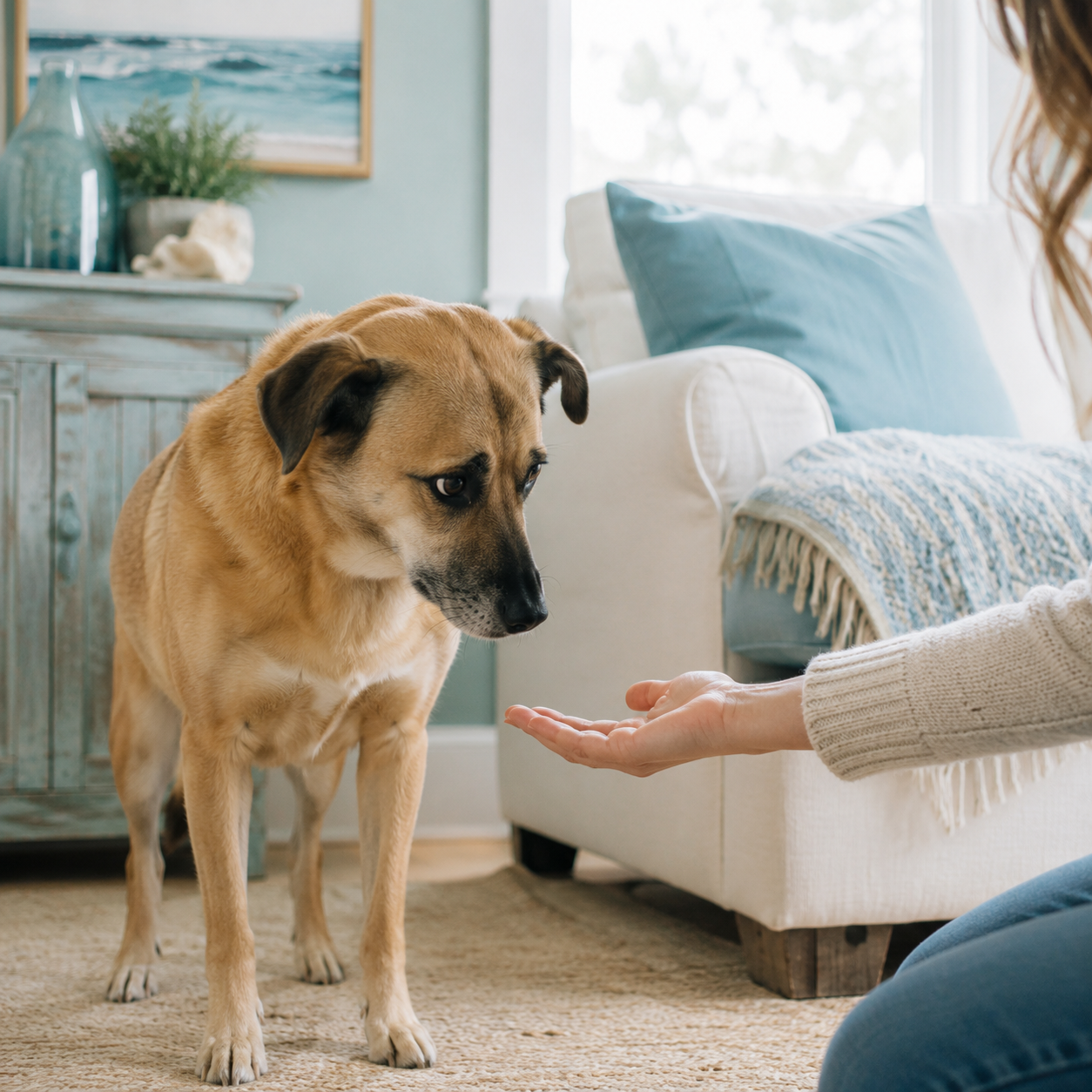
We often expect dogs to cooperate before they feel safe. We ask them to get into the car, walk into the veterinary clinic, allow someone to examine a painful area, hand over a paw, remain home alone or tolerate grooming, and then we become frustrated when they resist. But resistance is often communication. The dog may not understand what is about to happen. They may remember that the experience frightened or hurt them before. They may feel trapped, overwhelmed or unable to escape, or they may be reading the tension in the person handling them and deciding there must be a reason to worry. Trust-based work changes the order. We first create enough safety for the dog to remain present and think, and then cooperation becomes more possible.
That does not mean the dog gets to avoid every uncomfortable experience forever, nor does it mean necessary veterinary care should be postponed indefinitely. There will be moments when something simply has to be done. But during the many times when we do have options, we need to stop expecting useful learning while the nervous system is screaming for the dog to escape. A frightened dog is not carefully considering our request and deciding to be difficult. The dog is responding to what their brain and body believe is a threat.
We Are Thinking About the Destination. The Dog Is Thinking About Step One.
Time may be one of the biggest stumbling blocks for pet parents because we are almost always thinking about the completed task. We need to get to the store. We have a veterinary appointment. The groomer is waiting. The nails need to be trimmed. We have to leave for work. We promised the dog a pup cup. Meanwhile, the dog may still be thinking, I cannot get into the car. We are thinking about where we are going, while the dog is struggling with the very first step required to get there.
You know the ride will take five minutes and end with whipped cream. Your dog may know only that the car has previously meant nausea, confinement, noise, loss of balance or a frightening trip to the veterinarian. You are ten steps ahead while the dog is still trying to work through step one. That mismatch creates pressure. We start coaxing, repeating ourselves, tightening the leash, offering increasingly desperate treats, picking the dog up or insisting that they follow through because we have somewhere to be. We may complete the task, but we have not necessarily built trust. In fact, we may have taught the dog that hesitation will not be respected and that taking the first step means being pushed through every step that follows.
Fear can then begin spreading backward through the sequence. The dog who was once afraid only after the car began moving may eventually become worried when the garage door opens. Then the keys become a trigger. Then the shoes. Eventually, the dog disappears when they hear the words “car ride.” The destination is no longer the only problem because every earlier cue now predicts the entire frightening experience.
We are focused on completing the journey. The dog is still trying to feel safe enough to begin it.
Practice Before You Need the Skill
The morning of a veterinary appointment is not the best time to teach a frightened dog to enter the car. The day you return to work is not the time to begin addressing separation anxiety. The moment you discover an overgrown, torn or painful nail is not the ideal time to introduce paw handling. Once a task becomes urgent, the human begins operating against the clock, and urgency changes our breathing, posture, voice, timing and patience. We may believe we are acting normally, but the dog can often feel that the entire interaction has changed.
Trust work needs to happen when there is no appointment, no deadline and no requirement to finish. You might walk toward the car and then return to the house. You might open the door, allow the dog to look inside and end the session. You might touch one paw and stop. You might pick up your keys, put them back down and go make coffee. You might visit the veterinary clinic, step onto the scale, collect a treat and leave without an examination. That may not look like much from the outside, but those quiet, uneventful repetitions are often where real learning happens.
The dog begins discovering that approaching the car does not always lead to being forced inside. Having a paw touched does not always mean all four feet will be restrained and trimmed. Seeing the keys does not always predict being left alone for six hours. Walking into the veterinary lobby does not always mean needles, restraint or discomfort. Little by little, the dog’s prediction begins to change.
The Repetition Is the Work
I want you to think about how many repetitions a trainer may complete during a lesson. A trainer does not usually ask for a behavior once, watch the dog struggle through it and then declare the skill learned. They repeat the exercise. They adjust the distance, timing or environment. They break the exercise into smaller pieces and practice the same portion again and again until the dog understands it with less hesitation and less effort.
Now think about what happens in a board-and-train program. Whatever your personal feelings may be about those programs, the dog is likely receiving many repetitions throughout the day. The trainer may practice approaching a doorway, pausing at the threshold, entering calmly and exiting calmly. They may repeat that sequence after a break and then practice it in another location. The same small skill may receive dozens of repetitions. Then Mom brings the dog home, tries it twice and says, “He still won’t do it.” Friend, two repetitions are not a learning history.
The trainer cannot send hundreds of successful repetitions home in the dog’s suitcase. The pet parent has to continue the work between lessons. That does not mean drilling the dog for an hour or repeating an exercise until everyone is miserable. It means practicing one small, manageable piece often enough that it no longer requires significant thought, effort or emotional struggle. Do the repetitions until the dog is no longer bracing or hesitating. Do them until you no longer need to coax, pull or heavily prompt. Do them until the step feels familiar, predictable and almost boring. Then move to the next segment.
Do not move forward simply because the dog survived the step once. Surviving an experience and feeling confident about it are not the same thing. We tend to celebrate completion, but the more important question is how the dog completed it. Did they volunteer? Were they able to think? Did their body remain soft? Could they recover quickly? Or did they freeze, shut down, scramble, tremble or simply give up because they learned that resistance would not change the outcome?
Move forward when the step has become easy, familiar and nearly effortless—not simply because it has been completed once.
There is an important difference between repeating a manageable experience until it becomes familiar and repeating an overwhelming experience until the dog stops resisting. A dog who freezes, disconnects or gives up has not necessarily become comfortable. They may have simply learned that their communication does not matter. Useful repetition should gradually produce softer body language, easier participation, less hesitation, more curiosity and faster recovery. Three calm repetitions may be far more valuable than twenty stressful ones. We are not trying to exhaust the resistance out of the dog. We are helping the dog discover that the experience is predictable, manageable and safe enough to participate in.
Break the Experience Into Smaller Pieces
For a dog who is afraid of the car, “take a car ride” is far too large of a task. The actual process may begin with walking toward the driveway and returning home. Once that becomes easy, the dog may approach the parked vehicle. Later, they may stand near an open door, place one paw inside, enter and immediately exit or sit in the vehicle without the engine running. Only after those pieces become familiar would we consider closing the door, turning on the engine, backing out of the driveway or driving around the block.
Every segment may need to be repeated several times over several days, and some dogs will need far longer. The repetition is not delaying the real work. The repetition is the work. The dog is learning that each step is predictable and that they will not automatically be pushed into the next stage. They are also learning that their person notices discomfort and adjusts before the dog reaches panic. That lesson is far larger than learning to get into a car. The dog is learning that the human can be trusted during uncertainty.
Applying This to Trauma Recovery
Trauma recovery is not about convincing a dog that the past did not happen. It is about creating enough safe experiences in the present that the past no longer controls every response. A dog with a trauma history may react to hands, collars, confinement, raised voices, particular rooms, certain people, equipment, sounds or surfaces. The reaction may appear disproportionate to what is happening now because the nervous system is not responding only to what is happening now. It is responding to what happened before and what it believes may happen next.
For a dog who is afraid of having the collar touched, the work may begin with the person simply sitting nearby without reaching. Later, the person moves one hand slightly. Then they may touch the shoulder. Eventually, the hand moves toward the neck, briefly touches the collar and releases. The leash may not be attached for days. That is not indulging fear. It is giving the dog enough time and repetition to form a different expectation: A hand moved toward me, but I was not grabbed, trapped or hurt.
Trauma recovery is often built through hundreds of quiet moments that look uneventful from the outside. You can read more about this in Trauma Imprints in Dogs and Understanding PTSD and Survival Responses in Dogs.
Applying This to Separation Anxiety
Separation anxiety also needs to be broken into much smaller pieces than most people expect. The initial goal is not to reach thirty minutes, two hours or a full workday as quickly as possible. The first goal may be helping the dog remain settled while the person stands up, walks across the room, touches the doorknob or steps behind a doorway for one second. Picking up the keys may be an entire exercise. Putting on shoes may be another. Opening and closing the front door may need to be practiced without leaving.
If the dog begins pacing, panting, vocalizing, scratching at the door or refusing food, the step was probably too large. The dog does not learn independence by repeatedly experiencing panic. Duration should increase according to what the dog can comfortably handle, not according to how long the person eventually needs to be gone. Herbs, essential oils and other calming support may help lower the overall stress level, but the learning still has to occur in those small, successful repetitions. For more, see How to Resolve Separation Anxiety and Essential Oils for Dogs With Separation Anxiety.
Applying This to Car Rides
Car stress may involve emotional fear, physical nausea or both, and that distinction matters. A dog who drools, lip-licks, swallows repeatedly, refuses food or vomits may be dealing with motion sickness in addition to anxiety. Once physical contributors have been considered, car work still needs to be built in small segments. Approaching the car, entering the car, remaining inside a stationary car and riding in a moving car are separate skills. The dog may be comfortable with one and terrified of the next.
Do not assume that because the dog jumped inside once, they are ready for a thirty-minute drive. Repeat each segment until it feels easy before adding another layer. You can find additional support in Resolve Your Dog’s Car Stress and How to Keep Your Dog From Getting Car Sick.
Veterinary Visits, Grooming and Cooperative Care
Veterinary visits are often a stack of triggers rather than one single fear. The dog may be coping with the car ride, unfamiliar smells, slippery floors, barking animals, restraint, physical discomfort, equipment and a worried owner before the examination even begins. Whenever possible, practice individual pieces when no medical care is needed. Walk into the lobby and leave. Step onto the scale. Enter an examination room without having an examination. Practice standing on a non-slip mat. Introduce gentle body handling at home. Teach a chin rest or positively condition a basket muzzle before either is urgently needed.
When every veterinary visit includes restraint, discomfort or needles, the dog has no reason to predict anything different. Neutral visits help create another possibility. During necessary appointments, pet parents may also be able to request waiting in the car, a quieter room, minimal restraint, a floor-level examination, non-slip surfaces, additional time or pre-visit support when appropriate. Emergencies are different, and when immediate care is needed, we do what must be done. Routine care, however, gives us much more opportunity to prepare.
The same principle applies to nail trims and grooming. Most pet parents are focused on finishing all four paws while the dog may still be struggling with having one leg touched. Nail work may begin with the dog resting on a mat while the clippers are visible across the room. Later, the dog hears the clippers close without being touched. The person may touch the shoulder, move a hand down the leg, briefly hold the paw and release. Eventually, the tool touches one nail, and one calm nail may be the entire session. Four paws completed through panic may technically finish the job, but it often makes the next session more difficult.
Slow Is Often Faster
Moving slowly can feel frustrating when all you want is the final result, but pushing too hard and too fast can create a larger reaction, stronger anticipation and more resistance the next time. It may take weeks or months to untangle a pattern that became deeply rehearsed because the dog was repeatedly pushed beyond their readiness. Going slowly now is often faster than repairing damaged trust later.
Sometimes we also need to move backward. A dog may handle several short drives beautifully and struggle on the next attempt. Pain, poor sleep, digestive discomfort, an earlier stressor, weather or simple fatigue may change what the dog can manage that day. Return to the last step that felt easy. Going backward one segment is not failure. It protects the progress already made. There is no prize for reaching the final step quickly.
Progress is not measured only by whether the dog completed the task. Look for less hesitation, softer posture, faster recovery, more voluntary participation and less need for prompting. Notice whether curiosity is beginning to replace avoidance. A dog who calmly walks halfway to the car and returns home may have made more meaningful progress than a dog who was dragged inside and transported across town. Completion and progress are not always the same thing.
Before beginning, ask yourself whether you are in a hurry, whether you need the exercise to work today and whether you are watching your dog or focusing only on the result. Ask whether you have repeated the current step enough for it to feel genuinely easy and whether you are willing to stop after one successful attempt. Trust grows when the dog learns that the human notices, adjusts and does not repeatedly force them beyond their readiness. That does not mean avoiding challenge forever. It means introducing challenge in an amount the dog can process, learn from and recover from.
Confidence is not built through one giant breakthrough. It is built through quiet, successful repetitions that gradually teach the dog: I understand what is happening. I can handle this. My person is listening, and I am safe enough to try.
My Take on the Trust Technique
The Trust Technique® was developed by James French as a mindfulness-based approach intended to build trust and cooperation between people and animals. Its formal teachings include concepts such as Mindful Regard, Creative Reaction, Realisation Learning, Trusted Cooperation and Communication Healing.
I took the class and found that many of its central ideas align naturally with the way I already approach canine behavior, trauma recovery, nervous-system regulation and holistic wellness. I do not teach or represent the formal Trust Technique program. What I am sharing here is my interpretation of how presence, observation, emotional regulation, incremental learning and trust can be incorporated into the work we are already doing with our dogs.
For years, I have encouraged pet parents to nourish the body, support the nervous system, lower inflammation, understand trauma, stop rushing and truly observe the dog in front of them. The Trust Technique gave additional language to many things I was already trying to teach, and I think that is why it resonated with me.
Sometimes the greatest gift we can give our dogs is not another command, another correction or even another supplement. Sometimes it is more time, more patience, more thoughtful repetition and far less pressure.