
Dog Allergies and Behavior
Can Dog Allergies Cause Behavior Changes?
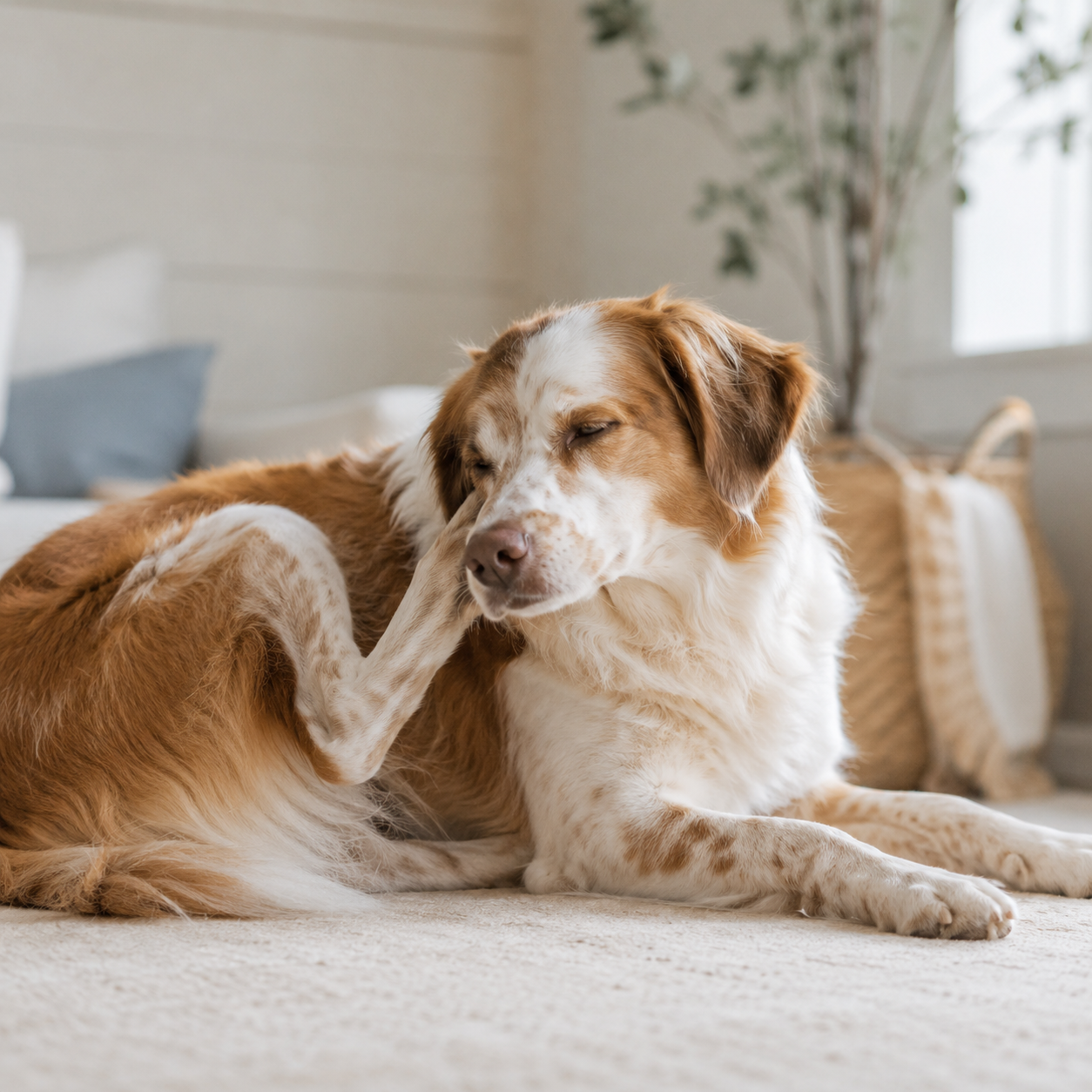
Your dog starts scratching. Then licking. Then the ears flare. Maybe the paws are red, the skin is hot, sleep gets restless, and suddenly the easygoing dog you knew seems more anxious, touchy, reactive or quick to snap.
Pet parents often treat those as two completely different problems: the veterinarian handles the skin and the trainer handles the behavior.
I don't think we should separate them that quickly.
The Skin and the Behavior Are Happening in the Same Dog
Think about yourself when you are miserable.
Maybe you have not slept well for three nights. Your skin burns or itches. Your stomach hurts. Your ear aches. You are already exhausted before anybody touches you, crowds you or asks you to do something you do not want to do.
Your patience probably is not at its lifetime high.
Dogs do not get to tell us, “My ears hurt today, please don't grab my collar,” or “I have been awake scratching since 2 a.m. and that other dog is getting on my last nerve.”
They communicate with behavior.
What Does the Research Say About Dog Allergies and Behavior?
This connection is not simply something holistic practitioners have imagined.
A 2022 study evaluated dogs with chronic pruritus and atopic dermatitis using a validated canine behavior questionnaire. Compared with healthy dogs, the itchy atopic dogs showed significantly more fear- and anxiety-related behaviors and aggression.
Another canine study involving hundreds of dogs found that increasing itch severity was associated with more behaviors commonly linked with stress, including hyperactivity, excitability, attention-seeking and displacement-type behaviors.
These studies show association rather than proving that itching directly causes every behavioral change. But they make one thing very difficult to dismiss:
Chronic itching is not merely a cosmetic skin problem.
Why Would an Itchy Dog Become Reactive or Aggressive?
Aggression is often discussed as though it appears in a vacuum.
But tolerance has a physical component.
The dog whose paws are burning may not want them handled. The dog with painful, inflamed ears may react when someone reaches toward his head. The dog who has been chewing his skin all night may have less patience with a puppy climbing on him the next morning.
That does not mean aggression becomes acceptable or that safety stops mattering.
It means the physical discomfort belongs in the explanation.
“He Suddenly Snaps When I Touch Him.”
When an otherwise tolerant dog becomes touch-sensitive, I want pain and physical discomfort high on the list.
Look at the ears. Paws. Skin. Belly. Back. Joints. Teeth. Anal glands. GI comfort. Anywhere the dog might reasonably anticipate discomfort from handling.
Do not assume he suddenly forgot his manners.
Sudden aggression always deserves a broader look, particularly when it overlaps with inflammation, itching, digestive changes, poor sleep or other physical signs.
Read: Sudden Aggression in Dogs — Liver, TCVM & Whole-Dog Support →
The Itch-Stress Cycle Can Work in Both Directions
An itchy dog can become stressed.
A stressed dog can also have a harder time with inflammatory and digestive patterns.
That is one reason chronic allergy cases can become so frustrating. The body does not necessarily respect the categories we put on a website.
Skin, nervous system, immune function, digestion, sleep and behavior are constantly influencing the same animal.
An uncomfortable dog may spend more time activated and less time genuinely resting. If your itchy dog also seems permanently “on,” unable to settle or increasingly reactive as the day goes on, read this next.
Read: The Over-Aroused Dog — When Your Dog Can't Settle Down →
What Does the Gut Have to Do With Allergies and Behavior?
Quite a lot can happen at this intersection, but I want to be more precise than simply saying, “Dysbiosis causes allergies and aggression.”
The gut microbiome participates in digestion, immune signaling, inflammatory regulation and communication along the gut-brain axis. The skin has its own microbiome as well. In allergic disease, barrier function, immune responses and microbial communities can all become part of a much larger picture.
At the same time, research continues to explore associations between the canine microbiome and behavioral traits.
That does not mean every itchy dog has one identical microbiome problem, or that changing gut bacteria is a guaranteed cure for aggression.
It does mean I am very interested when the same dog has:
When those things travel together, I do not want six disconnected plans.
I want to understand the dog.
If itching, yeast, diarrhea, ear problems and food sensitivities keep cycling through your house, this article goes much deeper into why the gut deserves attention.
Read: Could Your Dog's Gut Be Behind the Itching, Yeast, Diarrhea and Allergies? →
And for the behavior side of the gut-brain axis:
Read: How Your Dog's Gut Influences Their Brain and Behavior →
What About Antibiotics?
Allergy dogs often have another important piece in their history: repeated treatment for secondary skin and ear infections.
Sometimes antibiotics are medically necessary. A bacterial infection still needs appropriate care.
But if the same dog repeatedly cycles through itchy skin, ear infection, antibiotics, improvement and then another flare, I do not want to look only at the organism we killed.
I want to know why the skin or ears remain vulnerable enough for the cycle to keep repeating, what happened to the gut during repeated medication exposure, and whether digestion or behavior changed along the way.
Read: The Hidden Link Between Antibiotics and Anxiety in Dogs →
Stopping the Itch Is Not the Same as Solving the Whole Case
This is an important distinction.
If your dog is scratching himself raw, cannot sleep, has infected ears or is miserable in his own skin, relief matters.
I am not interested in letting a dog suffer because we have decided symptom relief is somehow philosophically impure.
Veterinary treatment may be appropriate to control severe inflammation, infection or pruritus while we investigate the bigger pattern.
Where I disagree with the quick-fix approach is when symptom control becomes the entire long-term strategy even though the dog keeps cycling back into the same problem.
So What Am I Looking For Beyond the Itch?
Once the dog is safe and appropriately comfortable, I start asking why this particular dog's system is so reactive.
The answer is not automatically one food, one supplement or one diagnosis.
| Area I Review | Why It Matters |
|---|---|
| Food & nutrition | I want a fresh-food foundation that appropriately supplies protein, fats, minerals, antioxidants and moisture while avoiding ingredients the individual dog does not tolerate well. |
| Gut health | Stool, digestion, microbiome history, antibiotics, food tolerance and GI inflammation can give me important clues about immune and inflammatory resilience. |
| Skin & ears | I want to know whether we are dealing with true allergy, infection, yeast, parasites, contact irritation, barrier problems or multiple issues at once. |
| Environment | Pollen, grasses, mold, dust, cleaning products, fragrances, laundry products, lawn treatments and other exposures may contribute to the total load. |
| Stress & sleep | Chronic stress, poor recovery and disrupted sleep can reduce how well the dog copes physically and behaviorally. |
| Pain & discomfort | Ear pain, inflamed paws, secondary infection and sore skin may directly affect handling tolerance and reactivity. |
| Medication history | Steroids, antibiotics, allergy medications and other treatments belong on the timeline so we can understand what changed, what helped and what keeps returning. |
| Behavior timeline | I want to know whether anxiety, aggression or reactivity began before the allergies, during a major flare, after repeated illness, or independently. |
Fresh Food Is Part of My Foundation
When I work with chronic allergy cases, nutrition is not an afterthought.
I want the body receiving real, moisture-rich, minimally processed food as the foundation whenever possible.
That does not mean there is one magical “allergy diet.”
Some dogs need a temporary simplified diet. Some need protein changes. Some need more careful fat selection. Some do poorly with foods that another allergy dog thrives on. TCVM food energetics may also influence the choices I make for a dog who presents red, hot and inflamed versus one who is depleted or chronically cold.
The goal is not to remove foods forever until the dog is living on three ingredients.
The goal is to create a nutritional foundation the individual dog's digestive and immune systems can handle while we work on the deeper pattern.
Read: Dog Allergies — What May Be Causing Your Dog's Itchy Skin →
Read: Can Dog Food Affect Behavior? Nutrition, Anxiety, Aggression & Reactivity →
When the Dog Is Red, Hot, Itchy AND Reactive
This is where my TCVM lens becomes especially useful.
I am not saying every allergic dog has a Liver problem, and I am not diagnosing conventional liver disease because a dog scratches.
But when I see the combination of red-hot skin, inflamed ears, paw licking, irritability, frustration, restlessness and explosive behavior, I pay attention to the pattern.
In Traditional Chinese Veterinary Medicine, the Liver belongs to the Wood element. Wood patterns can involve frustration, rigidity, stagnation and heat, and some dogs show physical and emotional “heat” at the same time.
That is why an aggression case with red skin, itchy paws, inflamed ears and a short fuse gets my attention differently from aggression in a dog with none of those signs.
Read: TCVM Wood Element — Liver, Skin, Reactivity & Red-Hot Flare-Ups →
Read: Red-Hot Aggression in Dogs — It's Not Just Behavior →
Can Natural Wellness Support Help the Itchy, Stressed Dog?
Yes, but I do not use natural modalities as an excuse to ignore a painful infection, severe allergic reaction or a dog scratching himself bloody.
Once I understand the individual dog, supportive work may include nutrition, targeted gut support, appropriate fatty acids, herbs, mushrooms, essential oils, homeopathy, mineral support, lymphatic work, Reiki, PEMF, massage or other tools.
Some of those tools are aimed at the skin and immune picture. Others may help the dog relax, sleep, recover and tolerate stress better while the physical problem is being addressed.
What I choose depends on the dog standing in front of me.
Calming the Dog Is Not the Same as Stopping the Itch
Essential oils, Reiki, bodywork and nervous-system support can be useful for an anxious or chronically stressed allergy dog.
But if the dog is awake because his skin burns, calming support alone is incomplete.
We still have to address the body asking for help.
What Can You Do Today If Your Itchy Dog Is Acting Differently?
When I Would Want Veterinary Evaluation Promptly
Behavior work should never delay appropriate medical care.
I would want prompt veterinary evaluation for a dog with rapidly worsening skin lesions, painful or severely inflamed ears, pus or significant odor suggesting infection, extensive hair loss, open wounds, significant lethargy, fever, persistent vomiting or diarrhea, facial swelling, hives, breathing difficulty, collapse, or a sudden major personality change.
Facial swelling, breathing difficulty, weakness or collapse after an allergic exposure can be an emergency.
The Behavior Change May Be Telling You Something Important
If your previously social dog suddenly does not want to be touched, pay attention.
If your itchy dog is becoming increasingly restless, reactive or irritable, pay attention.
If training suddenly seems much harder during the worst allergy season, pay attention.
I am not asking you to excuse behavior.
I am asking you to become curious about what the behavior may be communicating.
Frequently Asked Questions
Can allergies make a dog aggressive?
Chronic allergic skin disease and itching have been associated with higher levels of aggression in canine studies. That does not mean allergies are the cause of every aggressive behavior. Physical discomfort, touch sensitivity, poor sleep and chronic stress may reduce a dog's tolerance, so I want allergy symptoms included in the assessment when aggression and itching occur together.
Can dog allergies cause anxiety?
Dogs with chronic atopic dermatitis and pruritus have shown higher levels of fear- and anxiety-related behaviors than healthy control dogs in published research. An itchy, uncomfortable dog may also become restless, sleep poorly or anticipate painful handling, all of which can affect behavior.
Why is my itchy dog suddenly snapping when touched?
Pain and discomfort should be considered. Inflamed ears, sore paws, irritated skin, hot spots, secondary infections and other painful conditions can make handling uncomfortable. Sudden touch sensitivity deserves a physical evaluation rather than being assumed to be disobedience.
Can itching make a dog hyper or restless?
It can contribute. Research in dogs with atopic dermatitis has found associations between greater itch severity and behaviors including hyperactivity, excitability, attention-seeking and other behaviors associated with stress. Persistent scratching and licking can also interfere with normal rest.
Can allergies make dog training harder?
They may. A published canine study found lower trainability among chronically pruritic atopic dogs compared with healthy dogs. A dog who is physically uncomfortable, distracted by itching or sleeping poorly may simply have less capacity available for learning and frustration tolerance.
Does gut health cause dog allergies?
That is too simple. Gut and skin microbiomes, immune regulation, diet, genetics, barrier function, environmental allergens and other factors can all influence allergic disease. Gut health may be an important part of the picture without being the sole cause of every allergy case.
Should I avoid allergy medication and only use natural remedies?
No. A dog with severe itching, infection or significant inflammation may need veterinary treatment and relief. I use whole-dog wellness strategies alongside appropriate medical care rather than asking a miserable dog to remain uncomfortable while we search for deeper contributors.
Will fixing my dog's allergies fix the aggression?
I would not promise that. Aggression may involve pain, fear, genetics, learning history, environment, stress, neurological or hormonal disease, resource conflict and other factors. Improving physical comfort may remove an important contributor while behavior and safety work still continue.
Still Trying to Figure Out What Is Driving Your Dog's Allergies?
Allergy cases can get complicated quickly because the answer is rarely as simple as identifying one food or adding one supplement.
Food, gut health, yeast, environmental exposures, medications, immune function, skin health, stress and even behavior can all become pieces of the same puzzle.
Inside my WellOiledK9 Membership, I have an extensive allergy troubleshooting guide designed to help you work through those pieces more systematically instead of bouncing from one random suggestion to the next.
And you are not simply handed a guide and left on your own. Membership also gives you access to ongoing Q&A with me, so you can ask questions, talk through what you are seeing with your dog and better understand what may deserve attention next.
Explore WellOiledK9 Membership →If your dog's allergies are severe, complicated, tied to significant digestive or behavior changes, or you simply want me to look at the whole case with you, personalized support may make more sense than trying to sort through it alone.
Research Worth Reading
McAuliffe LR, Koch CS, Serpell J, Campbell KL. Associations Between Atopic Dermatitis and Anxiety, Aggression, and Fear-Based Behaviors in Dogs. Journal of the American Animal Hospital Association. 2022. View on PubMed.
Harvey ND, Craigon PJ, Shaw SC, Blott SC, England GCW. Behavioural Differences in Dogs with Atopic Dermatitis Suggest Stress Could Be a Significant Problem Associated with Chronic Pruritus. Animals. 2019. View on PubMed.
Noli C, Minafò G, Galzerano M. Quality of life of dogs with skin diseases and their owners. Part 1: development and validation of a questionnaire. Veterinary Dermatology. 2011. View on PubMed.