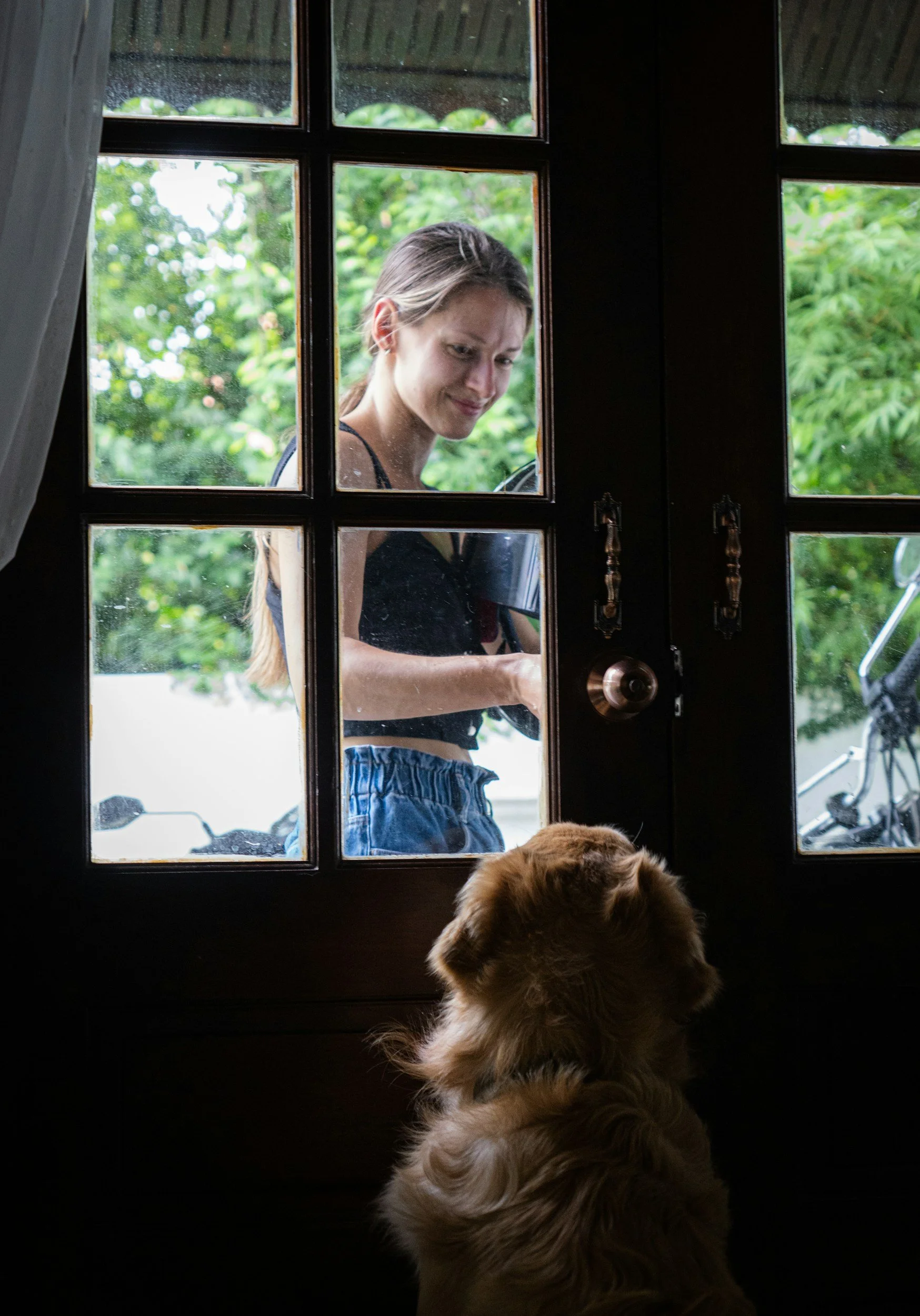
Are You Being Fair to Your Dog? When Socialization Pushes Too Far
Should I Make My Dog Greet Visitors?
Somewhere along the way, many dog parents got the idea that a “good dog” should happily tolerate every person who enters the house, every stranger who reaches toward him, every child who wants a hug and every well-meaning dog lover who insists, “Dogs love me.”
I disagree.
Your dog does need to learn how to live safely in a human world. He needs skills. He needs boundaries. He needs to be manageable, and if fear or aggression is creating a safety problem, that behavior deserves appropriate work.
But none of that means your dog is required to personally interact with everyone who wants access to him.
Fairness Is Not the Same Thing as Permissiveness
I want to make this distinction very clear because “respect the dog” can get interpreted in ways I do not mean.
I believe in training dogs.
I believe in leadership, expectations, boundaries and teaching dogs better ways to respond to the world around them.
But I also believe the human has a responsibility to understand the dog standing in front of them.
A fearful dog should not be thrown into a situation he cannot handle and then blamed for failing.
An aggressive dog should not be deliberately placed within biting distance of someone simply because we want him to “get over it.”
A dog who dislikes people touching his face should not have to repeatedly defend his face because a guest refuses to listen.
| Fair | Not Fair |
|---|---|
| Teaching a dog how to remain safely in the presence of visitors. | Requiring the dog to be touched by every visitor. |
| Using distance, management and controlled exposure while skills develop. | Pushing the dog closer because “he needs to get used to it.” |
| Expecting appropriate behavior from the dog. | Ignoring distress until the only communication left is a growl or bite. |
| Protecting visitors from a dog who may bite. | Allowing a risky interaction simply to prove the dog has improved. |
| Protecting the dog from people who refuse to follow instructions. | Letting “but dogs love me” overrule what you know about your own dog. |
Why Does My Dog Growl at Visitors?
Growling at visitors can have several causes.
Fear is a very common one. A dog may also feel trapped, socially pressured, protective of space, uncomfortable with movement inside the home, physically painful, highly aroused or uncertain about what is expected.
What matters is that the growl is information.
It tells me the dog is not comfortable with what is happening.
That does not mean I simply allow the dog to stand in the middle of the living room threatening guests.
It means I change the setup.
A Growl Is Not Permission to Keep Pushing
If a dog is growling because a stranger is approaching, staring, reaching or trying to touch him, continuing the interaction may leave the dog with fewer options.
Management can mean distance, a leash, a gate, a crate, another room or simply telling the visitor to completely ignore the dog.
There is nothing wrong with preventing a dangerous rehearsal while you work on the bigger problem.
The Dog Who Was Pushed Too Far
I originally wrote this article years ago after hearing about a dog who was known to be uncomfortable with strangers entering the home.
The recommendation the family had received was to set up greetings at the door with visitors.
My question then is still my question now:
To what end?
What exactly did this dog need to accomplish?
Did he need to learn that visitors can exist safely inside the home?
Absolutely.
Did he need to learn that barking, lunging or threatening people was not an appropriate way to manage the situation?
Yes.
But did he need to walk up to those people, accept petting and participate in a social greeting?
No.
There is a huge difference between learning to cope with a visitor being present and being required to interact with that visitor.
The dog was pushed too far, too fast.
He was ultimately put down.
There Is a Difference Between Exposure and Overwhelming the Dog
Dogs do need experience with the world.
Avoiding every difficult situation forever is not necessarily the answer either.
But useful exposure gives the dog enough capacity to observe, learn and recover.
Too much pressure overwhelms the dog with more than he can reasonably process and then waits for the outward behavior to stop.
Those two situations may look similar if we only watch whether the dog is technically standing still.
They are not the same experience for the dog.
Food Can Create Conflict If We Use It to Pull a Fearful Dog Closer
A dog may desperately want the chicken in a visitor's hand while simultaneously wanting nothing to do with the visitor.
That creates conflict.
He stretches forward, grabs the food, and the person thinks:
“See! He likes me now.”
Then they reach for the dog.
But the food may have been the only part of that interaction the dog wanted.
Food can absolutely be used in behavior work. But there is an important difference between creating a good association from a safe distance and using food as bait to pull an uncomfortable dog within touching range.
This is where I deliberately hand the conversation over to The K9 Coach. The WellOiledK9 side asks whether the dog has the emotional and physical capacity for the interaction. The K9 Coach side deals with the practical mechanics of greetings and socialization.
He Didn't Want People in His Face
The second case in my original article involved a dog who was already known not to like people in his face.
During one visit, a friend of the family tried to give him a treat while also trying to teach him to roll over.
He did not want the interaction.
He bit her in the face.
During another visit, a family member was petting the dog and trying to give him a treat.
He bit again.
Now the dog had a bite record.
Did that dog need behavior work?
Of course.
Could he benefit from better coping skills around visitors?
Absolutely.
But he never needed to become a dog who enjoyed strangers touching his face, feeding him from their hands or asking him to perform tricks.
Those interactions were optional.
And the humans had information beforehand that told them the dog was uncomfortable with exactly that type of pressure.
Children Make This Conversation Even More Important
Children often do exactly the things a socially uncomfortable dog may find difficult: direct eye contact, fast movement, leaning, hugging, reaching over the head, getting close to the face and unpredictable changes in direction.
That does not make children the problem.
It means adults have to manage the interaction instead of assuming the dog and child will work it out.
If children and dogs will share space, the practical introduction and management piece belongs on The K9 Coach:
Your Dog Does Not Have to Like Everybody
Humans do not like everybody.
We do not expect ourselves to hug every stranger, enjoy every coworker, welcome every unfamiliar person into our personal space or feel comfortable with every hand reaching toward us.
Yet we often expect dogs to tolerate exactly that.
A socially appropriate dog does not necessarily need to be a social butterfly.
For many dogs, neutrality is an excellent goal.
The visitor can exist.
The dog can exist.
Nobody needs to have a relationship.
That distinction is important enough that I cover it separately on The K9 Coach. Socialization should help a dog function appropriately around the world — not create an obligation to personally interact with every dog or human he encounters.
Continue: What Socialization and Greetings Should Actually Look Like →
And Sometimes the Dog's Capacity Changes
This is where the WellOiledK9 part of this conversation becomes especially important.
A dog's threshold is not fixed in stone.
The same dog who tolerated a visitor last month may have much less capacity today because something else is filling the bucket.
If the Behavior Changed, Look at the Body Too
If your dog has always disliked strangers, that history matters.
But if your previously tolerant dog suddenly becomes less patient with visitors, children, handling or touch, I want you to pause before deciding this is simply a new training problem.
Sudden behavior change can be a clue.
Look at pain, sleep, digestion, itching, ear inflammation, medications, recent health changes and overall stress load.
Behavior is often where a dog finally tells us that the bucket is full.
Read: Sudden Aggression in Dogs — When Behavior Changes Deserve a Whole-Dog Look →
Read: Dog Allergies and Behavior — Can Itching Make a Dog Anxious, Reactive or Aggressive? →
The Over-Aroused Dog May Have Even Less Room for a Visitor
The doorbell itself can be enough to launch some dogs.
The car pulling into the driveway starts the anticipation. Then the knock. Then the door opens. People move through the entryway, voices rise, everyone says hello, and suddenly we ask a dog who is already functioning at full speed to calmly navigate a close social interaction with a stranger.
Sometimes the growl at the guest is only the last visible moment in an arousal sequence that started five minutes earlier.
Read: The Over-Aroused Dog — When Your Dog Can't Settle Down →
Newly Adopted Dogs Are Especially Easy to Push Too Fast
This is one of the places where our good intentions can get us in trouble.
We bring home a newly adopted dog and immediately want to show him his wonderful new life.
Family comes over to meet him.
We take him shopping.
We introduce the neighbor's dog.
We invite the grandchildren over.
We take him to the brewery.
Meanwhile, the dog may still be trying to figure out where he is, who these people are, where he sleeps, where food appears, whether the other dogs are safe and whether this home is actually permanent.
A newly adopted dog does not need to meet his entire new social network during the first weekend.
Bringing Home a New Dog?
The practical transition, socialization and introduction work belongs on The K9 Coach. I have separate resources for slowing down the first days, introducing the dog appropriately and integrating a new dog into an existing pack.
Pack Introductions Are Not a Group Meet-and-Greet Either
The same principle applies when another dog is involved.
Humans often think:
“Let's put them together and see what happens.”
I would rather not discover how a difficult introduction goes by waiting until two dogs are nose-to-nose in the living room.
Dogs need time to gather information, move, disengage and become familiar with one another without being trapped in social pressure.
And again, the goal is not necessarily:
“These dogs must become best friends.”
Peaceful coexistence may be an excellent outcome.
If you are adding a dog to a multi-dog home, use the introduction process rather than improvising:
Get the K9 Coach New Pack Member Introductions Guide →
Should You Correct a Dog for Growling at a Visitor?
I care about inappropriate aggression, and I care about clear behavioral expectations.
But I also want to know why the dog is growling and what situation the humans created before deciding what the response should be.
If you punish the warning without changing the reason for the warning, you have not necessarily made the dog more comfortable.
You may simply have made the communication less obvious.
Safety comes first.
Create distance. Control access. Manage the dog. Manage the visitor. Then work on the underlying response with an appropriate plan.
Use appropriate management and get individualized behavior support. A gate, closed door, leash, crate or properly conditioned muzzle is not a failure. It may be exactly what prevents the next bite while you work on the problem.
At that point, realistic expectations and management become part of protecting both the dog and the people around him. I cover that more directly on The K9 Coach.
You Also Have to Train the Humans
Sometimes this is harder than training the dog.
You tell the guest:
“Please ignore him.”
Thirty seconds later:
“Oh, but dogs LOVE me.”
Then they stare at him, call his name, slap their thigh and reach toward his head.
No.
If your dog has a history of fear or aggression around people, you may need to be far firmer with your visitors than feels socially comfortable.
Your House. Your Dog. Your Rules.
If you say the dog is not to be approached, then the dog is not to be approached.
If your visitor cannot follow that rule, separate the dog.
Do not put your dog's future at risk because you were worried about offending Aunt Susan.
What Does Being Fair Actually Look Like?
Not Every Dog Needs the Same Life
Some dogs can go to a brewery, attend a family reunion, greet twenty people and fall asleep underneath the table.
Wonderful.
Another dog may live a perfectly rich, happy life without ever enjoying crowded patios, strangers rubbing his head or neighborhood children running up to hug him.
That is not failure.
The newly adopted dog may need a quiet first few weeks.
The fearful dog may need neutrality instead of greetings.
The senior dog may no longer enjoy the kind of handling he tolerated when he was five.
The dog with chronic pain, allergies or inflammation may have a smaller social battery than he once did.
The dog joining an existing pack may need a careful introduction instead of being dropped into the living room and told to work it out.
Our goal should not be to force every dog into the same version of what humans think a social dog ought to be.
The goal is a dog who can live safely, function well, trust the people responsible for him and have his physical and emotional needs respected.
Frequently Asked Questions
Should I make my dog greet visitors?
No. Your dog may need to learn to remain safe and manageable while visitors are present, but that does not require physical interaction. For a fearful, reactive or aggressive dog, calm neutrality and safe management may be a much more appropriate goal.
Does socialization mean my dog should greet everyone?
No. Good socialization helps a dog function appropriately around people, dogs, environments and everyday experiences. It does not require the dog to personally interact with every individual he encounters.
Should strangers pet a fearful dog?
Not automatically. Reaching, staring, leaning over or touching a fearful dog can increase social pressure. Many fearful dogs do better when visitors initially ignore them and allow the dog to remain at a comfortable distance.
Should I use treats to make my fearful dog approach people?
Food can be useful in behavior work, but I do not like using it as bait to pull a fearful dog closer than he would otherwise choose to be. A dog can want the treat and still be afraid of the person holding it.
Why does my dog growl when guests try to pet him?
The dog may be fearful, socially uncomfortable, physically painful, over-aroused or attempting to create distance. A growl is important information that the dog is not comfortable with the current interaction.
Does my dog need to like strangers?
No. Dogs should be safely manageable, but they do not need to enjoy interacting with every person they meet. For some dogs, learning to remain calm and neutral around unfamiliar people is an excellent goal.
How soon should a newly adopted dog meet visitors?
There is no prize for rushing introductions. A newly adopted dog may need time to learn the household, rest, decompress and develop security before being asked to navigate a parade of visitors and outings.
Should I immediately introduce my new dog to my other dogs?
I prefer deliberate introductions rather than simply putting unfamiliar dogs together and hoping for the best. Give the dogs space to gather information, move, disengage and become familiar without unnecessary social pressure.
Can pain make a dog less tolerant of visitors?
Yes. Pain and physical discomfort can change a dog's tolerance for handling, touch and stressful situations. If a dog who previously enjoyed visitors suddenly becomes irritable, avoidant or aggressive, medical and physical contributors should be considered alongside behavioral ones.
Can allergies make my dog dislike being touched?
They may contribute. Chronic itching, inflamed ears, sore paws and irritated skin can make handling uncomfortable, and canine research has found increased touch sensitivity in dogs with chronic atopic dermatitis.
What should I do if my dog has already bitten a visitor?
Prevent another uncontrolled interaction and get qualified individualized help. Management may include separation, barriers, a leash, crate or appropriately conditioned muzzle depending on the dog and circumstances.
Sometimes Being Your Dog's Advocate Means Saying No.
No, you cannot pet him.
No, he does not need to say hello.
No, the new dog does not need to meet everybody this weekend.
No, we are not putting two unfamiliar dogs together and “seeing what happens.”
And no, we are not going to push him closer today just to prove that he can handle it.
Sometimes advocacy also means asking harder questions about why your dog's tolerance has changed — whether pain, inflammation, poor sleep, chronic stress, over-arousal, gut health or another physical problem is reducing his ability to cope.
My background in both behavior and whole-dog wellness allows me to look at those pieces together.
Tell Me What Is Going On With Your Dog →