Ozempic for Dogs? Before GLP-1 Drugs, Let’s Rethink the Bowl
When I first started seeing serious conversations about GLP-1 weight-loss drugs for pets, my reaction was not, Wow, another exciting tool for veterinary medicine.
It was: Of course THEY are going there.
We have spent decades making life increasingly convenient for ourselves and, in the process, often making our dogs' lives smaller. Many dogs eat highly processed food from a bag twice a day, spend most of their time in the house, move less as they get older, collect treats and chews from everyone in the family, and sometimes live with pain, inflammation or metabolic changes that have never been fully addressed.
Then they gain weight, and apparently one of our next great ideas may be an injection designed, in part, to make them less interested in eating.
I'm tossing the BS flag on that one.
Canine obesity is a genuine health problem. Excess body fat can affect mobility, joints, metabolic health, inflammation, quality of life and longevity. I absolutely want an overweight dog to reach a healthier body condition.
What I question is our order of operations. Before we start manipulating the dog's appetite, I want to know what we have done about the food, movement, muscle, pain, inflammation, enrichment and the way that dog actually lives.
See your vet for a diagnosis and then you and I can collaborate on a custom strategy for your dog's health.
If you need the practical side of portions, calories, treats, body condition and helping a dog gain or lose weight, I already cover that in How Much Should I Feed My Dog? Weight Loss, Weight Gain and Calories. This article is about the bigger question: why are we so eager to suppress a dog's appetite before we have fully examined why the dog became overweight?
Can Dogs Take Ozempic or Other GLP-1 Weight-Loss Drugs?
Ozempic and Wegovy contain semaglutide, a GLP-1 receptor agonist used in human medicine. These medications influence blood sugar regulation, gastric emptying, hunger and satiety. There is not currently a routine FDA-approved GLP-1 obesity drug for dogs, but veterinary researchers and pharmaceutical companies are already exploring the territory.
A small 2025 study evaluated another GLP-1 medication, liraglutide, in just 21 senior Golden Retrievers. Seven overweight dogs received calorie-adjusted food, while another seven received the calorie-adjusted diet plus liraglutide. The dogs receiving liraglutide lost more weight, but this was a tiny study involving one breed and one age group. The researchers themselves called for larger and longer studies. You can read the published canine study here.
Meanwhile, Cornell University is studying a once-weekly GLP-1 therapy from Akston Biosciences in overweight and obese cats. One of the stated objectives of that clinical study is to identify common side effects, which should remind us just how early this research still is. Cornell describes that GLP-1 obesity trial here.
There is also a commercial side to this conversation. Okava Pharmaceuticals describes its approach as adapting successful human medicines for companion animals, and its development pipeline has specifically included an Ozempic-derived candidate for pet obesity. You can see that development pipeline here.
So when I say, Of course THEY are going there, I am not inventing a pharmaceutical conspiracy. There is quite literally a market being developed around translating human obesity drugs into treatments for pets.
What I have not seen is evidence that dogs suddenly developed a deficiency in weight-loss medication.
Before Weight-Loss Drugs for Dogs, Why Aren't We Changing How Dogs Live?
This is the conversation I would much rather have.
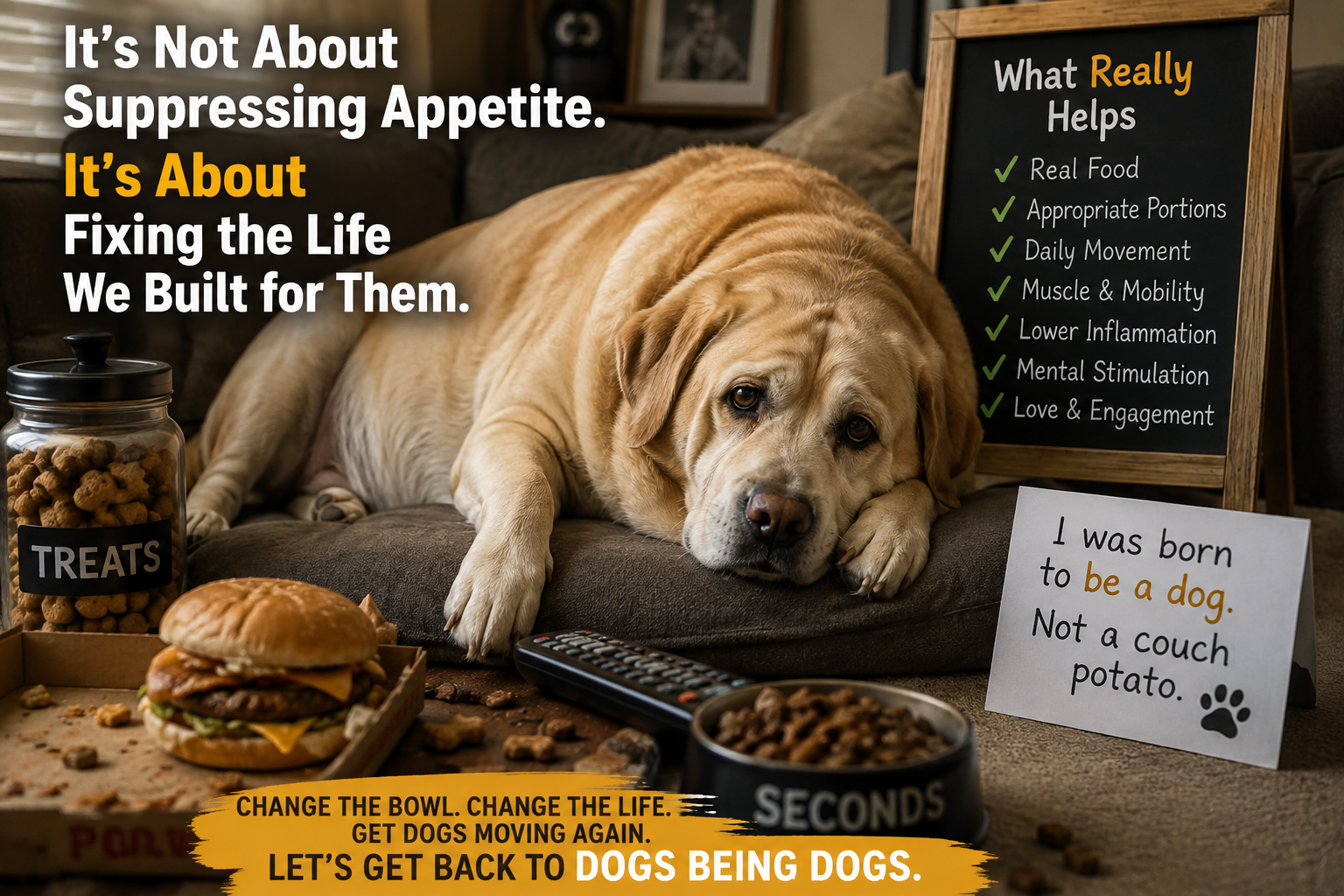
Let's get dogs back to being dogs.
Dogs are built to move, sniff, explore, search, investigate, climb, play, chase, carry things, interact with their environment and use their brains. Yet many modern dogs spend most of their lives moving between the couch, the food bowl, the backyard and a short walk around the same block.
Then we decide the dog is lazy.
Maybe we need to broaden our definition of activity before deciding the dog's metabolism needs pharmaceutical assistance.
A senior dog does not need to run five miles. A Dachshund does not need CrossFit, and an arthritic dog certainly should not be pushed through painful exercise just to burn calories. Appropriate movement can mean longer sniff walks, wandering a different trail, swimming, gentle hill work, retrieving, tug, scent games, hide-and-seek, searching for part of dinner, balance exercises, training games or several shorter outings spread through the day.
For a dog with arthritis or another painful condition, veterinary pain management, rehabilitation, bodywork, PEMF or other appropriate mobility support may need to come first. If pain caused the dog to move less and moving less contributed to the weight gain, simply taking food away does not address the whole problem either.
The goal is not merely to burn calories. I want to preserve muscle, improve mobility, reduce sedentary time, stimulate the brain and give the dog a reason to get off the couch.
Dogs do not need another hobby involving a food bowl.
If You Can Budget for Ozempic for Dogs, Can You Budget for Better Food?
We also need to talk about money, because somehow that piece gets skipped.
If we reach a point where pet parents are willing to budget for an ongoing pharmaceutical weight-loss treatment, then I want food included in that budget conversation first.
What would happen if some of that money went toward improving what is in the bowl?
Maybe you can move toward a thoughtfully balanced fresh-food diet. Maybe fully fresh is not realistic right now, but you can improve the quality of the current diet, add appropriate fresh ingredients, choose better proteins or stop spending half the dog's food budget on treats, chews and toppers while buying the cheapest possible main food.
I am fresh-food-first because I believe nutritious food should be one of the foundations of health. If you want to understand more about that approach, start with my Canine Nutrition and Fresh Feeding resources or read Why Fresh Food Helps Dogs Heal.
And if kibble is where you are right now, meet the dog where you are and improve the bowl. Even adding appropriate fresh animal protein can be a meaningful step. I talk more about that in Adding Fresh Meat to Kibble.
Better food may cost more, although it does not have to mean buying the most expensive thing on the planet. Movement, however, can cost almost nothing.
A walk is free. Sniffing is free. Playing tug is nearly free once you own the tug. Hiding pieces of the dog's meal around the house costs nothing extra. Training for five minutes in the kitchen costs nothing. Going somewhere new to sniff, explore and use the brain may cost nothing more than the gas to get there.
We have somehow turned wellness into something we think we have to purchase.
Sometimes your dog just needs you to put on your shoes.
Is Kibble Making My Dog Fat?
Not automatically. I can overfeed a fresh diet too, and calories do not disappear just because dinner contains grass-fed beef and organic vegetables.
But if an overweight dog eats kibble every single day, the kibble belongs in the investigation.
I want to know how calorie-dense it is, how much protein the dog is getting, what the primary ingredients are, how much starch the diet contains, how highly processed it is, how much moisture the dog receives and how large the actual serving looks for the calories being consumed.
I also want to know what gets added to that bowl and what appears between meals. The dental chew counts. The bully stick counts. The cheese wrapped around medication counts. Peanut butter counts. Training treats count. Oils and toppers have calories. Dad's little pieces of dinner count even if Dad insists they were practically microscopic.
I am not willing to treat the phrase complete and balanced as shorthand for there is nothing about this diet worth questioning.
Complete and balanced tells us something about nutrient standards. It does not tell us that one particular food is automatically the best choice for every dog, every metabolism, every health condition or every stage of life.
Before we spend money suppressing appetite, I want to know whether we have spent enough time nourishing the dog.
What Side Effects Are People Seeing With GLP-1 Weight-Loss Drugs?
This is another reason I have very little enthusiasm for rushing GLP-1 drugs into the canine weight-loss market.
In people, common adverse effects of medications such as semaglutide and tirzepatide include nausea, vomiting, diarrhea, constipation and abdominal discomfort. FDA prescribing information also includes warnings involving pancreatitis, acute gallbladder disease, severe gastrointestinal reactions, kidney injury associated with dehydration and delayed gastric emptying.
That delayed gastric emptying has become important enough that the prescribing information now discusses the possibility of food remaining in the stomach despite normal fasting before anesthesia or deep sedation, creating a risk of pulmonary aspiration. The FDA semaglutide prescribing information can be reviewed here.
The thyroid warning also deserves accurate context. GLP-1 drugs such as semaglutide and tirzepatide carry warnings because thyroid C-cell tumors occurred in rodent studies. It has not been established that these medications cause the same cancers in humans, so I am not going to turn a warning into a claim the evidence does not support. FDA prescribing information for tirzepatide discusses that warning here.
What catches my attention perhaps even more when we start talking about dogs is what happens to lean tissue during significant weight loss.
Could GLP-1 Drugs Cause Dogs to Lose Muscle Along With Fat?
We do not yet have enough long-term canine data to answer that question, which is precisely why I think we should be asking it before celebrating a lower number on the scale.
In human studies, some of the weight lost during GLP-1 therapy is lean mass rather than body fat alone. In a body-composition substudy involving tirzepatide, approximately one-quarter of the weight lost was lean mass. Weight loss through other methods can also reduce lean tissue, so this does not mean GLP-1 drugs uniquely destroy muscle. It does mean that protein intake, movement and muscle preservation deserve serious attention during substantial weight loss. You can read the human body-composition study here.
That makes my ears perk up when we start talking about senior and overweight dogs.
A dog can be overweight and still have poor muscle condition. In fact, excess fat can sometimes make muscle loss harder for pet parents to see. I do not want to celebrate that a senior dog lost eight pounds if too much of what disappeared was valuable muscle the dog desperately needs for mobility, stability and aging well.
This is one reason I care about body condition and muscle condition rather than simply chasing a target weight. For senior dogs especially, maintaining muscle deserves its own attention. You can read more in my Senior Dog Health Guide: Nutrition, Supplements & Longevity.
What Happens When Someone Stops Taking a GLP-1 Weight-Loss Drug?
This is another question I would want answered before we normalize long-term appetite medication for dogs.
In the extension of the human STEP 1 semaglutide trial, participants regained roughly two-thirds of the weight they had lost within a year after the medication was withdrawn. That does not mean every individual regains weight in exactly the same way, but it illustrates why these drugs are increasingly discussed as chronic therapy rather than a short-term reset. You can read that follow-up study here.
So if we eventually get to routine canine GLP-1 treatment, I want to know what the actual plan is.
Is the dog supposed to stay on appetite medication indefinitely while the food, activity and lifestyle remain unchanged?
What happens when the medication stops? What happens to hunger? What happens to muscle? What happens after two years, five years or ten?
I am interested in whether the dog is healthier, stronger and living better. A lower number on the scale by itself does not answer that.
Why Is My Dog Overweight in the First Place?
This is still the question I want answered before we start discussing drugs.
Maybe the portions slowly became too large. Maybe treats contribute hundreds of calories nobody was counting. Maybe the food is incredibly calorie-dense. Maybe arthritis caused the dog to move less. Maybe the dog is losing muscle with age. Maybe a medication increased appetite. Maybe thyroid or adrenal disease deserves investigation. Maybe the dog is bored and food-seeking has become one of the few interesting things that happens during the day.
I want to know the dog's age, breed, diet history, body condition, muscle condition, activity level, medications, supplements, stool history, appetite patterns and laboratory trends. I want to know when the weight started changing and what else changed around the same time.
I am particularly interested when someone tells me, My dog barely eats anything and still can't lose weight.
That is not when I automatically remove another quarter-cup of food. That is when I become more curious.
Has someone actually calculated all the calories? Is the dog painful? What is happening with mobility? What do the thyroid and other appropriate laboratory values look like? Is the dog losing muscle? Are there digestive, metabolic or inflammatory patterns worth looking at?
From a whole-dog perspective, I may also consider gut health, liver and gallbladder clues, kidney health, inflammation, stress and endocrine patterns. TCVM can add another lens by helping identify patterns such as dampness, stagnation, digestive weakness, heat, deficiency or inflammation.
That does not mean I go hunting for an exotic diagnosis every time a Beagle gains three pounds. It means we remain curious enough to look deeper when the obvious explanation does not fit.
Should Dogs Use Ozempic or GLP-1 Drugs for Weight Loss?
My position is pretty simple.
Could someone eventually show me an extremely unusual dog with severe obesity, significant medical complexity and compelling evidence that a well-studied veterinary GLP-1 medication offers benefits that clearly outweigh the risks? I am not foolish enough to say an exception could never exist.
But for the overwhelming majority of overweight dogs, I am nowhere near that syringe.
I want to feed the dog nutritious food, figure out an appropriate amount, preserve and rebuild muscle, address pain, reduce unnecessary inflammatory burden, look for medical reasons when the weight does not make sense, count the treats and get the dog moving again.
I want the dog sniffing, exploring, playing, searching, thinking, working and interacting with the world.
I want dogs to be dogs again instead of couch potatoes whose biggest daily event is hearing the refrigerator door open.
Before Ozempic for Dogs, Can We Please Rethink the Bowl?
This is the part I keep coming back to.
We have normalized feeding dogs highly processed food for breakfast and dinner every day of their lives. When they gain weight, we often tell people to feed less of the same food. Now we are beginning to explore drugs that could make the dog want less food.
At some point, I think we are allowed to question the entire setup.
Maybe your dog's answer is a thoughtfully balanced fresh-food diet. Maybe you stay with kibble but make meaningful improvements to the bowl. Maybe the biggest problem turns out to be 300 calories a day in treats nobody was counting. Maybe arthritis reduced activity months before the weight gain became obvious. Maybe the thyroid deserves another look. Maybe the dog simply needs more appropriate movement, more muscle and more opportunities to act like a dog.
Whatever the answer is, I would rather investigate those things before we decide the dog's appetite is defective.
Because when our dogs become overweight after living the lifestyle we created for them, I have a hard time accepting that the first thing needing correction is the dog.
Maybe we should change the food.
Maybe we should change the lifestyle.
Maybe we should get off the couch with them.
And maybe, before engineering away their desire to eat, we should give them better things to eat and a little more reason to get up in the morning.
Related Content
- How Much Should I Feed My Dog? Weight Loss, Weight Gain and Calories
- Canine Nutrition Tips from a Certified Dog Nutritionist
- Why Fresh Food Helps Dogs Heal
- Adding Fresh Meat to Kibble
- Senior Dog Health Guide: Nutrition, Supplements & Longevity
When Your Dog's Weight Still Doesn't Make Sense
If your dog's weight is not changing despite what you are feeding, or if you are seeing muscle loss, reduced mobility, unusual hunger or other changes that do not add up, this is where a more personalized look can help.
As a Holistic Canine Health Practitioner and canine nutritionist, I look at the food, health history, laboratory trends, medications, supplements, pain, movement, digestion, body condition, muscle condition and the patterns that may help explain why your individual dog is struggling.
The goal is not simply to make your dog weigh less. I want your dog eating better, moving better, maintaining muscle, feeling better and getting back to doing the things dogs are supposed to do.
Learn more about working with me on your dog's nutrition and whole-dog health strategy.
Transparency: I am a Holistic Canine Health Practitioner and canine nutritionist, not a veterinarian. I do not diagnose disease or prescribe medications. I help pet parents evaluate nutrition, lifestyle and whole-dog wellness strategies while collaborating with veterinary care when diagnosis or medical treatment is needed.
Ozempic for dogs | GLP-1 for dogs | weight loss drugs for dogs | overweight dog | dog can't lose weight | is kibble making my dog fat | how to help my dog lose weight | best food for overweight dogs | fresh food for overweight dogs | dog exercise for weight loss | canine obesity | dog weight management |