

Essential Oils For Healthy Senior Dogs
Essential Oils Can Support Much More Than a Senior Dog's Stiff Joints
When I think about essential oils for senior dogs, I am not looking for one bottle labeled “old dog.”
I am looking at the dog.
How are they moving? Are they comfortable? Are they sleeping well? Are they anxious at night? Is cognition changing? Are they still eating? How is digestion? Are we dealing with arthritis, spinal disease, cancer, skin changes, lymphatic congestion, weakness or several things at once?
Essential oils are one part of a much larger senior wellness toolbox, but they are a part I reach for often because they are versatile, easy to incorporate and can support several body systems without requiring me to hide another powder or capsule inside the dog's dinner.
The goal is not to treat “old age.” The goal is to identify what is changing and support the senior dog standing in front of me.
How I Choose Essential Oils for a Senior Dog
Two fifteen-year-old dogs may need completely different support.
Mobility & Pain
Is the dog stiff getting up? Reluctant to use stairs? Compensating for a knee, hip or spinal problem? Losing muscle because movement hurts?
Cognition & Nervous System
Are we seeing pacing, confusion, staring, getting stuck, altered sleep, anxiety or changes in the dog's normal daily rhythm?
Digestion & Appetite
Is nausea, reflux, stress, digestive discomfort or illness interfering with eating?
Rest & Emotional Comfort
Does the dog have trouble settling, wake repeatedly, become anxious after dark or seem unsettled by changes in hearing or vision?
Circulation & Lymphatics
Would movement, massage, lymphatic support and selected oils fit into a broader plan for circulation and tissue health?
The Whole Health Picture
Cancer, kidney or liver changes, medications, seizures, heart disease, skin sensitivity and other conditions matter before I decide what belongs in the plan.
I don't choose an oil because the dog is old. I choose support based on what that particular old dog needs.
Essential Oils for Senior Dog Mobility & Comfort
Mobility is one of the biggest reasons I use essential oils with older dogs. But mobility is much bigger than “joint support.”
A senior dog may have arthritis, an old knee injury, hip changes, IVDD, spinal discomfort, compensating muscles, weakness from muscle loss or several of those things at the same time.
That is why I look at the entire movement system.
Copaiba & Frankincense
These are two oils I reach for often when I am thinking about comfort, movement and whole-body support.
They fit particularly well into my broader approach when the goal is to help a senior dog remain willing and able to move.
Lemongrass & Wintergreen
These may also have a place in selected mobility plans, particularly when I am working around muscles, joints and areas of chronic stiffness.
They are not oils I treat casually. The dog's health history, medications, size, application and overall protocol matter.
Mobility is rarely an oil-only problem.
I may combine essential oils with nutrition, weight management, protein and muscle support, PEMF, cold laser, massage, gentle strengthening, lymphatic work and other modalities depending on the dog.
Explore My Senior Mobility Approach →Essential Oils for Cognitive & Nervous-System Support
Cognitive change is another reason essential oils become especially interesting in senior dogs.
Dogs with cognitive decline may begin pacing, staring, getting stuck, sleeping differently, vocalizing at night, seeming less connected to familiar routines or becoming anxious in situations that never bothered them before.
Frankincense is one of the oils I think about frequently in this space, particularly as part of a broader nervous-system and senior-brain plan.
Depending on the dog, I may also incorporate calming or grounding oils when nighttime restlessness, anxiety or sensory changes are part of the picture.
But don't assume every confused senior has CCD.
Pain, hearing loss, vision loss, urinary urgency, medication effects, sleep disruption and other medical changes can look a lot like cognitive decline.
That is why I want to look at the whole dog before deciding what we're actually supporting.
Raindrop Technique for Senior Dogs
Raindrop is one of the ways I use essential oils as part of a broader whole-body senior wellness plan.
Rather than chasing one stiff knee or one sore hip, I may use an adapted Raindrop approach when I am thinking about the spine, muscles, nervous system, circulation, relaxation and general body comfort together.
For a senior dog, I do not approach Raindrop as a rigid recipe that must be performed exactly the same way on every animal.
I consider the dog's age, health, medications, sensitivity, mobility, energy and what I am trying to support that day.
Why I May Use Raindrop
- General senior-body comfort
- Muscle and spinal support
- Mobility support
- Nervous-system support
- Relaxation and settling
- Circulatory support
- Whole-body wellness
Why I Adapt It
A seventeen-year-old dog with muscle loss and significant medical history does not need me proving that I can use the same intensity I would use with a young athletic dog.
I respect sensitivity while still choosing the support I believe best fits that dog's needs.
I teach the deeper application details, oil selection and protocol work inside my member resources rather than turning this public page into a one-size-fits-all how-to.
Appetite, Nausea & Digestive Support
A dog who isn't eating may also be the dog who refuses every powder, capsule and supplement you have hidden in the bowl.
This is one reason essential oils are such a useful tool for me.
I may be able to begin supporting nausea, digestive discomfort, emotional stress or the gut-brain connection without first convincing the dog to eat an entire meal.
Depending on the oil, product and individual dog, I may use aromatic, topical or appropriately selected oral or sublingual approaches.
The route matters.
Not every oil belongs in the mouth, and not every dog needs oral use. When I use an oral or mucosal route, I choose products appropriate for that use and consider the dog's size, sensitivity, medications and health history.
The public goal here is to explain what I may be trying to accomplish. The detailed how-to belongs in the deeper educational material.
Essential Oils for Senior Dog Sleep & Anxiety
Nighttime can become difficult for some senior dogs.
They may pace, wake repeatedly, appear disoriented, become anxious when the house gets quiet or struggle when hearing and vision begin to change.
Selected calming oils may fit into the plan alongside environmental changes, pain management, cognitive support, appropriate activity during the day and addressing whatever is actually waking the dog.
Lavender & Calming Support
Lavender is one of the familiar oils I may think about when relaxation, settling or emotional balance is part of the goal.
The exact choice depends on the dog and what the nighttime behavior actually looks like.
Don't Treat Pain Like Anxiety
A dog pacing because the hips hurt is not necessarily having an emotional problem.
A dog repeatedly waking because they need to urinate is not necessarily “sundowning.”
The symptom still needs context.
Essential Oils, Circulation & Lymphatic Support
Senior dogs often move less—and movement itself is part of healthy circulation and lymphatic flow.
I may incorporate selected oils alongside massage, gentle movement and lymphatic techniques when I am supporting tissue health and circulation.
This becomes especially relevant in dogs who are less active, recovering from illness or surgery, or dealing with chronic health changes that have reduced normal movement.
Essential Oils in the Senior Dog With Cancer
Cancer becomes part of the senior-dog conversation far too often.
I do use essential oils within broader wellness plans for dogs dealing with cancer, but I do not reduce cancer support to “give this one oil.”
I may be thinking about comfort, emotional stress, sleep, appetite, nausea, skin and tissue support, immune wellness, mobility and quality of life—all while paying attention to the dog's diagnosis and conventional treatment.
Frankincense is one of the oils people frequently ask me about in this context, and it can certainly have a place in my broader approach.
An essential oil can be an important piece of the plan without pretending that one bottle is the cancer plan.
My Senior Dog Essential-Oil Toolbox
These are not “recipes.” They are examples of the kinds of oils I may think about based on what I am trying to support.
| What I'm Supporting | Oils I May Think About | The Bigger Picture |
|---|---|---|
| Mobility & Comfort | Copaiba, Frankincense, Lemongrass, Wintergreen and selected blends | Joints, muscles, spine, compensation, inflammation, pain and willingness to move |
| Cognition & Nervous System | Frankincense and selected grounding or nervous-system supportive oils | CCD, sleep-wake changes, sensory loss, anxiety, brain nutrition and MCT support |
| Relaxation & Sleep | Lavender and other calming oils or blends | Pain, nighttime restlessness, environment, cognition and daily activity |
| Digestion & Nausea | Selected digestive oils based on the individual pattern | Nausea, reflux, acidity, medication effects, pancreatitis, appetite and food tolerance |
| Circulation & Lymphatics | Selected oils used alongside massage, movement and lymphatic support | Reduced activity, tissue health, recovery and whole-body circulation |
| Whole-Body Support | Raindrop and individually selected oils | Spine, muscles, nervous system, relaxation, mobility and overall senior wellness |
Why I don't give one universal senior-dog blend
Wintergreen may fit one dog and be completely inappropriate for another. A highly scent-sensitive dog may need a much lighter approach than the dog next door.
Medications, seizures, liver function, kidney function, heart disease, cancer treatment, skin condition and many other factors can change the choice.
That is why I teach principles and individual decision-making rather than telling every senior dog owner to use the same bottle in the same way.
Ways I May Use Essential Oils With Senior Dogs
One of the reasons I continue to rely heavily on essential oils is that I have options.
A senior dog who refuses food, cannot tolerate another supplement in the bowl or simply needs support from another direction may still be able to benefit from an appropriately chosen oil.
Aromatic
Aromatic use may be useful when I am thinking about emotional support, settling, cognition or the nervous system.
I do not believe that filling the room with an overwhelming smell is better. Senior dogs may become more sensitive to strong aromas.
Topical
Topical use lets me work more directly around muscles, joints, the spine or another area where I am providing support.
Placement, dilution and the particular oil still matter.
Oral / Sublingual
With appropriately selected products and dogs, oral or sublingual use may be another option.
This can be particularly helpful when the dog is not willing to eat a full meal and I do not want to bury every support product in the food.
I reserve detailed oil selection, dilution and application guidance for the deeper educational resources.
Raindrop & Hands-On Support
Raindrop allows me to integrate oils with hands-on work around the body rather than treating essential oils as something that only comes out of a diffuser.
With senior dogs I adapt the session to the individual dog and the goal.
Respect sensitivity without losing the goal.
Senior dogs may become more sensitive to aroma, touch, temperature and change.
I pay attention to how the dog responds and adjust the approach accordingly, but that does not mean avoiding support they may benefit from.
The goal is to choose the right oil, route and intensity for that dog— not to overwhelm them and not to abandon the plan.
Don't Build a Senior-Dog Plan Around Oils Alone
I love oils. They are often one of the first things I reach for. But longevity depends on much more than what is in the roller bottle.
Senior Nutrition
Protein, muscle preservation, hydration, food preparation and maintaining interest in eating become increasingly important with age.
Senior Dog Nutrition →Mobility
Support joints, muscles, spine, pain, body condition and the dog's ability to keep moving.
Senior Mobility Support →Cognition
Look at brain nutrition, MCTs, sleep, pain, sensory loss, enrichment and natural nervous-system support.
Canine Cognitive Dysfunction →Appetite
Nausea, food quality, dental pain, illness, temperature, texture and changing preferences all matter when a senior stops eating.
Dog Won't Eat? →Lymphatics
Movement, massage, circulation and lymphatic support become increasingly valuable as activity changes.
Lymphatic Support →Whole Senior Dog
Bring nutrition, mobility, cognition, organ health, cancer awareness, herbs, oils, homeopathy and lifestyle together.
Senior Dog Health & Longevity →I Keep the Detailed Protocol Work Deeper Inside the Site
This public article is meant to help you understand how I think about essential oils for senior dogs and the kinds of problems I may use them to support.
The detailed work—oil selection, application, dilution, combinations, Raindrop guidance and how I decide what belongs together—is where individual context becomes much more important.
Frequently Asked Questions
What essential oils are good for senior dogs?
There is no single senior-dog oil. I choose oils according to what the dog needs support with—mobility, pain, cognition, sleep, anxiety, digestion, appetite, circulation or another concern.
Copaiba, frankincense, lemongrass, wintergreen and lavender are examples of oils I may consider in different senior-dog situations, but they are not interchangeable and not appropriate for every dog.
What essential oils do you use for senior dog mobility?
Copaiba and frankincense are two oils I reach for frequently around comfort and mobility. Lemongrass and wintergreen may also have a place in selected dogs.
I combine essential oils with the bigger mobility picture, including muscle support, weight, nutrition, PEMF, cold laser, massage and movement.
Can essential oils help dogs with cognitive decline?
Essential oils may be incorporated into a broader nervous-system and cognitive wellness plan. Frankincense is one oil I often consider, along with oils chosen around calming, sleep and emotional balance when those issues are present.
Cognitive support should also look at nutrition, MCTs, pain, sensory loss, sleep and other reasons a senior dog may appear confused.
What is Raindrop Technique for senior dogs?
I use an adapted Raindrop approach as a whole-body wellness tool that may fit into support for the spine, muscles, nervous system, circulation, relaxation and mobility.
I modify what I do based on the senior dog's health, sensitivity, strength and the goal of the session rather than using one rigid approach for every dog.
Can essential oils help a senior dog who won't eat?
Essential oils may be useful when nausea, digestive discomfort, stress or another issue is interfering with appetite.
One advantage is that support does not always need to be mixed into food. Depending on the oil and dog, I may use aromatic, topical or appropriately selected oral or sublingual methods.
Can essential oils help an older dog sleep?
Selected calming oils may fit into a plan for relaxation and settling, but I also want to know why the dog is awake. Pain, cognitive change, urinary urgency, hearing or vision loss and other medical problems can all cause nighttime restlessness.
Can you use essential oils orally or sublingually with dogs?
There are situations where I use appropriately selected products through oral or sublingual routes, but not every essential oil is appropriate for internal use and the individual dog's health matters.
I reserve detailed product, dilution and application guidance for deeper education rather than publishing a universal oral-use recipe.
Are essential oils safe for very old dogs?
Age alone does not automatically exclude essential oils, but a very old dog may have increased sensitivity, multiple medications or kidney, liver, cardiac, neurologic or other health changes that affect oil selection.
I adjust the oil, route and intensity to the individual dog while still keeping the health goal in mind.
Can essential oils be used with cancer in senior dogs?
I may use essential oils as part of a broader wellness plan for a dog with cancer, particularly around comfort, stress, sleep, appetite, nausea, mobility and quality of life.
I do not treat one essential oil as a substitute for understanding the diagnosis or building a complete cancer-support plan.
Essential Oils Are One of My Most Versatile Senior-Dog Tools
The oil I choose for stiffness may not be the oil I choose for nighttime restlessness. The dog with cognitive changes may need something different from the dog recovering from surgery or struggling to eat.
That is exactly why I like working with essential oils.
They give me options for mobility, cognition, nervous-system support, digestion, appetite, sleep, emotional balance, circulation and whole-body comfort—and I can often begin supporting the dog without needing to add one more thing to the food bowl.
But I still want the oils inside a complete senior plan.
Educational Note
This information is provided for educational and wellness-support purposes. Essential-oil selection, concentration and route should take the individual dog's size, medications, health history and sensitivity into account.
Essential oils are not a substitute for veterinary evaluation when a senior dog develops significant pain, weakness, neurologic changes, persistent appetite loss, breathing changes or other concerning symptoms.
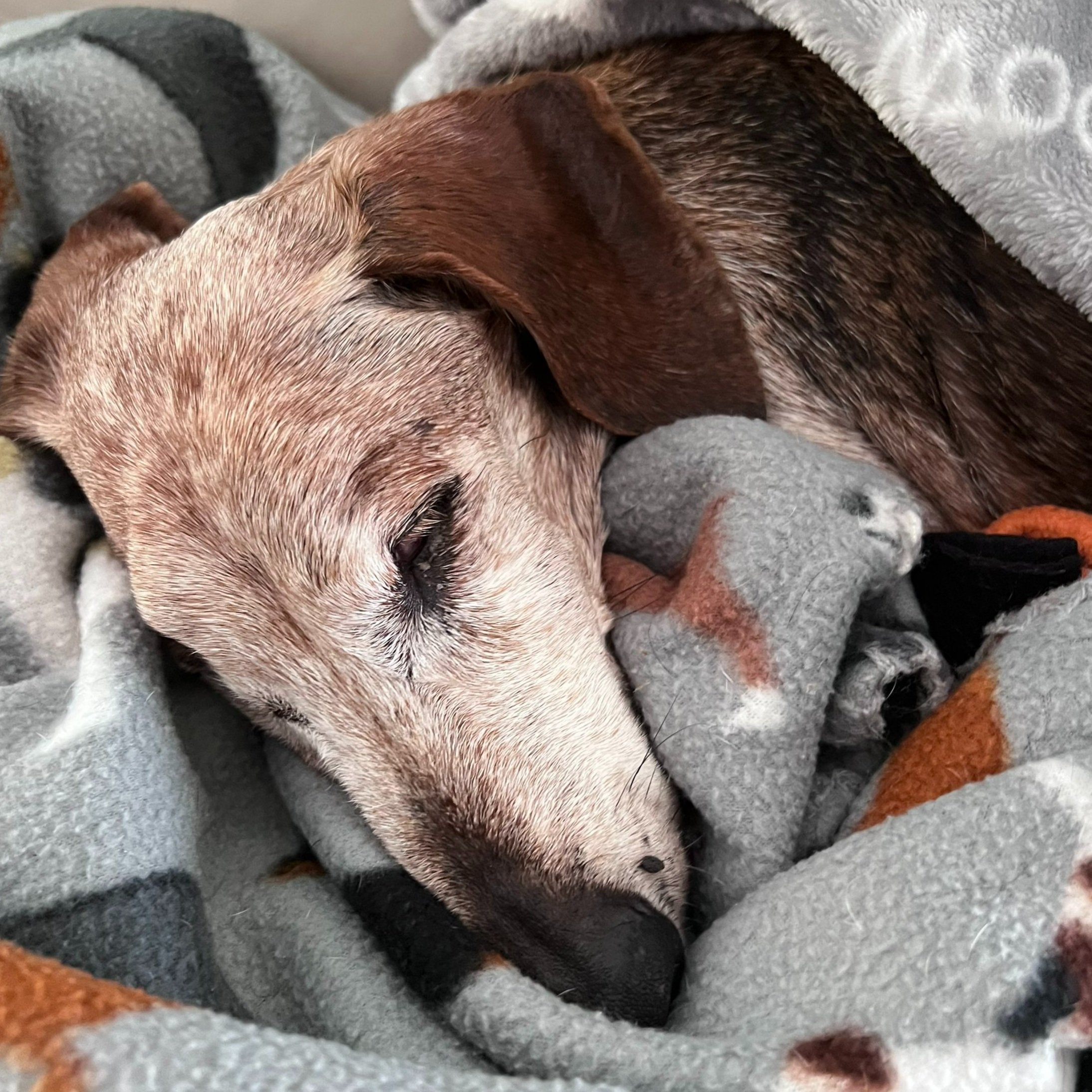
Old Dog Using Essential Oils
Essential Oils Can Support Much More Than a Senior Dog's Stiff Joints
When I think about essential oils for senior dogs, I am not looking for one bottle labeled “old dog.”
I am looking at the dog.
How are they moving? Are they comfortable? Are they sleeping well? Are they anxious at night? Is cognition changing? Are they still eating? How is digestion? Are we dealing with arthritis, spinal disease, cancer, skin changes, lymphatic congestion, weakness—or several things at once?
Essential oils are one part of a much larger senior wellness toolbox, but they are a part I reach for often because they are versatile, easy to incorporate and can support several body systems without requiring me to hide another powder or capsule inside the dog's dinner.
The goal is not to treat “old age.” The goal is to identify what is changing and support the senior dog standing in front of me.
How I Choose Essential Oils for a Senior Dog
Two fifteen-year-old dogs may need completely different support.
Mobility & Pain
Is the dog stiff getting up? Reluctant to use stairs? Compensating for a knee, hip or spinal problem? Losing muscle because movement hurts?
Cognition & Nervous System
Are we seeing pacing, confusion, staring, getting stuck, altered sleep, anxiety or changes in the dog's normal daily rhythm?
Digestion & Appetite
Is nausea, reflux, stress, digestive discomfort or illness interfering with eating?
Rest & Emotional Comfort
Does the dog have trouble settling, wake repeatedly, become anxious after dark or seem unsettled by changes in hearing or vision?
Circulation & Lymphatics
Would movement, massage, lymphatic support and selected oils fit into a broader plan for circulation and tissue health?
The Whole Health Picture
Cancer, kidney or liver changes, medications, seizures, heart disease, skin sensitivity and other conditions matter before I decide what belongs in the plan.
I don't choose an oil because the dog is old. I choose support based on what that particular old dog needs.
Essential Oils for Senior Dog Mobility & Comfort
Mobility is one of the biggest reasons I use essential oils with older dogs. But mobility is much bigger than “joint support.”
A senior dog may have arthritis, an old knee injury, hip changes, IVDD, spinal discomfort, compensating muscles, weakness from muscle loss or several of those things at the same time.
That is why I look at the entire movement system.
Copaiba & Frankincense
These are two oils I reach for often when I am thinking about comfort, movement and whole-body support.
They fit particularly well into my broader approach when the goal is to help a senior dog remain willing and able to move.
Lemongrass & Wintergreen
These may also have a place in selected mobility plans, particularly when I am working around muscles, joints and areas of chronic stiffness.
They are not oils I treat casually. The dog's health history, medications, size, application and overall protocol matter.
Mobility is rarely an oil-only problem.
I may combine essential oils with nutrition, weight management, protein and muscle support, PEMF, cold laser, massage, gentle strengthening, lymphatic work and other modalities depending on the dog.
Chronic low-grade inflammation can also be part of the aging picture, which is why I look beyond one sore joint.
Essential Oils for Cognitive & Nervous-System Support
Cognitive change is another reason essential oils become especially interesting in senior dogs.
Dogs with cognitive decline may begin pacing, staring, getting stuck, sleeping differently, vocalizing at night, seeming less connected to familiar routines or becoming anxious in situations that never bothered them before.
Frankincense is one of the oils I think about frequently in this space, particularly as part of a broader nervous-system and senior-brain plan.
Depending on the dog, I may also incorporate calming or grounding oils when nighttime restlessness, anxiety or sensory changes are part of the picture.
But don't assume every confused senior has CCD.
Pain, hearing loss, vision loss, urinary urgency, medication effects, sleep disruption and other medical changes can look a lot like cognitive decline.
That is why I want to look at the whole dog before deciding what we're actually supporting.
Raindrop Technique for Senior Dogs
Raindrop is one of the ways I use essential oils as part of a broader whole-body senior wellness plan.
Rather than chasing one stiff knee or one sore hip, I may use an adapted Raindrop approach when I am thinking about the spine, muscles, nervous system, circulation, relaxation and general body comfort together.
For a senior dog, I do not approach Raindrop as a rigid recipe that must be performed exactly the same way on every animal.
I consider the dog's age, health, medications, sensitivity, mobility, energy and what I am trying to support that day.
Why I May Use Raindrop
- General senior-body comfort
- Muscle and spinal support
- Mobility support
- Nervous-system support
- Relaxation and settling
- Circulatory support
- Whole-body wellness
Why I Adapt It
A seventeen-year-old dog with muscle loss and significant medical history does not need me proving that I can use the same intensity I would use with a young athletic dog.
I respect sensitivity while still choosing the support I believe best fits that dog's needs.
I teach the deeper application details, oil selection and protocol work inside my member resources rather than turning this public page into a one-size-fits-all how-to.
Appetite, Nausea & Digestive Support
A dog who isn't eating may also be the dog who refuses every powder, capsule and supplement hidden in the bowl.
This is one reason essential oils are such a useful tool for me.
I may be able to begin supporting nausea, digestive discomfort, emotional stress or the gut-brain connection without first convincing the dog to eat an entire meal.
Depending on the oil, product and individual dog, I may use aromatic, topical or appropriately selected oral or sublingual approaches.
The route matters.
Not every oil belongs in the mouth, and not every dog needs oral use. When I use an oral or mucosal route, I choose products appropriate for that use and consider the dog's size, sensitivity, medications and health history.
The public goal here is to explain what I may be trying to accomplish. The detailed how-to belongs in the deeper educational material.
Essential Oils for Senior Dog Sleep & Anxiety
Nighttime can become difficult for some senior dogs.
They may pace, wake repeatedly, appear disoriented, become anxious when the house gets quiet or struggle when hearing and vision begin to change.
Selected calming oils may fit into the plan alongside environmental changes, pain management, cognitive support, appropriate activity during the day and addressing whatever is actually waking the dog.
Lavender & Calming Support
Lavender is one of the familiar oils I may think about when relaxation, settling or emotional balance is part of the goal.
The exact choice depends on the dog and what the nighttime behavior actually looks like.
Don't Treat Pain Like Anxiety
A dog pacing because the hips hurt is not necessarily having an emotional problem.
A dog repeatedly waking because they need to urinate is not necessarily experiencing cognitive decline.
The symptom still needs context.
Essential Oils, Circulation & Lymphatic Support
Senior dogs often move less—and movement itself is part of healthy circulation and lymphatic flow.
I may incorporate selected oils alongside massage, gentle movement and lymphatic techniques when I am supporting tissue health and circulation.
This becomes especially relevant in dogs who are less active, recovering from illness or surgery, or dealing with chronic health changes that have reduced normal movement.
Essential Oils in the Senior Dog With Cancer
Cancer becomes part of the senior-dog conversation far too often.
I do use essential oils within broader wellness plans for dogs dealing with cancer, but I do not reduce cancer support to “give this one oil.”
I may be thinking about comfort, emotional stress, sleep, appetite, nausea, skin and tissue support, immune wellness, mobility and quality of life—all while paying attention to the dog's diagnosis and treatment.
Frankincense is one of the oils people frequently ask me about in this context, and it can have a place in my broader approach.
An essential oil can be an important piece of the plan without pretending that one bottle is the cancer plan.
My Senior Dog Essential-Oil Toolbox
These are not recipes. They are examples of the kinds of oils I may think about based on what I am trying to support.
| What I'm Supporting | Oils I May Think About | The Bigger Picture |
|---|---|---|
| Mobility & Comfort | Copaiba, Frankincense, Lemongrass, Wintergreen and selected blends | Joints, muscles, spine, compensation, inflammation, pain and willingness to move |
| Cognition & Nervous System | Frankincense and selected grounding or nervous-system supportive oils | CCD, sleep-wake changes, sensory loss, anxiety, brain nutrition and MCT support |
| Relaxation & Sleep | Lavender and other calming oils or blends | Pain, nighttime restlessness, environment, cognition and daily activity |
| Digestion & Nausea | Selected digestive oils based on the individual pattern | Nausea, reflux, acidity, medication effects, pancreatitis, appetite and food tolerance |
| Circulation & Lymphatics | Selected oils used alongside massage, movement and lymphatic support | Reduced activity, tissue health, recovery and whole-body circulation |
| Whole-Body / Raindrop | Raindrop and individually selected oils | Spine, muscles, nervous system, relaxation, mobility and overall senior wellness |
Why I don't give one universal senior-dog blend
Wintergreen may fit one dog and be completely inappropriate for another. A highly sensitive dog may need a lighter approach than the dog next door.
Medications, seizures, liver function, kidney function, heart disease, cancer treatment, skin condition and many other factors can change the choice.
That is why I teach principles and individual decision-making rather than telling every senior dog owner to use the same bottle in the same way.
Ways I May Use Essential Oils With Senior Dogs
One of the reasons I continue to rely heavily on essential oils is that I have options.
A senior dog who refuses food, cannot tolerate another supplement in the bowl or simply needs support from another direction may still be able to benefit from an appropriately chosen oil.
Aromatic
Aromatic use may be useful when I am thinking about emotional support, settling, cognition or the nervous system.
I do not believe that filling the room with an overwhelming smell is better. Senior dogs may become more sensitive to strong aromas.
Topical
Topical use lets me work more directly around muscles, joints, the spine or another area where I am providing support.
Placement, dilution and the particular oil still matter.
Oral / Sublingual
With appropriately selected products and dogs, oral or sublingual use may be another option.
This can be particularly helpful when the dog is not willing to eat a full meal and I do not want to bury every support product in the food.
I reserve detailed oil selection, dilution and application guidance for the deeper educational resources.
Raindrop & Hands-On Support
Raindrop allows me to integrate oils with hands-on work around the body rather than treating essential oils as something that only comes out of a diffuser.
With senior dogs I adapt the session to the individual dog and the goal.
Respect sensitivity without losing the goal.
Senior dogs may become more sensitive to aroma, touch, temperature and change.
I pay attention to how the dog responds and adjust the approach accordingly, but that does not mean avoiding support they may benefit from.
The goal is to choose the right oil, route and intensity for that dog— not to overwhelm them and not to abandon the plan.
Other Natural Support I May Combine With Essential Oils
Senior support works best when I can choose from more than one toolbox.
Senior Herbs
Herbs may complement oils when I am thinking about digestion, cognition, mobility, circulation, organ support or overall senior resilience.
Herbs for Senior Dogs →Homeopathy
Homeopathy gives me another individualized tool when the dog's complete symptom picture points in that direction.
Explore Homeopathy →Inflammaging
Chronic low-grade inflammation can influence mobility, cognition, metabolic health and the way a senior dog feels overall.
Understanding Inflammaging →Build the Whole Senior-Dog Plan
I love oils. They are often one of the first things I reach for. But longevity depends on much more than what is in the bottle.
Senior Nutrition
Protein, muscle preservation, hydration, food preparation and keeping an older dog interested in eating become increasingly important.
Senior Dog Nutrition →Mobility
Support joints, muscles, spine, pain, body condition and the dog's ability to keep moving.
Senior Mobility Support →Cognition
Look at brain nutrition, MCTs, sleep, pain, sensory loss, enrichment and natural nervous-system support.
Canine Cognitive Dysfunction →Appetite
Nausea, food quality, dental pain, illness, temperature, texture and changing preferences all matter when a senior stops eating.
Dog Won't Eat? →Lower-Tox Living
Senior health also means thinking about the total environmental and chemical burden around the dog.
Low-Tox Lifestyle for Dogs →Whole Senior Dog
Bring nutrition, mobility, cognition, organ health, cancer awareness, herbs, oils, homeopathy and lifestyle together.
Senior Dog Health & Longevity →Start With What Is Changing in Your Dog
If you landed here because your senior dog is stiff, pacing, not eating, losing muscle, recovering from illness or simply seems different, you do not have to guess which article comes next.
Use the Resource Finder to start with the symptom, diagnosis or concern you are seeing.
I Keep the Detailed Protocol Work Deeper Inside the Site
This public article is meant to help you understand how I think about essential oils for senior dogs and the kinds of problems I may use them to support.
The detailed work—oil selection, application, dilution, combinations, Raindrop guidance and how I decide what belongs together—is where individual context becomes much more important.
Frequently Asked Questions
What essential oils are good for senior dogs?
There is no single senior-dog oil. I choose oils according to what the dog needs support with—mobility, pain, cognition, sleep, anxiety, digestion, appetite, circulation or another concern.
Copaiba, frankincense, lemongrass, wintergreen and lavender are examples of oils I may consider in different senior-dog situations, but they are not interchangeable and not appropriate for every dog.
What essential oils do you use for senior dog mobility?
Copaiba and frankincense are two oils I reach for frequently around comfort and mobility. Lemongrass and wintergreen may also have a place in selected dogs.
I combine essential oils with the bigger mobility picture, including muscle support, weight, nutrition, PEMF, cold laser, massage and movement.
Can essential oils help dogs with cognitive decline?
Essential oils may be incorporated into a broader nervous-system and cognitive wellness plan. Frankincense is one oil I often consider, along with oils chosen around calming, sleep and emotional balance when those issues are present.
Cognitive support should also look at nutrition, MCTs, pain, sensory loss, sleep and other reasons a senior dog may appear confused.
What is Raindrop Technique for senior dogs?
I use an adapted Raindrop approach as a whole-body wellness tool that may fit into support for the spine, muscles, nervous system, circulation, relaxation and mobility.
I modify what I do based on the senior dog's health, sensitivity, strength and the goal of the session rather than using one rigid approach for every dog.
Can essential oils help a senior dog who won't eat?
Essential oils may be useful when nausea, digestive discomfort, stress or another issue is interfering with appetite.
One advantage is that support does not always need to be mixed into food. Depending on the oil and dog, I may use aromatic, topical or appropriately selected oral or sublingual methods.
Can essential oils help an older dog sleep?
Selected calming oils may fit into a plan for relaxation and settling, but I also want to know why the dog is awake. Pain, cognitive change, urinary urgency, hearing or vision loss and other medical problems can all cause nighttime restlessness.
Can you use essential oils orally or sublingually with dogs?
There are situations where I use appropriately selected products through oral or sublingual routes, but not every essential oil is appropriate for internal use and the individual dog's health matters.
I reserve detailed product, dilution and application guidance for deeper education rather than publishing a universal oral-use recipe.
Are essential oils safe for very old dogs?
Age alone does not automatically exclude essential oils, but a very old dog may have increased sensitivity, multiple medications or kidney, liver, cardiac, neurologic or other health changes that affect oil selection.
I adjust the oil, route and intensity to the individual dog while still keeping the health goal in mind.
Can essential oils be used with cancer in senior dogs?
I may use essential oils as part of a broader wellness plan for a dog with cancer, particularly around comfort, stress, sleep, appetite, nausea, mobility and quality of life.
I do not treat one essential oil as a substitute for understanding the diagnosis or building a complete cancer-support plan.
Essential Oils Are One of My Most Versatile Senior-Dog Tools
The oil I choose for stiffness may not be the oil I choose for nighttime restlessness. The dog with cognitive changes may need something different from the dog recovering from surgery or struggling to eat.
That is exactly why I like working with essential oils.
They give me options for mobility, cognition, nervous-system support, digestion, appetite, sleep, emotional balance, circulation and whole-body comfort—and I can often begin supporting the dog without needing to add one more thing to the food bowl.
But I still want the oils inside a complete senior plan.
Educational Note
This information is provided for educational and wellness-support purposes. Essential-oil selection, concentration and route should take the individual dog's size, medications, health history and sensitivity into account.
Essential oils are not a substitute for veterinary evaluation when a senior dog develops significant pain, weakness, neurologic changes, persistent appetite loss, breathing changes or other concerning symptoms.
When DIY Isn't Enough Already tried the basics? If this is happening with your dog and you're still stuck, I can help you figure out what deserves attention next.
Request a Discovery Callback →