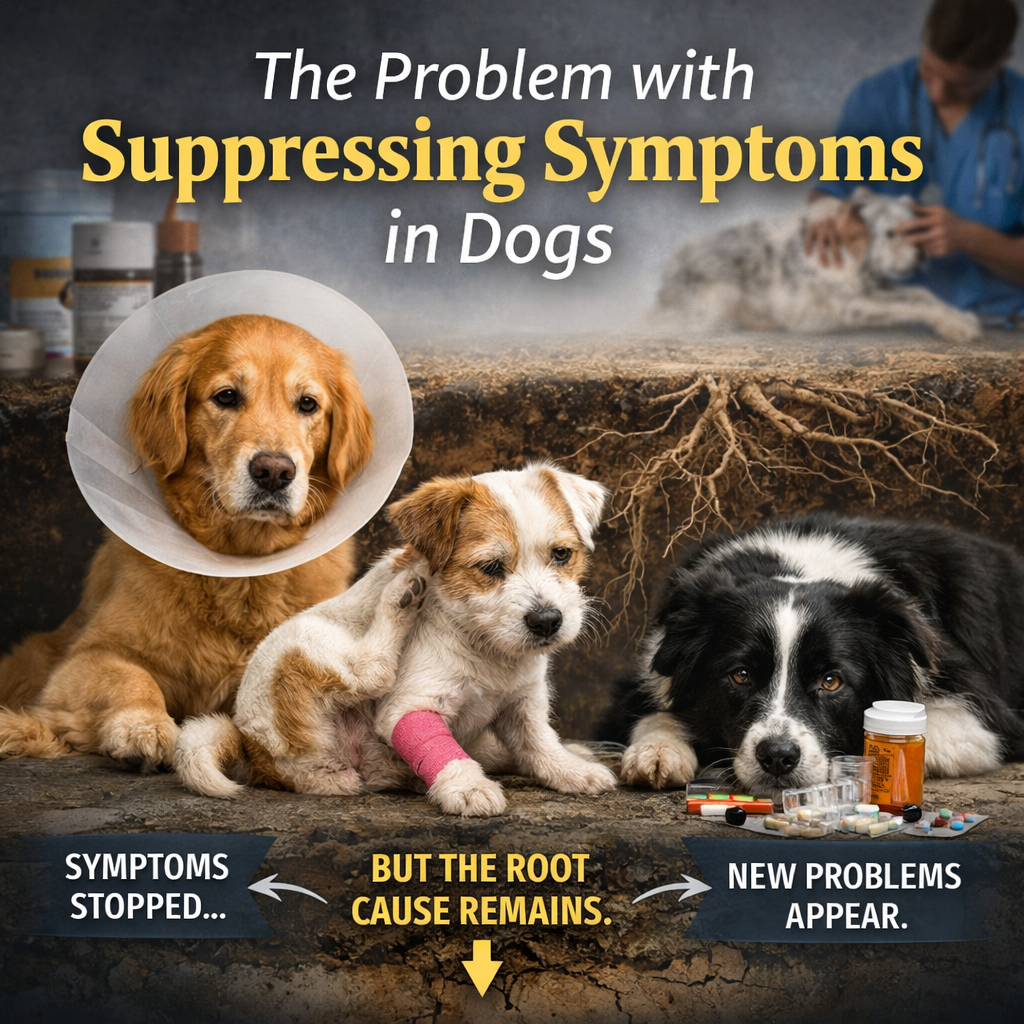

Symptom Suppression in Dogs: When Relief Isn’t the Same as Resolution
If your dog is miserable, I want relief too.
I do not believe a dog should scratch herself bloody, vomit for three days, live with a painful ear infection or limp around in pain because we are trying to prove how “holistic” we can be.
My concern begins when stopping the symptom becomes the entire plan.
The itching stopped. Wonderful. Why was the dog itching?
The ear infection cleared. Good. Why is this the fourth one this year?
The diarrhea stopped. Excellent. Why does it keep returning every few weeks?
The anxiety medication helped the dog cope. Great. Is pain, digestive discomfort, chronic stress, hormones, sleep or something else still contributing?
Relief and resolution are not always the same thing.
What I Mean by Symptom Suppression
In holistic health traditions, including homeopathy, the word suppression is often used when an outward symptom disappears but the underlying tendency, trigger or imbalance has not necessarily been resolved.
I use the concept more practically than dramatically.
If treatment stops the itching, diarrhea, inflammation, pain or anxiety, that can be very useful. But if the same problem repeatedly returns when treatment stops — or the dog begins collecting additional chronic problems — I don't want to keep asking only, “What can I give for this symptom?”
I want to widen the lens.
A Symptom Is Information — Not Always the Problem Itself
Itching is not a diagnosis.
Neither is diarrhea. An ear infection tells us what is happening in the ear today, but not necessarily why that ear keeps becoming inflamed. Anxiety describes what we are seeing, but it does not automatically tell us whether the driver is behavioral, environmental, painful, digestive, hormonal or some combination of those things.
Symptoms are clues.
Sometimes the clue leads to something simple. Other times it takes a little detective work. What I don't want is to throw away the clue the moment we have found a way to quiet it.
Does That Mean We Shouldn't Treat Symptoms?
Absolutely not.
This is where holistic conversations sometimes go off the rails.
A symptom may provide useful information and still need treatment.
A dog in pain, having difficulty breathing, repeatedly vomiting, becoming dehydrated from diarrhea, having seizures, experiencing severe allergic swelling, unable to urinate, or rapidly declining needs appropriate veterinary care.
“I don't want to suppress the symptom” is not a reason to let a dog suffer or delay necessary diagnostics and stabilization.
Conventional veterinary medicine can be invaluable for diagnostics, emergency care, stabilization, infection, surgery, pain control and serious disease.
My issue is not that the symptom got treated.
My issue is when nobody keeps asking why the dog needed the treatment in the first place — especially when they need it again and again.
When Symptom Relief Is Exactly What the Dog Needs
Sometimes we know what is wrong and the symptom needs to be controlled while the dog heals.
Sometimes diagnostics are underway and we need to keep the dog comfortable in the meantime.
Sometimes chronic disease cannot simply be “fixed,” and symptom management is part of giving the dog a good quality of life.
And sometimes medication provides enough relief that we finally have the breathing room to work on food, gut health, environment, rehabilitation, behavior or another deeper piece of the problem.
I am not opposed to relief. I am opposed to mistaking relief for an explanation.
Where I Start Asking More Questions
One episode does not necessarily create a pattern.
Repetition gets my attention.
The Itching Keeps Coming Back
The allergy medication works, but symptoms return when it wears off or the season changes. Now I want to look at food, pollen, grass, fleas, mites, yeast, skin-barrier health, gut health and household exposures rather than simply escalating the itch product.
The Ear Infection Is Back Again
Clearing bacteria or yeast from a painful ear is important. Four infections in a year make me ask about allergy patterns, food, moisture, anatomy, skin inflammation, endocrine health and why that ear environment keeps changing.
The Stool Firms Up — Until It Doesn't
Medication can stop diarrhea. Recurring diarrhea may make me investigate diet, parasites, food intolerance, stress, pancreatic function, medications, microbiome disruption and chronic GI inflammation.
The Dog Is Calmer — But Why Was She Struggling?
Behavior medication can be useful. I still want to know whether pain, digestive discomfort, endocrine changes, sleep disruption, chronic stress, aging, environment or learned behavior are also part of the picture.
The Difference Between Managing a Symptom and Investigating a Pattern
What About Apoquel, Cytopoint, Steroids and Other Symptom-Control Medications?
Allergy medications are a good example because they can make a dramatic difference in how comfortable an itchy dog feels.
A dog who cannot sleep, is chewing holes in her skin or is creating repeated secondary infections needs relief. I am not interested in making her miserable while we proudly announce that we are “finding the root cause.”
But if the dog needs the medication continuously, I still want to understand what keeps driving the inflammatory cycle.
Is it environmental allergy? Food? Fleas? Yeast? Secondary bacterial infection? Skin-barrier dysfunction? Gut problems? Household exposure? More than one thing?
If allergy medication is part of your dog's story, start with my Dog Allergies: Symptoms, Causes, Food Triggers and What to Do Next guide.
For a deeper discussion of the medication side of the conversation, see Natural Alternatives to Apoquel for Dog Allergies .
Recurring Symptoms Often Have Layers
Chronic problems rarely stay neatly in one box.
An itchy dog may eventually have damaged skin, yeast, bacterial infection, disrupted sleep and stress.
A dog with chronic diarrhea may begin losing weight, eating differently, developing nutrient deficiencies or becoming more reactive to foods.
A dog with chronic pain may become restless, anxious, reactive or reluctant to exercise.
That is one reason I don't love chasing each new symptom as though it appeared in a completely different dog.
Sometimes what looks like five separate problems is really one dog whose body has been asking for a wider look for quite a while.
What I Look at When Symptoms Keep Returning
As a holistic pet health coach and canine nutritionist, I often start with the timeline rather than the supplement shelf.
I want to know:
- How old was the dog when the problem started?
- Was the onset sudden or gradual?
- How often does it return?
- What reliably makes it better?
- What happens when treatment stops?
- What food has the dog eaten over time?
- What treats, chews, toppers, oils and extras are part of the diet?
- What medications have been used, and for how long?
- What supplements are already being given?
- What do the stool, appetite and nausea patterns look like?
- Has weight or muscle condition changed?
- What do lab trends show over time rather than on one isolated test?
- Are there gut, liver, gallbladder, kidney, endocrine, immune or inflammatory clues?
- What changed in the home, environment or routine around the time symptoms started?
- Is stress, pain or behavior part of the picture?
That history often tells us where the next investigation should go.
Gut Health Can Be One Piece of the Pattern
I pay particular attention to the gut when skin problems, yeast, food reactions and recurring digestive symptoms begin traveling together.
That does not mean every chronic symptom is “leaky gut,” nor does fixing the microbiome solve every allergy.
It means digestion, immune signaling, inflammation and skin health do not operate as completely separate systems.
If your dog cycles through itching, yeast, loose stool, gas and recurring ear problems, read Could Your Dog's Gut Be Causing Itching, Yeast and Diarrhea? .
Food Is Often Worth Another Look
Food is not the cause of every chronic condition. It is, however, something the dog interacts with every single day.
I look at protein sources, processing, fat balance, ingredient quality, freshness, food reactions, dietary variety and whether the current diet fits the dog's actual health picture.
Randomly changing food every three weeks is not what I mean by nutritional investigation.
If food reactions are part of the question, see Dog Food Allergies vs. Food Intolerances .
The Environment Belongs in the Conversation Too
Sometimes pet parents spend months changing foods while the dog is walking through lawn chemicals, sleeping on fragranced laundry products and breathing plug-ins all day.
I look at cleaners, fragrances, flea and tick products, lawn treatments, grooming products, mold, water quality and other repeated environmental exposures where they fit the history.
We cannot put a dog in a bubble, and that is not the goal.
The goal is to reduce unnecessary load where we reasonably can.
For practical ideas, see Low-Tox Living With Dogs .
Where Natural Support May Fit
Natural support can be useful, but replacing one symptom-suppressing product with six “natural” products without understanding the dog is not automatically a more holistic plan.
Depending on the dog and diagnosis, support may include:
- fresh-food and nutrition changes,
- gut and microbiome support,
- omega-3 and inflammatory support,
- herbs,
- homeopathy,
- essential oils,
- medicinal mushrooms,
- targeted nutritional supplements,
- liver and gallbladder support,
- stress and nervous-system support,
- massage, bodywork, PEMF or Reiki where appropriate,
- and TCVM pattern support.
TCVM can help me think about patterns such as heat, dampness, stagnation, deficiency, digestive weakness, stress and inflammation rather than looking only at the name attached to the diagnosis.
Muscle testing may also help guide tolerance and direction in sensitive or complicated dogs.
Experience helps me recognize patterns, ask better questions and avoid wasting time on random product guessing.
Sometimes the Best Plan Uses Both Conventional and Holistic Care
This does not have to be a team jersey.
Conventional medicine may give us the diagnosis, imaging, bloodwork, cytology, pain control, antibiotics when truly needed, surgery, emergency stabilization or a medication that gives the dog immediate relief.
Holistic work may then help us look at food, lifestyle, gut health, inflammation, environment, stress, natural support, prevention and the patterns that are harder to fit into a fifteen-minute appointment.
Treat what needs treating today. Then keep asking what could make tomorrow different.
When the Pattern Is the Clue
One itchy week during peak pollen season may be just that.
One bout of diarrhea after getting into the trash does not require an investigation worthy of a crime documentary.
But when the same symptoms keep returning, the dog starts needing more medication, or apparently unrelated problems begin stacking up, I want to look at the timeline.
The question changes from:
“What can I give my dog for this?”
to:
“Why does this particular dog keep ending up back here?”
That question usually gets us much farther.
Frequently Asked Questions About Symptom Suppression in Dogs
What does symptom suppression mean in holistic dog care?
In holistic traditions, symptom suppression generally describes a situation where an outward symptom improves or disappears without necessarily resolving the underlying trigger or health pattern. I use the idea as a reminder to keep investigating recurring problems rather than assuming symptom control automatically explains why the problem happened.
Is treating my dog's symptoms bad?
No. Dogs should not be left in pain, severe itching, respiratory distress, repeated vomiting or other significant discomfort simply because we want a holistic approach. Symptom relief can be appropriate and necessary. The bigger question is whether recurring symptoms deserve additional investigation after the immediate problem is controlled.
Why do my dog's symptoms keep coming back after medication?
There are many possibilities. The medication may be controlling the symptom while the original trigger remains, the dog may have several overlapping problems, or the condition may require ongoing management. Recurring symptoms are a reason to review the diagnosis, history, diet, environment, medications and other health patterns rather than simply assuming the previous treatment failed.
Why does my dog's ear infection keep coming back?
Recurring ear problems can be associated with allergies, food reactions, yeast or bacteria, moisture, ear anatomy, endocrine disease and chronic skin inflammation. Treating the active infection is important, but repeated infections are a reason to investigate why the ear environment keeps becoming vulnerable.
Read more in Natural Support for Recurring Dog Ear Infections .
Why is my dog still itching when allergy medication works?
Allergy medication may successfully reduce inflammatory signaling and make the dog much more comfortable without identifying the original trigger. Food reactions, environmental allergies, fleas, mites, yeast, bacterial infection, household irritants and several overlapping factors can all contribute to itching.
For immediate comfort options, see Natural Relief for Itchy Dogs .
Can natural remedies suppress symptoms too?
They can certainly be used in the same symptom-chasing way. Swapping a prescription product for a supplement, herb or essential oil does not automatically make the plan holistic. I still want to know why we are using it, what job it is doing and whether the dog's larger pattern is improving.
Does symptom suppression cause other diseases?
Some holistic traditions describe unresolved or suppressed patterns as becoming deeper or shifting over time. I do not tell a pet parent that treating one rash caused a later diagnosis. What I do pay attention to is a dog whose recurring symptoms continue, change or accumulate despite repeated symptom-focused treatment. That pattern tells me the whole dog deserves another look.
How do I know when to investigate beyond the symptom?
Recurrence is one of the biggest clues. If the same issue repeatedly returns, treatment is needed more often, several body systems become involved, or your dog never seems to regain a stable baseline, reviewing the larger history can be useful.
When You're Tired of Treating the Same Problem Again
Maybe the medication works — until it doesn't. Maybe you've changed foods, added supplements, treated the ears, managed the itching or cleaned up the stool, only to find yourself back in the same place a month later.
That is where looking at the whole dog can be useful.
We can review food, symptoms, medications, supplements, lab trends, gut health, environment, stress, behavior and the timeline together and decide which pieces deserve attention next.
Not another random product. A strategy that actually fits your dog.
Request a Discovery Callback