
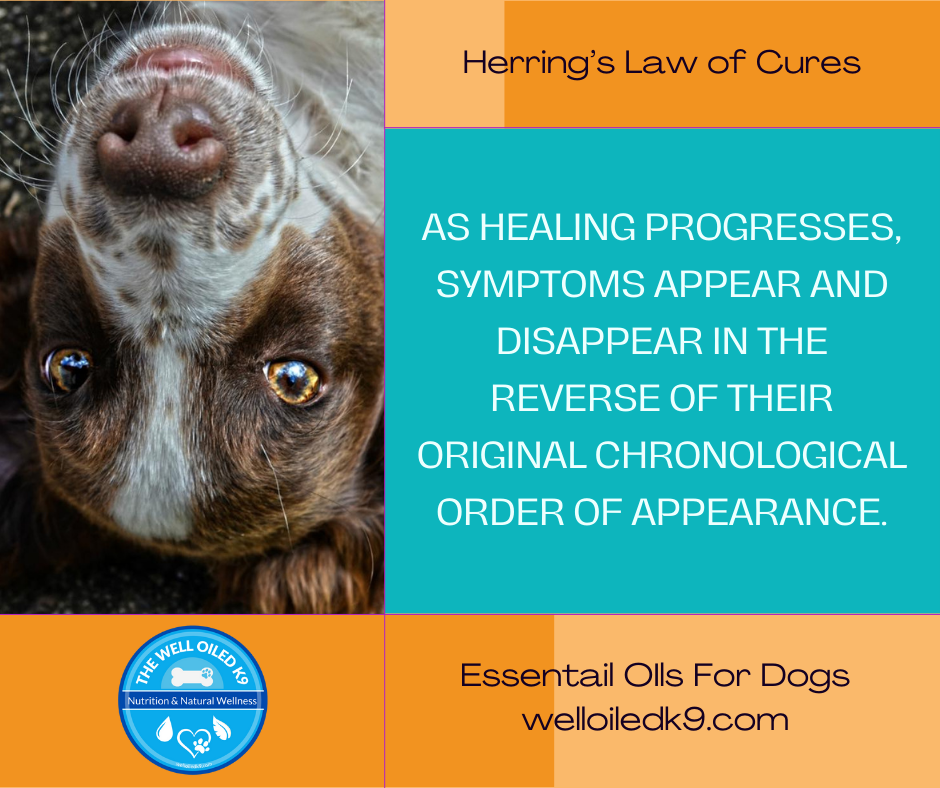
Hering's Law of Cure
Why Healing Doesn't Always Look Like Healing
Have you ever started making healthy changes for your dog, only to wonder if things were getting worse instead of better?
Maybe the digestion improved, but now the ears are acting up.
The itching is better, but your dog suddenly has loose stools.
Or an old symptom that disappeared years ago suddenly makes a brief appearance.
Your first thought is usually, "We must have done something wrong."
Sometimes that's true.
But not always.
One concept that has influenced how I interpret healing over the years is Hering's Law of Cure. It comes from homeopathy, but I've found it helpful when looking at the bigger picture of how dogs recover—not just from homeopathic remedies, but sometimes through nutrition, lifestyle changes, and other natural support as well.
It doesn't explain every setback, and it certainly shouldn't be used to ignore serious illness. But it does remind me that healing is often more complex than simply watching one symptom disappear.
What Is Hering's Law of Cure?
Developed by Dr. Constantine Hering, a 19th-century physician and homeopath, Hering's Law describes a pattern that practitioners have observed during healing.
According to this principle, healing may occur:
From the inside out
From the head downward
In the reverse order that symptoms originally appeared
In practical terms, that means the body may restore deeper functions before more superficial problems resolve. It also suggests that older symptoms may briefly return before disappearing again.
Whether every case follows this pattern is open to debate, and it isn't considered established medical science. But after years of working with dogs, I've seen enough examples that I pay attention when I start connecting the dots.
What Might This Look Like in Dogs?
Healing doesn't always happen in the order we'd choose.
A dog with chronic allergies may suddenly have better digestion before the skin improves.
Another dog's energy may return long before the ears stop flaring.
I've worked with dogs whose stools became beautifully consistent months before the itching finally settled down.
I've also seen old symptoms briefly reappear.
A dog who used to struggle with ear infections years ago may have one mild flare.
A dog that licked their paws as a puppy may briefly start licking again.
A dog who once had occasional loose stools may experience a short digestive wobble while the rest of the body continues improving.
That doesn't automatically mean the treatment failed.
Sometimes it may simply mean the body is working through older layers of imbalance.
Not Every Setback Is Hering's Law
This is where I think some people get into trouble.
Not every symptom is a "healing crisis."
Not every flare is evidence that detox is working.
Not every old symptom returning means your dog is healing.
Sometimes the food truly isn't the right fit.
Sometimes you've introduced too many changes at once.
Sometimes medications are causing side effects.
Sometimes the disease is progressing.
Sometimes your dog needs additional diagnostics or a completely different plan.
This is why I don't judge progress by one bad day—or one good one.
I look for patterns.
Looking at the Whole Dog
One of the biggest mistakes I see is focusing on only one symptom.
If your dog's skin is still itchy, you may completely miss that digestion is stronger.
If you're only watching the ears, you might not notice that your dog has more energy, sleeps better, and is recovering more quickly after exercise.
Those improvements matter.
They're clues that the body may be rebuilding function rather than simply suppressing symptoms.
Controlled is not always the same as stable.
A dog who falls apart after one missed supplement, one stressful weekend, or one tiny food indiscretion may have fewer symptoms than before—but they may not yet be truly resilient.
That's the goal I'm working toward.
Not just fewer symptoms.
A stronger dog.
Healing Takes Time
Most chronic conditions didn't develop in a week.
They developed over months—or years.
It makes sense that rebuilding health often takes time as well.
There may be progress.
There may be plateaus.
There may even be temporary setbacks.
The important question isn't whether your dog had one itchy day.
It's whether the overall direction is improving.
Are the flares becoming less frequent?
Less intense?
Shorter?
Is your dog bouncing back faster?
Are you seeing more good days than bad?
Those are the questions I ask.
When a Setback Needs Attention
Hering's Law should never be used as an excuse to ignore serious symptoms.
Repeated vomiting, severe diarrhea, bloody stool, collapse, difficulty breathing, seizures, abdominal pain, refusal to eat with lethargy, or any rapid decline should always be evaluated by your veterinarian.
Natural healing should never replace appropriate diagnostics or emergency care.
My Take
One of the reasons I appreciate Hering's Law is that it reminds me to zoom out.
Instead of asking, "Did my dog's ears flare today?"
I ask,
"Is my dog healthier than they were a month ago?"
Healing is rarely a straight line.
Sometimes it pauses.
Sometimes it takes a step backward before moving forward again.
Sometimes the body surprises us with the order in which it rebuilds.
That's why I spend so much time looking at patterns instead of isolated symptoms.
Because when we understand the bigger picture, we're much less likely to quit a good plan too soon—or keep following the wrong one for far too long.
If you’ve tried food changes, supplements, medications, and advice from every corner of the internet, the next step may not be trying harder. It may be trying more intentionally. Read: When You’ve Tried Everything, Try One More Thing
Related Reading
If you're wondering whether your dog is experiencing a true detox reaction or a healing crisis, be sure to read my article on Herxheimer Reactions in Dogs.
About the Author
Written by Dana Brigman, Holistic Pet Health Coach and Canine Nutritionist at The Well Oiled K9. Dana helps dog parents look beyond generic advice and build personalized nutrition and natural wellness plans using fresh food, digestive support, herbs, essential oils, homeopathy, TCVM-informed assessment, and whole-dog strategy.