Checking Pee-Mail: Why Your Dog Needs to Sniff on Walks
I teach people how to take control of the walk.
I also stop and let my dogs sniff bushes, investigate where another dog has peed, follow an interesting scent and occasionally spend what feels like an unreasonable amount of time studying one particular blade of grass.
Those two things are not contradictory.
A dog should know how to walk with you. A dog should also get opportunities to use the nose attached to his face.
Yes. Sniffing, scent investigation and exploration are natural canine behaviors that provide information, mental engagement and opportunities for choice. But sniffing does not have to be the entire walk. A good walk can include structured movement, training, exercise, potty time and periods when you deliberately release your dog to explore and read the neighborhood “pee-mail.”
Your Dog Is Not Just Smelling Pee
When your dog buries his nose in a patch of grass where another dog has urinated, he isn't simply being gross.
He's gathering information.
Dogs communicate chemically. Urine marking and other scent marks can tell another dog that somebody was here and provide information about the individual who left the mark. Dogs may respond differently depending on who left it, whether the scent is familiar or unfamiliar and what other social information is present.
Which is why I call it checking pee-mail.
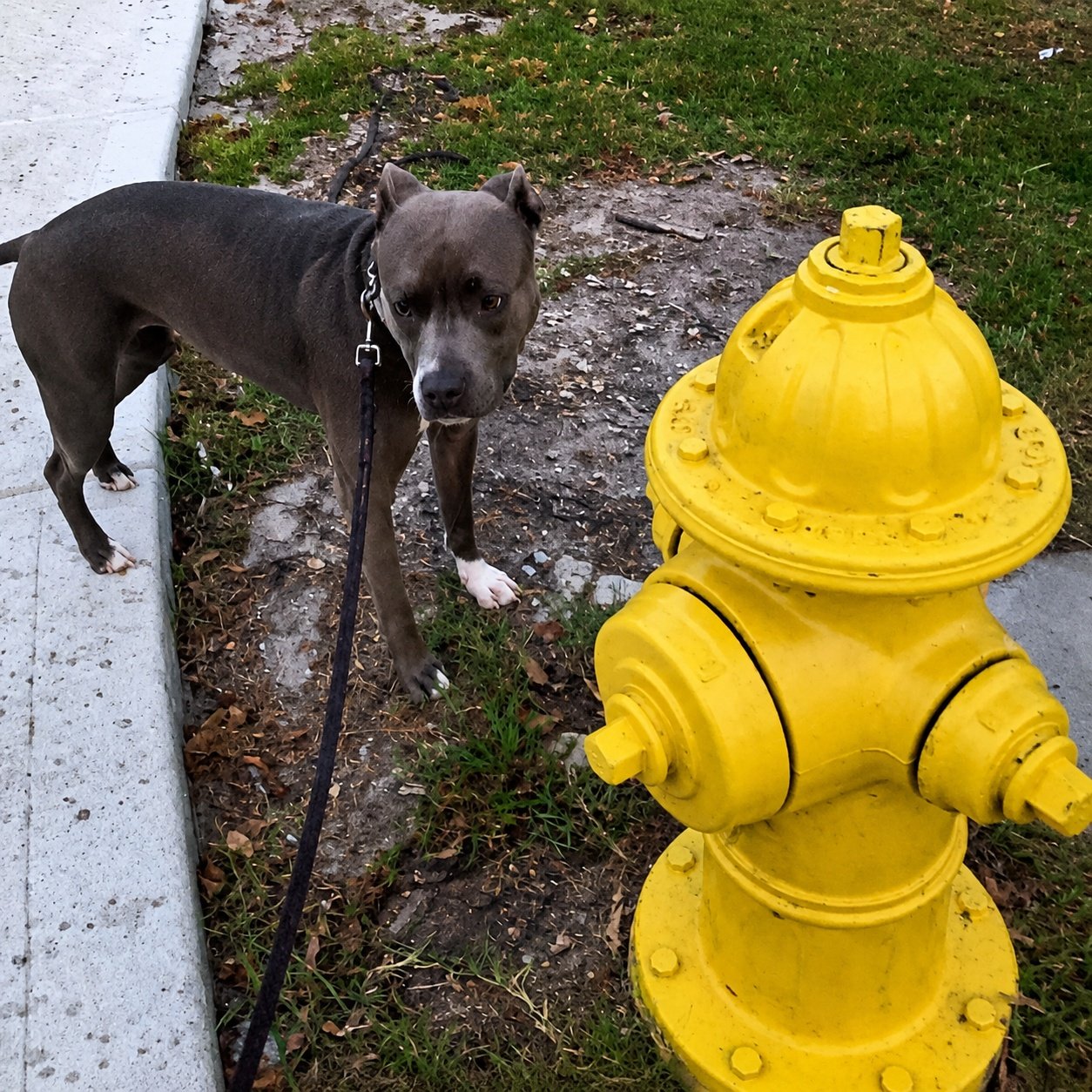
We scroll Facebook. They investigate the fire hydrant.
I am not entirely convinced our version is more sophisticated.
Why Is Sniffing So Important to Dogs?
Humans experience the world primarily through vision. Dogs put far more emphasis on scent.
Their nose helps them investigate where they are, who has been there, what may have happened, what is changing and whether something deserves more attention.
That means a walk isn't only an opportunity to move the legs.
It can also be an opportunity to gather information, make choices, solve tiny puzzles and engage in one of the most natural behaviors a dog has.
Research into canine nosework supports this bigger welfare picture. In one study, dogs who spent time practicing nosework showed a more positive judgment bias than dogs practicing heelwork. The researchers specifically pointed to natural behavior and autonomy — having some control and making choices — as relevant pieces of animal welfare.
That does not mean heelwork is bad.
It means dogs benefit from more than one kind of experience.
Sniffing Is Mental Work
I often remind clients that using the brain can create a very different kind of fatigue than simply covering miles.
That is one reason training sessions, scent games, searching and exploration can be so useful for dogs who need more than another lap around the subdivision.
But I don't love internet formulas that claim five minutes of sniffing equals exactly X minutes of walking. Dogs aren't math problems. A slow senior investigating a new trail, a frantic adolescent scanning for squirrels and a trained scent dog actively solving an odor problem are not doing the same thing simply because all three have their noses down.
What Is a Sniffari?
A “sniffari” is simply a walk — or part of a walk — where exploration becomes more important than mileage.
Instead of marching from Point A to Point B at human speed, you give the dog more time to investigate.
Maybe you use a longer leash in an appropriate area. Maybe you wander through a field or wooded trail. Maybe the dog gets to choose which direction to investigate for a few minutes. Maybe you stop measuring the success of the outing by how many miles your watch recorded.
I like sniffaris.
I just don't believe every minute of every walk has to become one.
Your Walk Can Have Gears
One of the things I taught for years as a trainer is the idea of an on-off switch.
There are times when I expect a dog to move with me. There are times when I want a loose leash, attention and forward movement. There are also times when I can say, essentially, “Go be a dog.”
That might look like:
Those things can all happen on the same walk.
You might heel for several minutes, cross a busy street under control, release the dog to sniff along a grassy area, call him away, walk briskly for another block, practice a few skills and then let him investigate something interesting again.
That's not inconsistency.
That's communication.
Sniffing Can Also Be a Reward
We don't have to treat the environment as something we're constantly competing against.
If your dog desperately wants to investigate a tree, access to that tree can become part of the conversation.
Walk nicely with me. Give me your attention. Don't drag me across the road.
Then: “Go sniff.”
The thing your dog already wanted becomes the reward.
And when I say, “Let's go,” I still expect the feet to move.
Freedom works beautifully when the dog also understands how to leave the freedom and come back to you.
When Should You NOT Let Your Dog Stop and Sniff?
Your dog cannot read the little pesticide sign stuck in the grass.
He does not know that the mysterious object near the curb is goose poop, somebody's discarded chicken wing or something I'd rather not discuss before breakfast.
He also doesn't understand property lines, traffic laws or that Old Man McGrumpypants does not want a Labrador conducting a detailed olfactory investigation of his azaleas.
There are absolutely times when I say no.
Keep Moving When Safety or Behavior Requires It
I am much more likely to keep a dog moving around chemically treated grass, trash, wildlife, unsafe footing, road crossings, private property or anything the dog should not put in his mouth.
I also use more structure when a dog is already overwhelmed by the environment, pulling frantically, fixating on another dog, loading into leash reactivity or becoming so absorbed in the surroundings that the human at the other end of the leash has ceased to exist.
Sometimes the dog needs freedom. Sometimes the dog needs guidance. Knowing which one you're looking at is part of good handling.
What About Reactive Dogs?
This is another place where blanket advice falls apart.
Sniffing and exploration can be wonderful for a reactive dog when they happen in an environment where the dog has enough space and capacity to actually explore.
But if your dog is dragging you from scent to scent while simultaneously scanning for another dog, loading harder with every block and exploding whenever something appears, I am not going to tell you to drop six more feet of leash and hope nature fixes it.
We may need structure first.
We may need distance.
We may need to change where and when you're walking.
And once the dog can move with you and remain below threshold, we can build more appropriate sniffing and exploration back into the outing.
Sniffing Isn't the Same Thing as Physical Exercise
This is especially important after the conversation we've just had about dogs whose lifestyles do not meet their physical needs.
Scent exploration can be tremendously enriching and mentally engaging.
It does not mean your high-energy dog no longer needs to move his body.
The husky-type dog who needed the treadmill, backpack work and ultimately a mountain-hiking human would not have been fulfilled by slowly smelling the same three shrubs for twenty minutes.
Likewise, the dogs who needed room to run still needed room to run.
We cannot substitute one need for every other need simply because we've discovered something beneficial.
This connects directly to: When More Dog Training Isn't the Answer →
Exploration Is More Than Sniffing the Same Neighborhood
One of the easiest ways to enrich a dog's life is simply to change what there is to investigate.
Walk another route.
Go to a quiet park.
Use a long line in an appropriate open area.
Walk on grass, sand, dirt, pine straw or a wooded trail instead of always using the same sidewalk.
Let the dog investigate a fallen log. Follow a scent trail. Search around trees. Notice the wind.
Exploration gives a dog information and opportunities to make decisions.
And some dogs desperately need more of that.
The Nose Can Also Give a Dog a Job
You don't have to stop with casual sniffing.
Dogs can learn to search for food, toys, people or specific odors. You can hide treats around the house, create simple search games in the yard or teach actual scent work.
This is where sniffing moves from casual exploration into purposeful problem-solving.
And for many dogs — particularly dogs bred to hunt, track, search or work independently — that can become a deeply satisfying outlet.
Want to turn the nose into an actual activity? Teaching Your Dog to Find Scent →
And if you have a dog whose genetics are screaming for a job, this connects directly to: Embrace Instincts of the Breed →
For Some Dogs, Sniffing May Be the Best Part of the Walk
This becomes even more important when a dog cannot physically do what he once did.
A senior dog may not cover three miles anymore.
A dog recovering from an injury may temporarily have limits on physical exertion.
An older dog may walk slowly enough that the human starts thinking, We're barely exercising at all.
But that nose can still be very busy.
Sometimes a shorter, slower walk where the dog gets to investigate the world is far more meaningful than dragging an aging dog around the block simply so the human can say the walk was completed.
We can only care for the dog who stands before us today.
Dogs Need Opportunities to Make Choices
We control an enormous amount of our dogs' lives.
We decide when they eat, where they sleep, when the door opens, where the leash goes, which direction we walk, when they get into the car and usually when the fun ends.
Giving a dog safe opportunities to make little choices does not mean giving up leadership.
It may simply mean:
Which side of the path do you want to investigate?
Do you want to smell that tree?
Want to spend another thirty seconds figuring out who peed here?
Go ahead.
Then when it's time: Let's go.
So What Should a Good Dog Walk Look Like?
There isn't one perfect formula.
A young athletic dog may need brisk movement, training and a few purposeful sniffing breaks.
A senior may spend much more of the outing wandering and investigating.
A reactive dog may need a quiet location, lots of distance and carefully chosen opportunities to decompress.
A scent-driven breed may turn a walk through the woods into a full research project.
The point is not to decide that structured walks are bad or sniffaris are good.
The point is to stop treating the walk as though it has only one purpose.
My Version of a Good Walk
Move your body. Practice some manners. Pay attention to each other. Let the dog use his nose. Explore something. Read a little pee-mail. Keep moving when you need to. Stop when you can.
And for the love of dogs, every once in a while put your phone away and experience the walk with the animal you brought with you.
Frequently Asked Questions
Should I let my dog sniff every time he wants to on a walk?
No. Sniffing should be part of the walk, but safety, manners, property boundaries, leash skills and your ability to move the dog when necessary still matter. I like giving dogs deliberate opportunities to sniff rather than allowing every interesting odor to stop the entire outing.
What is “pee-mail” for dogs?
Pee-mail is a playful name for the scent information dogs investigate in urine marks left by other dogs. Scent marking is a form of canine chemical communication, so your dog may be gathering information about animals that have passed through the area.
Is a sniffari good for dogs?
Yes. Giving dogs appropriate opportunities to explore with their nose supports natural behavior, mental engagement and choice. A sniffari can be an excellent form of enrichment, but it does not need to replace structured walking, training or appropriate physical exercise.
Does sniffing tire a dog out?
Olfactory work requires attention and information processing, so scent-based activities can be mentally engaging and tiring. The amount varies by dog and activity, which is why I avoid formulas claiming a specific number of sniffing minutes equals a specific length of physical exercise.
Can sniffing help a reactive dog?
It can be a useful part of decompression when the dog is in an environment where he feels safe enough to explore. A dog who is already over threshold, fixating or dragging the handler toward triggers may need more distance and structure before additional freedom is useful.
Is sniffing enough exercise for a high-energy dog?
Usually not by itself. Sniffing and scent work provide mental enrichment, while many dogs still need sufficient physical movement, conditioning, play or breed-appropriate work. The right balance depends on the individual dog.
Are sniffing walks good for senior dogs?
They can be especially valuable for seniors because the pace can be adjusted to the dog's physical ability while still providing exploration and mental engagement. Physical activity should always fit the senior dog's mobility and medical needs.
Research Behind the Nose
Duranton C, Horowitz A. Let me sniff! Nosework induces positive judgment bias in pet dogs. Applied Animal Behaviour Science. 2019;211:61–66.
Sobol S, Dowling-Guyer S. Effects of scentwork and traditional training classes on dog welfare, behavior, and human-dog bond. Applied Animal Behaviour Science. 2026;297:106924.
Kokocińska-Kusiak A, Woszczyło M, Zybala M, Maciocha J, Barłowska K, Dzięcioł M. Canine Olfaction: Physiology, Behavior, and Possibilities for Practical Applications. Animals. 2021;11(8):2463.
If the Walk Has Become a Battle, That's a Different Problem.
Sniffing should enrich the walk — not leave you being dragged behind a dog who has forgotten you're attached.
If pulling, lunging, reactivity, over-arousal or inability to disengage is making walks miserable, we may need to fix the communication and behavior first so your dog can safely have more freedom later.
Dog Training & Behavior Support →