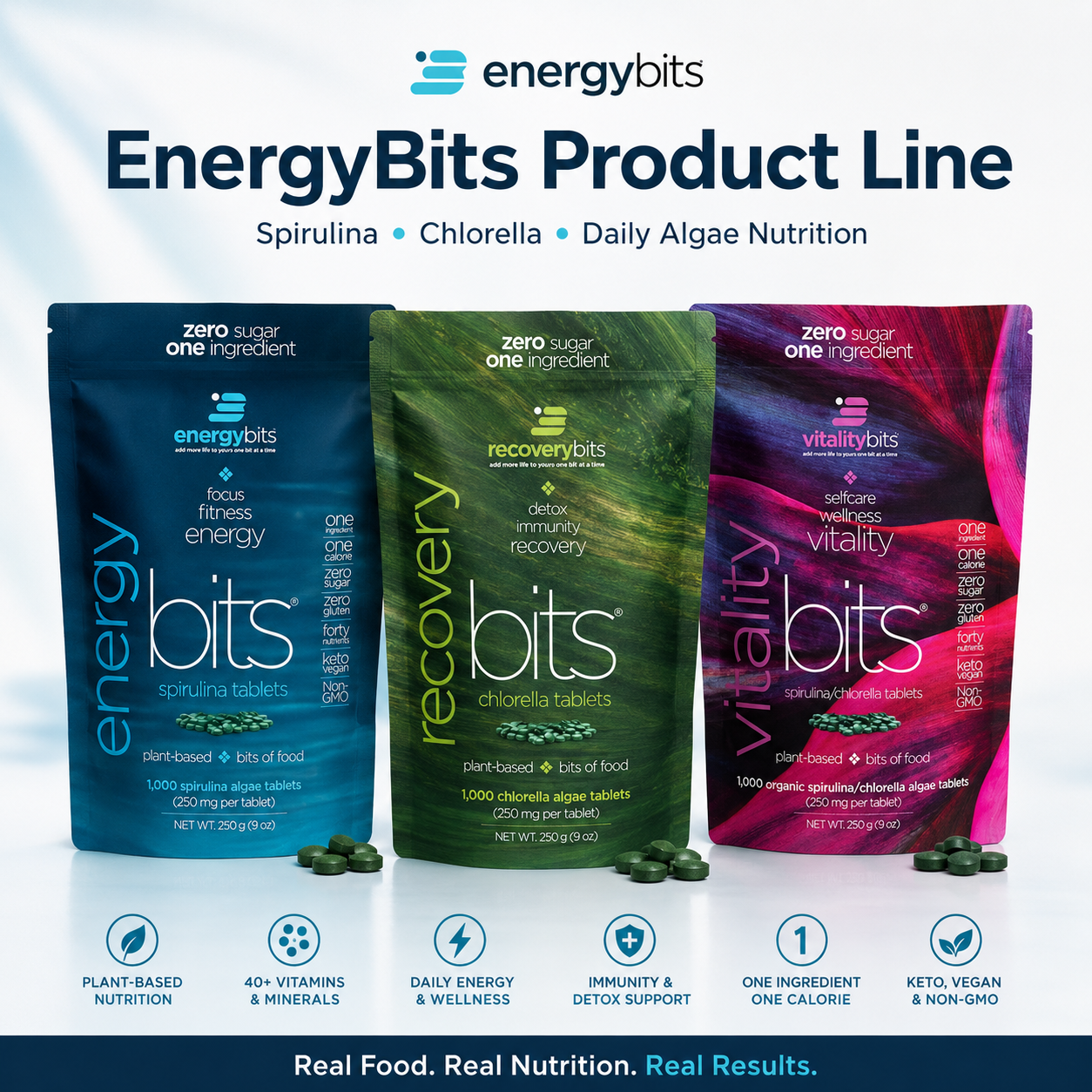

EnergyBits Spirulina & Chlorella for Dogs
Spirulina and chlorella aren't supplements I recommend from a distance. They are part of what I use in my own house — every day.
I take them myself. My dogs get them. And, perhaps most importantly from their perspective, Harvey and Poppy think the little green tablets are treats.
Spirulina and chlorella are both nutrient-dense microalgae, but I don't use them for exactly the same reasons.
I tend to think of spirulina for concentrated green nutrition, antioxidant, immune and gut support, while chlorella becomes especially interesting when I also want gentle binding and detox support.
ENERGYbits has become an easy way for me to use both without adding another complicated powder or giant proprietary blend to the bowl.
Can Dogs Have Spirulina and Chlorella?
Yes. Both spirulina and chlorella can be used as food-based supplements for dogs.
And unlike a lot of trendy “superfoods,” we now have actual canine research showing effects involving gut microbiota, mucosal immunity, antioxidant status, immune response and nutrient utilization.
That doesn't mean algae replaces a balanced fresh-food diet or treats every disease on the internet.
It means these are nutrient-dense whole foods that can earn a very practical place in a dog's wellness plan.
Why They're Part of My Own Dogs' Routine
I think readers deserve to know when I actually use the things I write about.
Spirulina and chlorella aren't sitting unopened in my supplement cabinet.
Harvey gets them as part of his ongoing wellness and detox-support strategy. His plan has included much more than one binder or one supplement — food, water quality, liver support, environmental exposure and other pieces all matter — but chlorella has remained one of the easy everyday tools I use as part of that bigger picture.
Poppy gets them too. With a senior dog, I am always thinking about nutrient density, antioxidant support, gut health, inflammation and resilience. Spirulina and chlorella have been a simple addition that fits beautifully into what I already do for her.
And yes — I take them every day myself.
That's part of why ENERGYbits has stuck around in my house. This isn't a product I remember to use twice and then abandon in the back of a cabinet.
Open the bag and my dogs appear.
Apparently “green algae tablet” translates to “cookie.”
Spirulina for Dogs: More Than a Green Powder
Spirulina — usually Arthrospira platensis — is commonly called a blue-green algae, although technically it is a cyanobacterium.
It is naturally rich in:
- Protein and amino acids
- Phycocyanin
- Carotenoids
- Chlorophyll
- Iron
- Several B vitamins
- Essential fatty acids including GLA
- Various minerals and antioxidant compounds
Yes, Spirulina Is High in Protein. No, It Does Not Replace Your Dog's Meat.
Spirulina is protein-dense by dry weight.
But we're feeding relatively small quantities.
I use spirulina as a nutrient-dense green food, not as a substitute for adequate animal protein.
If your senior dog is losing muscle, I am far more interested in the quality and amount of protein in the actual meals before I start counting protein from algae tablets.
What Are the Benefits of Spirulina for Dogs?
Gut Health
Canine research suggests spirulina can influence the intestinal immune system and support greater stability of the gut microbiota.
Immune Function
Dogs receiving spirulina in a controlled study had higher fecal IgA and a stronger immune response following routine vaccination than control dogs.
Antioxidant Support
Spirulina contains phycocyanin and other compounds associated with antioxidant activity. New canine research has also found changes in antioxidant and inflammatory markers.
Whole-Food Nutrition
Spirulina delivers concentrated amino acids, pigments, minerals and micronutrients in a very small amount of whole-food material.
There Is Real Canine Research on Spirulina
A 42-Week Study: Gut + Immune Support
In a controlled study, adult dogs were fed either a control diet or the same diet supplemented with spirulina.
The spirulina group developed higher fecal IgA, greater gut-microbiota stability and a stronger response to a routine rabies vaccination.
Body weight, food intake and routine blood chemistry did not significantly differ between groups.
Newer Research in Working Dogs
A newer study followed German Shepherd working dogs receiving either their normal food or spirulina supplementation.
Researchers reported changes involving antioxidant status, inflammatory and immune markers, intestinal-health markers and selected fecal bacteria.
It's a small exploratory study, so I don't turn it into proof that spirulina treats disease. But it adds another layer of dog-specific evidence around gut, immune and antioxidant support.
Quality Matters Enormously With Spirulina
This may be more important with algae than with many other supplements.
Blue-green algae products can potentially be contaminated by unwanted cyanobacteria and toxins such as microcystins when growing conditions and quality control are poor.
This Is Why I Don't Buy Mystery Green Powder
I want to know:
- Where it was grown
- Whether the water source is controlled
- Whether batches are tested for contaminants
- Whether heavy metals and microcystins are monitored
- What species I'm actually buying
- Whether anything else has been added
Cheap algae isn't necessarily cheap if I don't trust what's in it.
Chlorella for Dogs: Nutrition + Gentle Detox Support
Chlorella is a green freshwater microalgae.
Like spirulina, it contains protein, pigments, minerals and other nutrient compounds.
But chlorella has a more substantial cell wall, which is why quality products are often cracked or broken-cell-wall products to make the nutrients inside more accessible.
When I'm thinking about chlorella for dogs, I usually have two things in mind:
whole-food nutrition + gentle detox and binding support.
Why Chlorella Has Stayed in Harvey's Detox Strategy
Harvey is one of the reasons this isn't just theoretical for me.
I've used chlorella as one piece of his ongoing detox-support plan because I'm not interested in treating detox like a one-week event where we throw a binder at the dog and declare victory.
For me, long-term lower-tox support means looking at things such as:
- The food going into the dog
- Drinking water
- Environmental and chemical exposures
- Gut health
- Liver support
- Regular elimination
- Hydration
- Appropriate binders or binding foods
Chlorella has a job inside that plan. It isn't the entire plan.
That's an important distinction because I don't want someone buying chlorella and assuming everything else suddenly becomes irrelevant.
What Are the Benefits of Chlorella for Dogs?
Gut + Microbiome Support
Canine microalgae research found that Chlorella vulgaris influenced fecal microbiota and increased protein digestibility without negatively affecting overall nutrient digestibility.
Concentrated Green Nutrition
Chlorella contains amino acids, chlorophyll, minerals, fatty acids and other compounds that make it useful as a nutrient-dense food addition.
Gentle Binding Support
Chlorella is commonly used in natural detoxification strategies because of its cell-wall and binding characteristics.
Everyday Wellness Support
Because it provides both green-food nutrition and gentle binding support, chlorella is one of the easier foods for me to incorporate into a broader daily wellness plan.
What Does the Dog Research Say About Chlorella?
Chlorella has less direct canine research than spirulina, but it isn't completely unstudied.
A canine microalgae study evaluated Chlorella vulgaris and other microalgae in healthy dogs.
Dogs tolerated dietary inclusion without detrimental effects on overall food intake or nutrient and energy digestibility.
Chlorella supplementation was associated with increased protein digestibility, while microalgae supplementation altered fecal microbiota.
Nutrition Is the Stronger Canine Claim
We have legitimate dog research supporting chlorella as a nutritional microalgae ingredient with effects on digestion and the gut environment.
I also use chlorella for gentle detox and binding support.
What we do not have is a giant canine clinical trial showing that chlorella removes a specific percentage of every heavy metal, pesticide or mold toxin from dogs.
I can use it without turning it into a miracle detox powder.
Chlorella for Heavy Metals, Mold and Environmental Toxins
I use chlorella as one of the gentler layers in lower-tox support.
I may consider it when a dog has:
- Routine environmental exposure
- A history of highly processed food
- Repeated medication exposure
- Flea, tick or heartworm chemical exposure
- Seasonal detox support
- Mold or mycotoxin concerns
- Heavy-metal concerns
- A need for additional green-food nutrition
Sometimes Chlorella Is Enough. Sometimes It Isn't.
For everyday environmental support, chlorella may be exactly the gentle layer I want.
When I'm dealing with significant documented heavy-metal exposure, mold exposure or another larger detox problem, I may want more targeted binding support as part of the plan.
Spirulina vs. Chlorella for Dogs: Which One Do I Use?
I Lean Toward Spirulina When...
- I want daily nutrient density
- Gut and immune support are priorities
- I want antioxidant support
- The dog is aging
- Recovery or resilience is a priority
- I want an easy concentrated green food
I Lean Toward Chlorella When...
- Gentle detox support is part of the goal
- Environmental exposure is part of the picture
- I want green nutrition plus binding support
- The dog is in one of my seasonal detox periods
- Gut and elimination support are already part of the plan
In My House? I Like Having Both.
This doesn't need to become the Spirulina vs. Chlorella Olympics.
My own dogs benefit from having access to both types of algae because I'm interested in both the nutritional side and the detox-support side.
And because they happily eat the tablets as treats, this may be one of the least dramatic things I ask them to do for their health.
Spirulina and Chlorella for Senior Dogs
This category makes particular sense to me for aging dogs — and Poppy is a good example of why.
With her, I'm thinking proactively about:
- Nutrient density
- Gut health
- Immune resilience
- Antioxidant support
- Inflammatory burden
- Environmental exposure
- Recovery
- Maintaining vitality as she ages
Spirulina and chlorella are easy pieces to layer into that bigger senior plan.
But I won't pretend a green tablet replaces the basics.
If Poppy isn't getting enough quality protein, spirulina isn't going to preserve her muscle for me.
If digestion changes, I address digestion.
If mobility changes, I address mobility.
That's the way I approach senior dogs: keep building the foundation while using targeted tools where they make sense.
Explore Senior Dog Health & Longevity →
Spirulina and Chlorella as Part of Detox Support
I like algae as one of the gentler layers in a lower-tox lifestyle.
But a good detox plan isn't:
chlorella + binder + milk thistle + cross your fingers.
I want to think about:
- Reducing the incoming exposure
- Water quality
- Hydration
- Fresh food
- Regular bowel movements
- Liver support
- Kidney support
- Lymphatic movement
- Gut health
- Binders when appropriate
Read: Detox for Dogs — What Are We Actually Trying to Accomplish? →
Can Spirulina or Chlorella Balance Homemade Dog Food?
No.
They're nutrient-rich foods.
They're not magic balancing dust.
A homemade diet can still be deficient in nutrients such as:
- Calcium
- Iodine
- Zinc
- Copper
- Vitamin D
- Specific fatty acids
depending on the recipe.
Spirulina and chlorella add nutritional value. They do not remove the need to evaluate the actual diet.
Why ENERGYbits Is the Brand I Actually Use
I can buy spirulina and chlorella from a lot of companies.
ENERGYbits is what I buy for myself and my dogs.
That matters to me because algae is one category where I care enormously about sourcing, growing conditions and contaminant testing.
I also like that the products are simple:
ENERGYbits®
100% spirulina.
This is my choice when I specifically want the nutritional, antioxidant, gut and immune side of spirulina.
RECOVERYbits®
100% chlorella.
I lean here when green-food nutrition plus detox and gentle binding support are more central to the plan.
VITALITYbits®
50% spirulina + 50% chlorella.
This is the easy option when I want both without making the supplement routine more complicated.
I take them daily.
My dogs get them daily.
And unlike some supplements I have to hide, disguise, pulverize or negotiate over, Harvey and Poppy happily eat these right out of my hand.
That counts for something.
Shop ENERGYbits Through Dana →How Much Spirulina or Chlorella Can I Give My Dog?
ENERGYbits provides pet guidance based on body weight.
I still prefer introducing any new food or supplement gradually, particularly with a sensitive or medically complicated dog.
The tablets can be:
- Given whole as treats
- Crushed into food
- Broken into smaller pieces
Mine vote strongly for the “hand them over as treats” method.
Can Spirulina or Chlorella Cause Side Effects?
Most dogs tolerate quality algae well, but I still watch the dog.
Possible signs to reassess include:
- Loose stool
- Gas
- Nausea
- Reduced appetite
- Itching or another unusual reaction
I would not automatically label diarrhea or itching a wonderful “detox reaction.”
The dog is giving us information. Listen to it.
Dana's Take: This One Lives in My House
There are products I research.
There are products I occasionally use.
And then there are products that simply become part of the routine.
Spirulina and chlorella fall into that last category for me.
I take them every day.
Harvey gets them as part of the long-term work I've done around lowering his environmental burden and supporting normal detoxification.
Poppy gets them because, especially as she ages, I want nutrient-dense food, antioxidant support, a healthy gut and as much resilience as I can reasonably build into her everyday routine.
And both dogs think I am handing them treats.
Everybody wins.
That doesn't mean I expect spirulina or chlorella to fix a lousy diet, remove every toxin or replace a targeted protocol when a dog has a serious problem.
It means I think these little green foods offer enough nutritional and practical value that they've earned a permanent seat at our table.
Frequently Asked Questions About Spirulina & Chlorella for Dogs
Can dogs have spirulina?
Yes. Spirulina has been directly studied in dogs and has been associated with changes in gut immunity, microbiota stability, antioxidant status and immune response. Product quality and contaminant testing are important.
What are the benefits of spirulina for dogs?
Spirulina provides concentrated whole-food nutrition and antioxidant compounds. Canine studies have also reported effects involving fecal IgA, gut-microbiota stability, immune response and antioxidant and inflammatory markers.
Can dogs have chlorella?
Yes. Chlorella has been studied as a canine dietary microalgae ingredient and may provide concentrated green nutrition while also fitting into gentle detox and binding strategies.
Does chlorella detox dogs?
Chlorella is commonly used as part of natural detox strategies because of its binding characteristics. I use it as one piece of ongoing detox support rather than expecting it to be the entire detox plan.
Is spirulina or chlorella better for dogs?
Neither is automatically better. I lean toward spirulina for nutrient density, antioxidants, immune and gut support, and toward chlorella when I also want gentle detox and binding support. I commonly use both.
Can I give spirulina or chlorella to my dog every day?
They can be used as part of a daily food-supplement routine when tolerated and appropriate for the individual dog. I personally use them daily with my own dogs as part of their broader wellness plans.
Do dogs like ENERGYbits?
Mine do. Harvey and Poppy eat the tablets directly from my hand and treat them like little green treats, which makes them one of the easier additions to our daily routine.
Can senior dogs take spirulina and chlorella?
Yes. I use both with my own senior dog as part of a broader strategy focused on nutrient density, gut health, antioxidant support and resilience. They do not replace adequate protein, balanced nutrition or appropriate care for age-related health problems.
Can spirulina or chlorella balance homemade dog food?
No. Both are nutrient-rich foods but neither automatically provides every nutrient required to balance a homemade recipe.
Keep Reading
Want to Build a Better Everyday Wellness Plan for Your Dog?
Spirulina and chlorella are easy additions in my own house.
But your dog's plan might need algae — or it might need better food, gut support, minerals, targeted detox support or something completely different.
I can help you figure out what actually earns a place in the bowl.
Request a Discovery Callback → Explore Membership →Canine Research on Spirulina & Chlorella
Satyaraj E, et al.
Supplementation of Diets With Spirulina Influences Immune and Gut Function in Dogs.
View on PubMed →
Abdelhady HA, et al.
Integrated effects of dietary supplementation of Spirulina platensis in working dogs.
View on PubMed →
Cabrita ARJ, et al.
Effects of microalgae as dietary supplement on palatability, digestibility, fecal metabolites, and microbiota in healthy dogs.
View on PubMed →