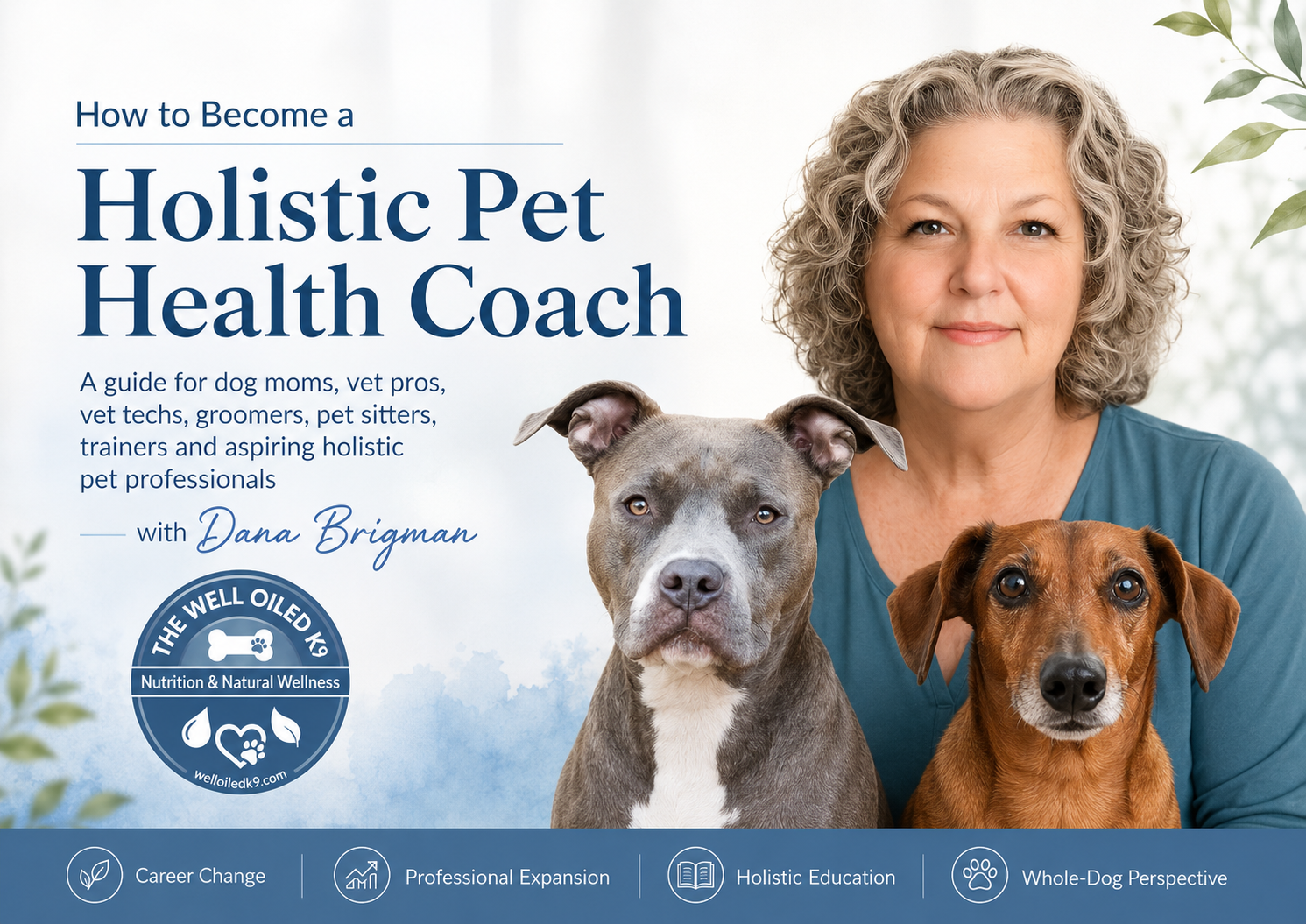
How to Become a Holistic Pet Health Coach
Maybe you are the dog mom who keeps reading, learning and asking better questions because one of your own dogs changed the way you look at health.
Or maybe you are already a veterinarian, veterinary technician, dog trainer, groomer, pet sitter, rescue professional, canine bodyworker or another dog professional and keep thinking: I want to understand more than my current role allows me to.
That was part of my path too.
I had already spent years professionally working with dogs and studying canine behavior and nutrition before I completed Dr. Ruth Roberts' Certified Holistic Pet Health Coach program.
I did not take the course because I wanted another collection of letters after my name.
I wanted to understand more of the dog.
Nutrition. Digestion. Inflammation. Lifestyle. Environmental exposures. Medications. Stress. Aging. Recovery. Traditional Chinese Veterinary Medicine concepts. Functional health.
And most importantly, how those pieces may interact instead of treating every concern as if it lives in its own little box.
What Is a Holistic Pet Health Coach?
A holistic pet health coach is an educator and wellness professional who helps pet parents better understand nutrition, lifestyle, environment, whole-pet wellness and supportive care while staying within a non-veterinary scope of practice.
A pet health coach is not a replacement for a veterinarian.
We do not diagnose disease, prescribe medications, perform veterinary procedures or tell a client to disregard necessary veterinary care.
The useful role is different.
A good coach may help a pet parent understand food choices, prepare questions for the veterinary team, recognize patterns in the dog's history, evaluate lifestyle and environmental factors, organize information, support healthier daily habits and connect the pieces between veterinary visits.
In my own practice, I specialize in dogs and combine that health-coaching education with my separate education and experience in canine nutrition, fresh-food feeding, dog behavior, animal aromatherapy, herbs, homeopathy, senior wellness and other supportive modalities.
A certification can give you a framework. It does not magically make someone an expert in every dog, every disease or every modality. Experience, continuing education, critical thinking and knowing your scope still count.
You Do Not Have to Be Starting From the Same Place I Did.
People search for pet health coach certification for very different reasons. Some want a new career. Others want to expand the work they already do. And some simply want to become far better advocates for their own animals.
The Dog Mom Who Wants to Know More
Maybe one complicated dog sent you down the rabbit hole of food, gut health, medications, supplements and natural wellness.
You may not know whether you ever want clients. You simply know you want structured education instead of another 400 open browser tabs.
Veterinarians & Veterinary Technicians
Some veterinary professionals want additional education in nutrition, functional wellness, TCVM concepts and holistic approaches they may want to explore more deeply.
It may complement — not replace — the clinical education and legal authority you already have.
Dog Trainers, Groomers & Pet Sitters
You already notice things.
The dog whose behavior suddenly changed. The recurring ear debris. The coat that looks different. The dog gaining weight, losing muscle, having chronic stool changes or simply not seeming like himself.
Health education can make you a better observer and stronger referral partner without turning you into the veterinarian.
The Dog Professional Ready for Something More
Rescue workers, kennel professionals, canine massage practitioners, pet retailers, breeders, shelter staff, walkers, daycare owners and other dog professionals may want to expand their services or move into a more education-focused career.
What About Veterinarians and Vet Techs?
Veterinary professionals come to holistic and integrative education from a very different starting point than most pet parents.
You already understand anatomy, physiology, disease, diagnostics, medications, medical records and clinical responsibility.
What may be missing — or simply something you want to explore more deeply — is a broader framework around nutrition, functional health, lifestyle and complementary wellness.
Dr. Ruth Roberts is a veterinarian, and her program incorporates conventional veterinary knowledge with functional medicine and Traditional Chinese Veterinary Medicine concepts.
For a veterinarian, this education may expand the way you approach conversations about nutrition and whole-pet wellness.
For a veterinary technician, it may also open additional avenues for client education, wellness support or a future career outside — or alongside — the traditional clinic environment, depending on your state's laws and professional scope.
What the Program Added to My Own Work
I came into holistic pet health coaching with an advantage and, frankly, a complication:
I already knew enough to have a lot more questions.
I was already a professional dog trainer and behaviorist. I had already studied canine nutrition, raw feeding and fresh-food diets. I had already spent years working with dogs and dog parents.
The health-coaching education helped me broaden the lens.
Instead of only asking what food a dog eats, I became even more interested in why digestion was changing, what medications had preceded the change, whether inflammation was showing up in multiple systems, whether behavior might be telling us something about pain or discomfort, and what patterns in the dog's history deserved another look.
It strengthened the part of my work that now says:
Before we add another thing, what are we actually trying to accomplish, and what piece of this dog's story are we looking at?
It also gave me another professional framework for working collaboratively. Sometimes my recommendation is nutritional. Sometimes it is lifestyle. Sometimes I want more testing.
Sometimes I want the pet parent to go back to the veterinarian with a very specific question.
Knowing when the next step belongs to someone else is part of doing this work well.
What Does Dr. Ruth Roberts' Holistic Pet Health Coach Program Cover?
The program has continued to evolve since I completed my certification, so my student experience and today's curriculum are not necessarily identical.
The current certification is described as a 16-week structured program combining self-paced learning with live coaching and mentorship.
Whole-Pet Health Foundations
Functional-health concepts, Traditional Chinese Veterinary Medicine principles, nutrition and a broader look at factors that can influence health over time.
Supportive Wellness Tools
Nutritional principles, wellness strategies and complementary approaches taught within an ethical, non-veterinary coaching scope.
Cases & Critical Thinking
Real-life scenarios and discussions designed to help students apply information instead of simply memorizing a stack of protocols.
Live Coaching & Mentorship
The current program includes group coaching, mentor support and opportunities to ask questions while working through the material.
Business Education
For students planning professional work, the program also addresses services, pricing, client communication and building a pet-health coaching practice.
Community & Continuing Education
Students and graduates have access to professional community and continuing-learning opportunities beyond the core certification.
Curriculum, pricing, bonuses, continuing-education eligibility and enrollment terms can change. Review the current official program information before enrolling.
What a Pet Health Coach Certification Does Not Make You
This deserves its own section because there is far too much confusion online about titles and qualifications.
Completing a holistic pet health coach certification does not make a non-veterinarian a veterinarian.
It does not give you authority to diagnose disease, prescribe medication, perform medical procedures or practice veterinary medicine without a license.
It also does not automatically make someone a canine nutritionist, animal aromatherapist, herbalist, homeopath or behaviorist unless that person has completed separate education and experience in those fields.
That distinction is important to me because my own practice pulls from several different areas of education.
Those credentials did not all come from one course.
Good pet health coaching should make veterinary collaboration better, not turn every client interaction into “your veterinarian is wrong.”
Scope-of-practice laws vary by state and country. Anyone building a professional pet-health-coaching business should understand the laws where they work and carry appropriate professional liability coverage.
What Could You Do With Pet Health Coach Education?
There is no single job description for a holistic pet health coach. Your existing education and professional background will influence where the training may fit.
| Your Background | How Health-Coaching Education Could Complement It |
|---|---|
| Dog Trainer / Behavior Professional | Better recognition of nutrition, pain, digestion, stress, medication and lifestyle factors that may affect behavior, while referring medical concerns appropriately. |
| Veterinarian | Additional structured education in holistic, functional, nutritional and TCVM-oriented wellness approaches that may complement clinical practice. |
| Veterinary Technician | Deeper wellness education, additional client-education skills and potential career options inside or outside traditional clinical practice within legal scope. |
| Dog Groomer | Greater understanding of how skin, coat, ears, diet and whole-dog wellness may intersect, while knowing when a dog needs veterinary evaluation. |
| Pet Sitter / Dog Walker | Better observation of appetite, stool, mobility, behavior, hydration and other changes because you often see the dog in everyday life. |
| Canine Massage / Bodywork Professional | A broader wellness framework around mobility, nutrition, inflammation, aging and recovery. |
| Rescue / Shelter Professional | More tools for understanding nutrition, stress, recovery, environmental health and dogs arriving with incomplete histories. |
| Dog Mom / Pet Parent | A structured way to deepen your knowledge for your own dogs, whether or not you ever turn that education into professional work. |
| Corporate Career Changer | A possible educational foundation for building a dog- or pet-centered career, especially when combined with your existing professional skills and additional animal-specific education. |
Is a Holistic Pet Health Coach Certification Worth It?
For me, yes.
But I would not tell you that one certification alone creates a successful pet health coach.
The certificate did not replace the years I had already spent training dogs, working with clients, studying nutrition and learning how to communicate with overwhelmed dog parents.
And it did not end my education.
It became another very important layer.
If your goal is to pay for a course, put “holistic” in your Instagram bio next week and start handing out medical advice, I would tell you this is the wrong mindset.
If your goal is to study seriously, understand your limits, continue learning, build professional relationships and become better at helping pet parents make informed decisions, the training can have real value.
The best pet professionals I know are not the ones who think they know everything. They are the ones who know enough to keep asking better questions.
Five Questions I Would Ask Yourself First
- Do I want this education primarily for my own dogs, professional expansion or a new career? Any of those answers can be legitimate, but they lead to different next steps.
- Am I willing to continue learning after certification? Nutrition, research, products and health information keep changing. Graduation is not the finish line.
- Can I stay inside my scope? Helping someone understand options is different from diagnosing and treating their animal.
- Do I actually like working with people? Pet health coaching sounds like a job about animals. A tremendous amount of it is helping humans understand information, priorities, expectations and next steps.
- What will make my eventual work distinct? Maybe that is senior dogs, fresh-food nutrition, behavior, rescue dogs, veterinary-client education or another area where your existing experience gives you depth.
Questions About Becoming a Holistic Pet Health Coach
Do you need to be a veterinarian to become a holistic pet health coach?
No. Holistic pet health coaching is a non-veterinary educational and wellness role. Non-veterinary coaches must stay within the laws and scope-of-practice requirements where they work and cannot diagnose, prescribe or practice veterinary medicine.
Can veterinary technicians become holistic pet health coaches?
Yes. Veterinary technicians may use holistic pet health education to deepen their knowledge of nutrition, wellness and complementary approaches. Current continuing-education acceptance should be verified with the certification provider and applicable licensing authority.
Can a dog trainer, groomer or pet sitter become a pet health coach?
Yes. Existing dog professionals often bring valuable hands-on observation and client experience to health coaching. Additional education can expand that knowledge while maintaining appropriate boundaries with veterinary medicine.
Can you become a pet health coach just to help your own dog?
Yes. Not everyone who completes pet-health education needs to build a business. Some dog parents pursue structured training simply because they want to make more informed decisions for their own animals.
How long does it take to become a Certified Holistic Pet Health Coach?
Dr. Ruth Roberts' current certification program is described as a 16-week structured program. Curriculum, format and enrollment terms may change, so confirm current details directly with the program.
Is a holistic pet health coach the same as a canine nutritionist?
No. Pet health coaching and canine nutrition are overlapping but different areas of education. A holistic pet health coach may study nutrition as part of a broader wellness curriculum, but that does not automatically equal a separate canine nutrition certification.
Can a holistic pet health coach diagnose or treat disease?
A non-veterinary pet health coach should not diagnose disease, prescribe medication or present coaching as veterinary treatment. Coaches educate, support wellness decisions, help clients organize information and refer appropriately to veterinary professionals.
Can pet health coaching become a full-time career?
It can become a paid professional service, but certification does not guarantee income or a particular business outcome. Building a practice also requires experience, communication skills, ethical boundaries, business systems, marketing and ongoing education.
Can I specialize in dogs instead of all pets?
Absolutely. Broad pet-health education can be combined with a species-specific professional focus. My own practice is centered on dogs, with additional education and experience in canine nutrition, behavior and whole-dog wellness.
Take a Look at the Training and Decide Whether It Fits Your Next Chapter.
You may be looking for a career change, another layer of professional education or simply a much deeper understanding of the animals already in your life.
Read the current curriculum. Look at the time commitment. Ask questions. Be clear about what you want the education to help you do.
Then decide whether it makes sense for you.
Affiliate link: I may receive compensation if you enroll through my link. Your price is not increased because of my referral.