

Why I Usually Recommend One Homeopathic Remedy at a Time for Dogs
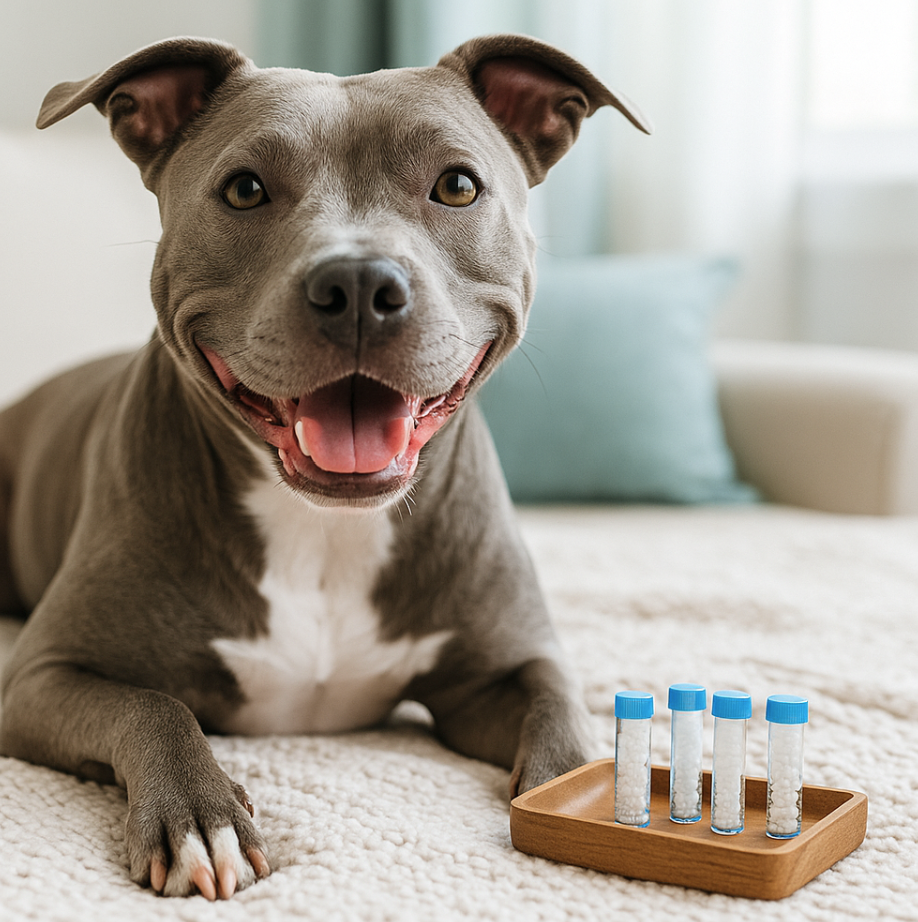
Homeopathy can become confusing very quickly.
You find one remedy that sounds promising. Then another seems to match one of the symptoms. A third appears in an online discussion. Before long, your dog has received Arnica, Rhus tox, Nux vomica, and something from a combination bottle—and nobody knows which remedy did what.
That is why I generally recommend:
Choose one well-matched homeopathic remedy, give it, and observe before adding another.
This is not because combining remedies is universally forbidden.
It is because one remedy at a time gives us cleaner information.
When the dog improves, worsens, develops new symptoms, or does nothing at all, we have a better chance of understanding the response.
Homeopathy Depends on Observation
Homeopathy is not only about choosing a remedy.
It is also about watching what happens next.
After giving a remedy, we want to know:
Did the dog become more comfortable?
Did restlessness decrease?
Did sleep improve?
Did appetite return?
Did the original symptom lessen?
Did the same pattern return later?
Did entirely new symptoms appear?
Was there no observable response?
Those answers guide the next decision.
But when several remedies are given together or in rapid succession, the response becomes much harder to interpret.
You may know that something changed.
You may not know why.
What Happens When Several Remedies Are Given at Once?
Imagine that your dog is stiff and uncomfortable after a long day of activity.
You give:
Arnica because there may be bruised soreness
Rhus tox because the dog is stiff
Ruta because ligaments might be involved
Bryonia because it was listed under joint pain
An hour later, the dog gets up and moves more comfortably.
Which remedy helped?
Was it Arnica?
Was it Rhus tox?
Was the dog going to improve after resting anyway?
Should any remedy be repeated?
Did one remedy fit while the others simply added noise?
There is no reliable way to know.
That may not seem important in one minor situation. But over time, this habit prevents you from learning how your dog responds.
One Remedy Gives You a Clearer Response
When one remedy is chosen thoughtfully, the process becomes much cleaner:
Observe the dog.
Identify the strongest pattern.
Choose the closest remedy.
Give one dose.
Record the time.
Watch the dog.
Stop when improvement begins.
Reassess if the pattern changes.
This does not guarantee that the first remedy will be correct.
It gives you usable information.
If nothing happens, you can reassess the remedy choice.
If improvement begins, you know which remedy was given.
If improvement fades and the same pattern returns, you can decide whether repeating makes sense.
If new symptoms appear, you can evaluate whether the case changed or the remedy may have contributed.
Clarity matters.
Does One Remedy Need to Match Every Symptom?
No.
A remedy does not need to match every small detail in the dog’s history.
We are looking for the remedy that best matches the most characteristic current pattern.
That may include:
The cause
The affected tissue
The sensation
What makes the symptoms better or worse
The dog’s emotional or behavioral response
Appetite and thirst
Temperature preference
The timing and progression of symptoms
For example, a dog may have pain, stiffness, irritability, and reduced appetite after an injury.
We do not necessarily need one remedy for pain, another for stiffness, a third for irritability, and a fourth for appetite.
Those symptoms may belong to one overall remedy picture.
The goal is to find the best match to the dog—not assign a separate pellet to every symptom.
Why Symptom Stacking Is So Tempting
Dog parents often stack remedies because they want to cover all the bases.
The thinking goes:
“Arnica helps trauma, Ruta helps ligaments, and Hypericum helps nerves—so maybe I should give all three just in case.”
I understand the instinct.
But homeopathy is not usually more effective because we included every conceivable possibility.
When we are uncertain whether the primary issue is bruised tissue, ligament strain, or nerve pain, the solution is not always to give all three remedies.
The better first step is to observe more carefully:
Is the dog generally bruised and sore?
Is the pain focused around a tendon or ligament?
Is the pain sharp, shooting, radiating, or disproportionate to the visible injury?
Is movement better or worse?
Is the dog improving with rest?
Does the injury need veterinary assessment?
Sometimes we need better information before we need another remedy.
Acute First Aid May Be Sequential
Using one remedy at a time does not mean the dog can only receive one remedy for an entire incident.
Different remedies may become appropriate at different stages.
For example, after an accident:
Aconite may initially fit the sudden panic or shock.
Arnica may later fit bruised soreness.
Hypericum may become relevant if nerve pain becomes clear.
Ruta may be considered later if tendon or ligament soreness dominates.
That is sequential use.
Each remedy is chosen according to the pattern present at that stage.
This is different from giving all four together at the beginning.
The case changes, and the remedy may change with it.
How Long Should Remedies Be Separated?
There is no single spacing rule for every situation.
The time between remedies depends on:
How acute the problem is
How quickly symptoms are changing
Whether the first remedy produced a response
The potency used
The dog’s sensitivity
Whether the problem is minor or medically significant
Whether the pattern has clearly changed
In a rapidly changing acute situation, a different remedy may occasionally become indicated within a relatively short period.
In a stable mild situation, several hours of observation may provide better information.
In a chronic case, the remedy may need days or longer to show its full response.
The principle is not:
Always wait exactly four hours.
The principle is:
Do not introduce another remedy before you have reasonably evaluated the first response.
When the First Remedy Helps
When the dog improves after one remedy:
Stop repeating
Do not add a second remedy
Continue observing
Record what changed
Allow the improvement to continue
This sounds obvious.
Yet dog parents frequently add another remedy because one symptom remains.
For example, the dog may become calmer, sleep comfortably, and move more easily—but still have mild residual soreness.
That does not necessarily mean another remedy is needed immediately.
Recovery may take time.
Do not interrupt clear improvement simply because the dog is not completely restored in 20 minutes.
When the First Remedy Does Nothing
No response may mean:
The remedy was not a close match
The remedy needs more time
The potency or repetition was not appropriate
The condition requires another kind of support
The problem is progressing
Veterinary care is needed
The symptoms were not severe enough to create an obvious change
Before switching remedies, reassess the dog.
Ask:
Is the original pattern still present?
Did I select the remedy based on a general complaint or a clear pattern?
Are there stronger symptoms now?
Has the dog remained stable?
Am I expecting an unrealistically fast response?
Is homeopathy still the most sensible tool?
Do not replace one uncertain remedy with another uncertain remedy simply because the first did not perform on command.
When the Symptom Picture Changes
A changed pattern may justify a changed remedy.
Suppose a dog initially experienced sudden panic after an accident and then settled after Aconite.
Several hours later, the fear is gone, but the dog is bruised, sore, and reluctant to be touched.
The current picture may now resemble Arnica more closely.
That does not mean Aconite failed.
It may have completed its job, and the next phase now looks different.
Before changing remedies, make sure:
The first remedy is no longer acting
The dog is not still improving
The new pattern is genuinely clear
You are not treating every minor residual symptom
The dog does not need veterinary care
The remedy follows the dog.
The dog does not remain committed to the first remedy forever.
What About Combination Homeopathic Products?
Combination products contain several homeopathic remedies in one formula.
They are often marketed for broad categories such as:
Calming
Digestion
Injury
Allergies
Joint discomfort
Urinary support
Teething
Travel
These products can be convenient, particularly for dog parents who do not yet know how to differentiate individual remedies.
But there are trade-offs.
With a combination product, it can be difficult to know:
Which remedy matched
Whether several remedies were unnecessary
Which ingredient caused a change
What should be repeated
Whether the same formula is still appropriate as the pattern evolves
Combination products may have a place.
They are not the same as individualized homeopathy.
I am not saying every combination product is bad or that nobody should ever use one.
I am saying that when our goal is to understand the dog’s response and improve remedy-selection skills, single remedies give us clearer feedback.
Do Combination Products “Cancel Each Other Out”?
Not necessarily.
The claim that multiple homeopathic remedies automatically cancel one another is too simplistic.
Some products are intentionally formulated with several remedies, and some practitioners use combinations or alternating remedies according to specific systems.
My concern is usually not that every combination is inherently invalid.
My concern is that casual stacking makes the case difficult to read.
The practical questions are:
Why are these remedies being combined?
Is there a clear rationale?
Is the dog’s response being monitored?
Is the product being used short term or indefinitely?
Is the dog stable?
Would one well-selected remedy provide clearer information?
Those questions matter more than repeating a rigid rule that remedies must never be combined under any circumstances.
What About Alternating Remedies?
Alternating remedies means giving one remedy, then another on a schedule.
For example:
Remedy A in the morning
Remedy B in the evening
Repeat daily
Some protocols use this approach.
But alternating should not be confused with individualized prescribing.
When two remedies are alternated automatically, it may be difficult to know:
Whether both are needed
Whether one is working
Whether one is interfering with observation
Whether symptoms changed
Whether the schedule should continue
I generally do not recommend alternating remedies casually—especially in chronic cases—without a clear reason and a plan for reassessment.
A schedule should not replace observation.
Chronic Cases Need More Space
Chronic homeopathy requires more restraint than acute first aid.
A deep or well-matched remedy may produce changes that unfold over days or weeks.
Those changes may include:
Better sleep
Improved emotional regulation
Changes in appetite
Shifts in digestion
Return of energy
Temporary reappearance of older symptoms
Gradual improvement in the primary complaint
Adding another remedy too quickly can interrupt our ability to see the full response.
In a chronic case, giving one remedy and waiting does not mean we are doing nothing.
We are watching:
The direction of change
Which symptoms improve first
Whether the dog’s overall vitality improves
Whether the original complaint changes
Whether new symptoms appear
How long the response lasts
Constantly changing remedies may create the illusion of action while preventing us from understanding the case.
One Homeopathic Remedy Does Not Mean One Holistic Modality
This distinction matters.
Using one homeopathic remedy at a time does not mean your dog cannot receive other appropriate support.
Depending on the situation, the dog may also need:
Veterinary treatment
Pain medication
Fluids
Wound care
Fresh-food nutrition
Digestive support
Herbs
Essential oils
PEMF
Red light or cold laser
Massage or rehabilitation
Reiki
Behavior support
Rest and environmental changes
The question is whether introducing several new interventions at once will make the response impossible to interpret.
Sometimes layering support is appropriate and necessary.
A dog recovering from a ligament injury may need veterinary assessment, structured rest, rehabilitation, PEMF, nutrition support, and a homeopathic remedy.
That is not the same thing as giving four homeopathic remedies simultaneously.
The modalities may have different jobs.
How to Layer Support Without Losing the Plot
When using several forms of support, document:
What was started
Why it was started
When it was started
What changed afterward
Which intervention is intended to address which need
Whether the dog remains stable
Whenever possible, avoid starting several optional new products on the same day.
That makes it easier to identify:
Benefits
Reactions
Digestive intolerance
Behavior changes
Lack of response
Of course, emergencies do not always allow us to introduce one intervention at a time.
Necessary treatment comes first.
We do not withhold fluids, pain relief, antibiotics, or stabilization because we are trying to run a pristine homeopathy experiment.
The dog matters more than the data.
Why Giving More Remedies Can Feel Safer
Giving several remedies can feel safer because it appears to increase the chance that one will work.
But it may actually reduce confidence.
You may end up asking:
Which one helped?
Should I repeat all of them?
Should I stop all of them?
Did the symptoms change because of the illness or the remedies?
Which remedy should I use next time?
One thoughtful choice teaches you more than four guesses.
Even when the first remedy is wrong, you gain useful information if you observe carefully.
What If You Already Gave Several Remedies?
Do not panic.
Stop adding remedies and assess the dog.
Write down:
Which remedies were given
Potencies
Times
Number of doses
Symptoms before each remedy
Any changes afterward
Other medications or supplements used
Then ask:
Is the dog improving?
Is the dog stable?
Have new symptoms appeared?
Is the original complaint worsening?
Does the dog need veterinary care?
If the dog is doing well, leave things alone and observe.
If nothing happened, do not immediately add another remedy.
If the dog worsened, stop and seek appropriate guidance.
The answer to too many remedies is rarely one more remedy.
A Practical One-Remedy Process
Step 1: Describe the current pattern
Include:
Trigger
Tissue involved
Sensation
Better and worse factors
Behavior
Appetite and thirst
Temperature preference
Timing
Step 2: Compare the strongest remedy possibilities
Narrow the list instead of trying everything.
Step 3: Choose the closest match
Do not expect perfection, but choose with a reason.
Step 4: Give one dose
Record the remedy, potency, and time.
Step 5: Observe
Watch the whole dog.
Step 6: Stop when improvement begins
Do not add or repeat while improvement continues.
Step 7: Reassess when needed
If nothing happens, improvement fades, or the pattern changes, evaluate the dog again before choosing the next step.
When Homeopathy Is Not the Immediate Priority
Seek veterinary care for:
Difficulty breathing
Collapse
Pale, blue, gray, or very dark-red gums
Severe pain
Uncontrolled bleeding
Significant trauma
Suspected fracture
Distended or painful abdomen
Repeated unproductive retching
Repeated vomiting
Inability to keep water down
Repeated attempts to urinate with little or no urine
Suspected poisoning
Heatstroke
Sudden weakness or paralysis
Loss of balance
Prolonged or repeated seizures
Rapid deterioration
In an emergency, the dog may receive several conventional treatments at once because stabilization matters more than isolating a single response.
Homeopathy should not interfere with that care.
“One remedy at a time” is a homeopathic observation principle.
It is not a reason to withhold medically necessary treatment.
The Goal Is Clarity, Not Rigidity
I prefer one homeopathic remedy at a time because it helps us:
Choose with intention
Observe more clearly
Learn the dog’s response
Avoid unnecessary repetition
Recognize when the pattern changes
Make better future decisions
It is not about following an inflexible rule for the sake of appearing classically correct.
It is about keeping the case understandable.
A thoughtful exception with a clear reason is very different from throwing everything in the cabinet at the dog and hoping the universe sorts it out.
Learn How to Choose and Sequence Remedies
Knowing a list of remedy names is not the same as knowing how to use them.
My Holistic Canine Remedies Class brings together homeopathy, herbs, essential oils, and introductory muscle testing so you can make more thoughtful decisions about your dog’s support.
Inside the class, you will learn:
How to recognize remedy patterns
How to compare similar remedies
Why one remedy may fit better than another
How to dose and observe
When to repeat
When to stop
How remedies may change as an acute situation evolves
How to layer homeopathy with herbs, essential oils, and other modalities
When home support is reasonable
When veterinary care comes first
Explore the Holistic Canine Remedies Class
The goal is not to prove that you chose the perfect remedy on the first try.
The goal is to make one thoughtful choice, watch what the dog tells you, and let that response guide the next step.
When DIY Isn't Enough Already tried the basics? If this is happening with your dog and you're still stuck, I can help you figure out what deserves attention next.
Request a Discovery Callback →