
Postbiotics for Dogs
Probiotics get most of the attention in gut health.
But the microbes living in your dog's gut are not useful simply because they are there.
A big part of the story is what those microbes produce and how those microbial products interact with the body.
That brings us to postbiotics.
They are one of the reasons I want pet parents to stop thinking about gut health as nothing more than “good bacteria versus bad bacteria.”
If you need the bigger gut-health picture first, read Dog Gut Health and the Microbiome .
For the difference between all three “biotics,” go to Prebiotics, Probiotics, and Postbiotics for Dogs .
What Are Postbiotics for Dogs?
Postbiotics are preparations or compounds associated with microorganisms that can provide a health benefit without requiring those organisms to be alive when they are consumed.
You will also hear the word used more broadly to describe beneficial substances produced during microbial fermentation.
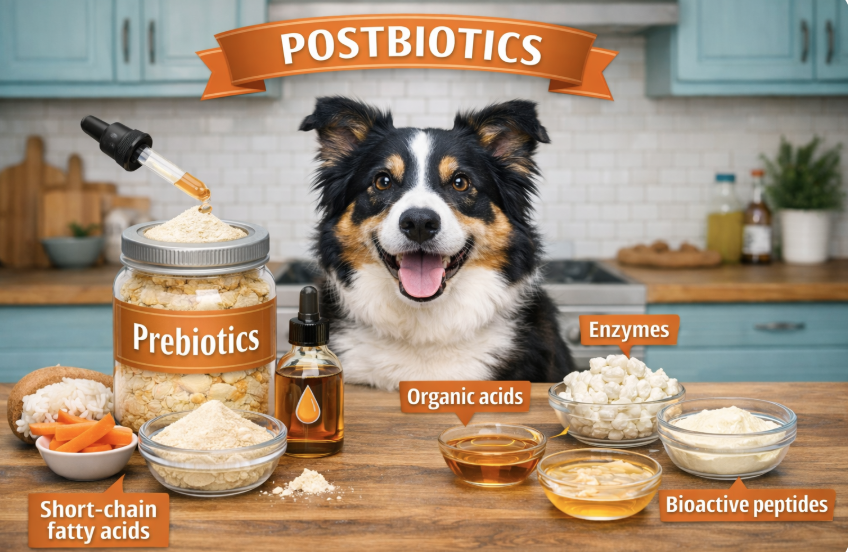
That broader group can include:
- Short-chain fatty acids
- Peptides
- Cell-wall components
- Enzymes
- Organic acids
- Other microbial metabolites and fermentation products
In plain English: microbes do things.
And some of what they produce or leave behind can interact with the gut lining, immune system and other body systems.
How Are Postbiotics Different From Probiotics?
Probiotics are live microorganisms.
Postbiotics do not require live organisms to be delivered to the dog.
That distinction is important.
A probiotic must remain viable enough to exert its intended effects. A postbiotic preparation does not depend on a living organism surviving storage, stomach acid and the rest of the digestive journey.
That does not make postbiotics universally “better” than probiotics.
It makes them a different tool.
How Are Postbiotics Different From Prebiotics?
Prebiotics are substrates that microbes can use.
Postbiotics are beneficial microbial products or preparations associated with microbial activity.
One way to picture the relationship is:
- Prebiotics: some of the raw material
- Microbes: the workers doing the fermenting
- Postbiotic compounds: part of what comes out of that process
It is a useful analogy, as long as we remember the actual microbiome is much more complicated than a tiny factory living in your dog's colon.
What Do Postbiotics Do for Dogs?
Research into postbiotics is still developing, especially in dogs, but these compounds are interesting because of their potential effects on:
- Gut barrier function
- Immune communication
- Inflammatory regulation
- The intestinal environment
- Microbial interactions
- Metabolic signaling
- Gut-brain communication
This is one reason the benefits of a healthy microbiome cannot be reduced to counting bacteria.
I care about who is living there, but I also care about what that ecosystem is actually producing.
What Are Short-Chain Fatty Acids?
Short-chain fatty acids—often abbreviated SCFAs—are among the most discussed microbial fermentation products.
They are produced when intestinal microbes ferment certain fibers and resistant starches.
The three most commonly discussed are:
- Acetate
- Propionate
- Butyrate
Butyrate gets particular attention because cells lining the colon can use it as an energy source and because it participates in gut-barrier and immune regulation.
This is one reason appropriate fiber and microbial diversity can have effects far beyond simply creating a nicer-looking stool.
Does My Dog Get Postbiotics Naturally?
Yes.
A healthy intestinal ecosystem naturally produces microbial metabolites when microbes ferment and metabolize what the dog eats.
So one of the best long-term ways to support healthy postbiotic activity is not necessarily to buy another supplement.
It is to create an intestinal environment in which the dog's own microbial ecosystem can function well.
Depending on the dog, that includes:
- Fresh, nutrient-dense food
- Appropriate food diversity
- Appropriate fermentable fiber
- Resistant starch when tolerated
- Good digestion
- A healthier gut lining
- Reduced unnecessary disruption to the microbiome
That is another reason food remains foundational even when we are discussing increasingly sophisticated gut products.
Are Fermented Foods a Source of Postbiotics?
Fermented foods can contain a combination of live organisms, microbial fragments and compounds created during fermentation.
Depending on the food and how it was produced or stored, the balance between those components can vary considerably.
Foods such as kefir and appropriately prepared fermented vegetables can therefore contribute microbial and fermentation-related compounds for dogs that tolerate them.
But fermented does not automatically mean appropriate for every gut.
A dog who becomes itchy, gassy or loose-stooled after fermented food does not need to keep eating it simply because it is theoretically wonderful for the microbiome.
Is Bone Broth a Postbiotic?
No—not in the way I would use the term.
Bone broth can provide fluids, amino acids, gelatin and other nutrients that may be useful in an overall digestive or recovery strategy.
But those nutrients are not the same thing as postbiotic compounds produced by microorganisms or contained in a defined postbiotic preparation.
It can support the gut.
That does not make it a postbiotic.
Are Slow-Cooked Meats a Source of Postbiotics?
Not inherently.
Slow-cooked meat can be nourishing, digestible and useful in a fresh-food diet, but cooking meat slowly does not automatically create postbiotics.
This is an important distinction because “supports gut health” and “is a postbiotic” are not interchangeable claims.
Can Postbiotics Be Useful When a Dog Is Not Ready for Probiotics?
Potentially, yes.
This is one of the reasons I find the category interesting.
Some dogs have such reactive guts that every new probiotic seems to create gas, stool changes or another flare.
Because a postbiotic does not require us to introduce a living microbial organism, it may sometimes be one option to consider while we work on making the intestinal environment more stable.
But I want to be careful with the phrase “not ready.”
A dog who does poorly with probiotics may be reacting to the probiotic strain, the dose, an included prebiotic fiber, a flavoring, another ingredient—or the underlying GI problem may simply be too unstable.
I do not assume every reactive dog therefore needs a postbiotic.
Sometimes the dog needs fewer supplements, a simpler diet, better digestion, veterinary diagnostics or gut-lining support first.
Can a Dog Be Not Ready for Postbiotics Too?
Yes.
Anything we introduce can be poorly tolerated by the wrong dog at the wrong time.
The postbiotic ingredient itself may not be the only issue. Products may contain fibers, flavorings, proteins, herbs or other ingredients that a highly reactive dog does not tolerate.
And when a dog is actively vomiting, severely diarrheic, painful, refusing food or medically unstable, the priority is not deciding which “biotic” to add.
Stabilize the dog first.
Can Postbiotics Help Dogs After Antibiotics?
They may have a role in recovery, but I do not use the formula: antibiotics = automatically add postbiotics.
After antibiotic treatment, I want to know what changed:
- Stool
- Food tolerance
- Gas or bloating
- Yeast
- Appetite
- Digestion
- Skin or immune patterns
The dog's recovery plan may involve probiotics, postbiotics, prebiotic food, gut-lining support, nutrition—or simply time and a stable diet.
If antibiotics are part of your dog's story, read Antibiotics for Dogs: When They're Needed, Side Effects, and Supporting Recovery .
Can Postbiotics Help Dogs With Allergies or Itching?
Because microbial metabolites interact with the gut lining and immune system, postbiotic support may be one component of a broader strategy for some dogs with allergic or inflammatory patterns.
But I would not tell a pet parent that postbiotics “treat allergies.”
Chronic itching can involve environmental allergens, food reactions, skin-barrier health, yeast, infection, endocrine disease, inflammation, gut health and other factors.
If your dog has itching, yeast, recurring ears and digestive symptoms together, go to Could Your Dog's Gut Be Behind the Itching, Yeast, Diarrhea, and Allergies? .
Can Postbiotics Help With Inflammation?
Some microbial compounds participate in pathways involved in inflammatory and immune regulation.
That makes this an interesting area of research.
But inflammation is not one switch that a postbiotic supplement simply turns off.
Chronic inflammation may be influenced by diet, disease, adipose tissue, immune activity, environmental exposure, pain, infection, gut health and many other variables.
I would use postbiotics as one possible piece of a broader strategy rather than selling them as an anti-inflammatory cure-all.
Can Postbiotics Affect the Gut-Brain Axis?
Microbial metabolites are one part of the communication network between the gut and nervous system.
The gut-brain axis also involves immune signaling, hormones, the vagus nerve, nutrient status and the dog's physical comfort.
This is fascinating—and it is also where marketing can outrun the science quickly.
I would not tell you that a postbiotic fixes anxiety or behavior.
I would say that gut health is part of the physical state from which a dog has to regulate, learn, sleep and respond to stress.
Should I Use Postbiotics Instead of Probiotics?
I do not see this as an either-or question.
The dog may need:
- Neither
- A probiotic
- Postbiotic support
- Prebiotic food
- A combination
- Or something entirely different first
The categories work differently.
That is why I wrote Prebiotics, Probiotics, and Postbiotics for Dogs as the comparison guide rather than trying to declare one winner.
What Should I Look for in a Postbiotic Supplement?
“Postbiotic” is increasingly appearing on product labels, so I want to know more than the marketing word.
Questions I would ask include:
- What microorganism or fermentation source was used?
- What exactly does the finished ingredient contain?
- Is the ingredient standardized or clearly identified?
- What research supports that specific preparation?
- What other ingredients are in the product?
- Does it also contain prebiotic fiber?
- Could any added ingredients be a problem for this dog?
- What am I actually trying to accomplish by using it?
Again, that last question keeps us out of a lot of supplement trouble.
When Postbiotics Are Not Enough
If your dog's gut is chronically unstable, a postbiotic does not replace the foundational work.
We may still need to look at:
- Food quality and digestibility
- Protein and fat tolerance
- Gut-lining health
- Microbial diversity
- Medication and antibiotic history
- Pancreatic function
- Liver and gallbladder clues
- Inflammation
- Parasites or infection
- Stress and pain
- Microbiome testing in selected cases
If you are beyond the “which supplement?” stage, continue with How to Rebuild Your Dog's Gut Microbiome Naturally .
The Individual Dog Changes the Plan
A young dog recovering from one round of antibiotics is not the same case as a senior dog with years of food intolerance, chronic diarrhea, steroids and immune disease.
I want to know age, breed, size, diet history, stool patterns, appetite, nausea, weight, muscle condition, medications, supplements, lab trends, allergies, stress and what happened when previous gut products were introduced.
TCVM helps identify patterns such as heat, dampness, stagnation, deficiency, digestive weakness, stress or inflammation.
Muscle testing may help guide tolerance and direction in sensitive or complicated dogs.
Experience helps recognize patterns, ask better questions and avoid wasting time on random product guessing.
When to See Your Veterinarian
Postbiotic support is not a substitute for diagnostics or stabilization.
Contact your veterinarian for repeated vomiting, bloody diarrhea, black or tarry stool, severe or persistent diarrhea, abdominal pain, refusal to eat, dehydration, rapid weight loss, weakness, fever, collapse, suspected pancreatitis, obstruction or other significant deterioration.
Once the urgent problem is identified and stabilized, we can come back to the longer-term microbiome conversation.
Go Deeper
Dog Gut Health and the Microbiome
How to Rebuild Your Dog's Gut Microbiome Naturally
Prebiotics, Probiotics, and Postbiotics for Dogs
Probiotics for Dogs
Prebiotics for Dogs
When Your Dog Needs More Than Another Gut Product
If your dog is generally stable and you want ongoing nutrition and natural wellness education, resources and Q&A, The Well Oiled K9 Membership is a good place to keep learning.
If your dog has chronic GI disease, repeated antibiotics, significant food reactions, multiple diagnoses or seems unable to tolerate the things that are supposed to be “good for the gut,” individualized support lets us work out what the dog may need first.
Explore the Membership Explore Private Support ```Come, Sit and Stay Well.
Educational information only. This content is not intended to diagnose, treat, cure or prevent disease and does not replace individualized veterinary diagnosis, emergency care or medical treatment.
When DIY Isn't Enough Already tried the basics? If this is happening with your dog and you're still stuck, I can help you figure out what deserves attention next. Want reliable education, live Q&A, and member resources? Explore Membership →
Request a Discovery Callback →