
Prebiotics, Probiotics, and Postbiotics for Dogs
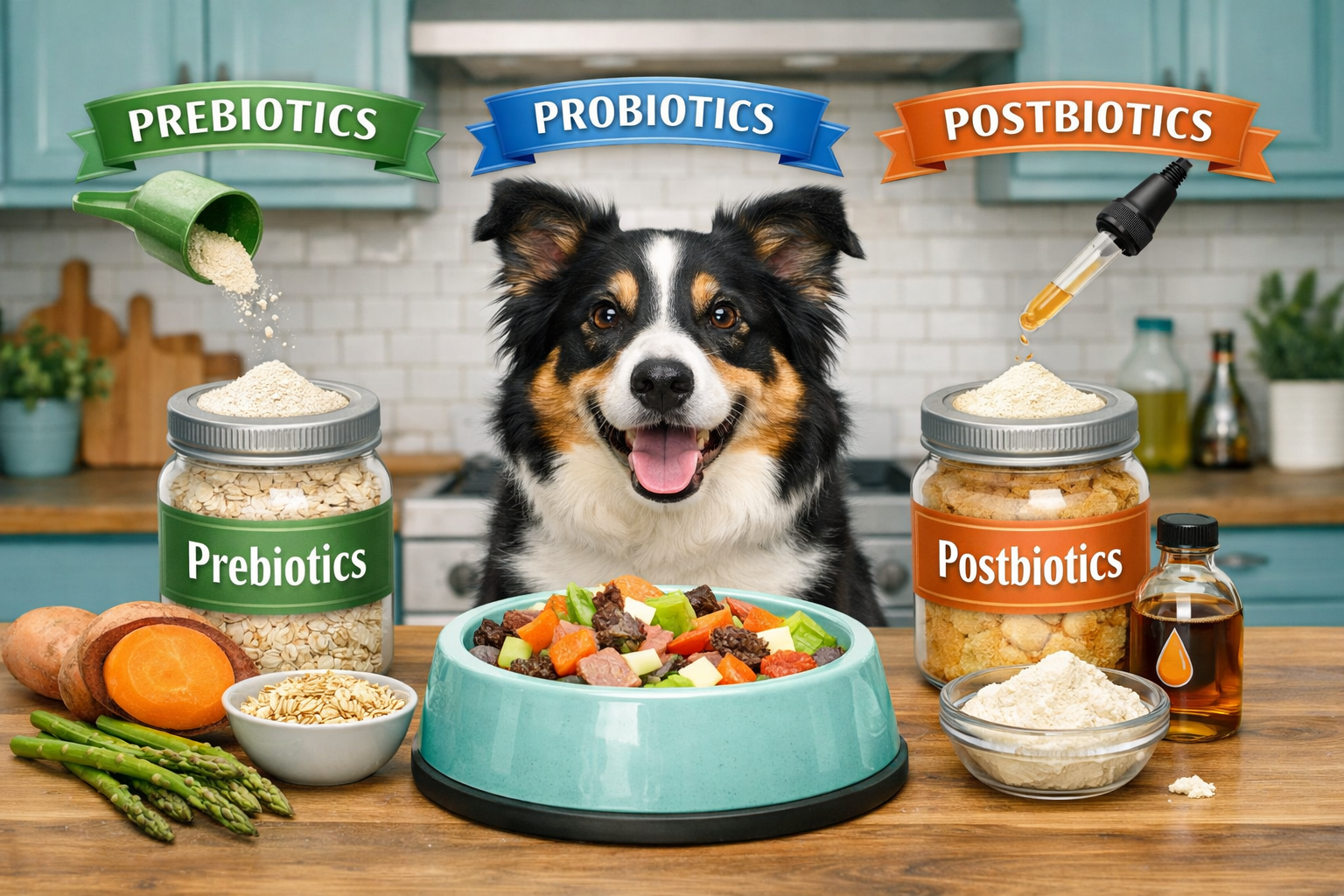
Prebiotics. Probiotics. Postbiotics.
Three nearly identical words that get thrown around on supplement labels as if every dog mom automatically graduated from Gut University.
They are related, but they are not the same thing.
Each plays a different role in the intestinal ecosystem, and understanding that difference can help you stop buying gut products based solely on which bottle has the prettiest promises.
If you want the bigger explanation of how your dog's microbial ecosystem works, start with Dog Gut Health and the Microbiome .
If you already know your dog's gut needs more than maintenance and you are wondering how rebuilding fits together, read How to Rebuild Your Dog's Gut Microbiome Naturally .
What Is the Difference Between Prebiotics, Probiotics and Postbiotics?
The simplest way to think about them is this:
They are introduced through certain foods or supplements and may support microbial function, digestion, stool quality and immune communication.
These are compounds—often certain fermentable fibers—that resident gut organisms can use as fuel.
These include compounds associated with microbial fermentation and activity that can interact with the gut lining, immune system and other body systems.
They are connected, but you do not necessarily need to supplement all three at the same time.
And no—the answer to every digestive problem is not “more probiotics.”
What Are Probiotics for Dogs?
Probiotics are live microorganisms that, when given appropriately, may provide a health benefit.
One important clarification: most supplemental probiotics do not simply move into your dog's intestines, unpack their little microbial suitcases and become permanent residents.
Many probiotic organisms are transient. They may interact with the existing microbiome and gut environment while they are passing through rather than permanently colonizing the intestinal tract.
That does not make them useless.
Depending on the strain and the dog, probiotics may help support:
- Stool quality
- Digestive function
- Microbial balance
- Immune communication
- Gut barrier function
- Recovery after some digestive disturbances
The key phrase is depending on the strain and the dog.
“Contains probiotics” tells me very little about whether a product is appropriate for the dog standing in front of me.
For the deeper discussion, read Does Your Dog Need Probiotics? .
What Are Prebiotics for Dogs?
Prebiotics are substrates that beneficial microbes can use.
Many are fermentable fibers or plant compounds that reach the lower digestive tract and become food for parts of the existing microbial community.
Depending on the source and the dog, prebiotic foods or supplements may support:
- Beneficial microbial activity
- Microbial diversity
- Short-chain fatty acid production
- Stool quality
- Gut barrier health
But prebiotics are not universally soothing.
A dog with a highly sensitive, inflamed or overly fermentative gut may become more gassy, bloated or loose-stooled when certain fibers are introduced too quickly.
That is one reason I do not automatically add more fiber simply because someone labeled it “gut healthy.”
Read more in Prebiotics for Dogs .
What Are Postbiotics for Dogs?
Postbiotics are a newer part of the gut-health conversation, but the basic idea is not complicated.
Gut microbes produce and interact with biologically active compounds as they ferment and metabolize nutrients.
These microbial products—and in some definitions components derived from microorganisms themselves—can influence the body even without introducing a live probiotic organism.
Postbiotic-related compounds may help support:
- Gut barrier integrity
- Immune regulation
- Inflammatory balance
- Communication between the gut and nervous system
- The intestinal environment
One of the reasons postbiotics interest me is that gut health is not only about which bacteria are present.
It is also about what the microbial ecosystem is actually doing.
Go deeper with Postbiotics for Dogs .
Do Dogs Need All Three?
Not necessarily.
This is where the tidy marketing diagram and the living dog begin to part ways.
A healthy dog eating a diverse fresh-food diet may already be receiving foods that nourish the resident microbiome and encourage beneficial microbial activity.
A dog recovering from antibiotics may benefit from more deliberate microbial support.
A dog with significant gas, bloating, SIBO-like patterns or severe GI sensitivity may tolerate some prebiotic fibers poorly.
Another dog may tolerate prebiotic food beautifully but react every time a new probiotic product is introduced.
The question is not:
“Does my dog need prebiotics, probiotics and postbiotics?”
The better question is:
“What is this dog's gut missing or struggling to do?”
How Do Prebiotics and Probiotics Work Together?
Prebiotics can provide fermentable fuel for parts of the gut microbiome. Probiotics introduce selected live organisms that may exert beneficial effects while present.
They can complement each other.
But I would not say a probiotic cannot work unless you also give a prebiotic.
Nor would I say every dog receiving a probiotic needs a separate prebiotic supplement.
Your dog's normal diet may already contain fermentable substrates. Different probiotic strains also have different characteristics, and some products include prebiotic ingredients in the formulation.
This is why I want to know what the dog eats before I start adding powders.
What Is a Synbiotic?
You may also see the word synbiotic on gut-health products.
A synbiotic combines live microorganisms with a substrate intended to support beneficial microbial activity.
In plain English, it generally means probiotics and prebiotic support packaged together.
That can be convenient. It still does not automatically mean the formulation is right for every dog.
Food Should Still Be Doing Most of the Heavy Lifting
I do not want a pet parent feeding a highly processed, poorly tolerated diet and then expecting a scoop of gut powder to repair the ecosystem every evening.
Food interacts with the microbiome every single day.
My preference is a fresh-food foundation appropriate for the individual dog, with thoughtful variety and fiber as tolerated.
Depending on the dog, natural sources that contribute to gut support may include vegetables, selected fruits, resistant starches, fermented foods, medicinal mushrooms and other whole-food ingredients.
But there is an important qualifier:
The irritated gut may not tolerate the same foods as the healthy gut.
Sometimes the long-term destination is diversity, while the short-term strategy is simplicity.
Why More Gut Products Can Make Things Worse
Gut products are one of the easiest places for well-meaning dog moms to end up with an impressive supplement cabinet and absolutely no idea what is working.
A probiotic gets added. Then another probiotic. Then pumpkin. Then kefir. Then a prebiotic powder. Then fermented vegetables.
And somewhere around Thursday the dog has explosive diarrhea.
More is not inherently better.
Adding fermentable substrates to a dog who is already gassy and bloated can make symptoms worse. Adding several new microbial products at once makes it nearly impossible to know which one the dog tolerated.
A useful gut strategy should give us information, not create more mystery.
When Might Probiotic Support Make Sense?
Depending on the individual dog and the product, probiotics may be considered during or after certain disruptions such as:
- Antibiotic use
- Acute or recurring diarrhea
- Diet transitions
- Stressful events
- Periods of GI instability
- Some chronic gut or immune patterns
But chronic diarrhea, recurring yeast, food reactions or allergy symptoms are not automatic proof that the answer is a probiotic.
If these symptoms keep returning, read Could Your Dog's Gut Be Behind the Itching, Yeast, Diarrhea, and Allergies? .
When Might Prebiotic Support Need More Caution?
Prebiotic foods and fibers are useful tools, but highly fermentable ingredients can be uncomfortable for some dogs.
I am especially thoughtful when a dog already has:
- Significant bloating
- Excessive gas
- Very frequent loose stool
- Severe food reactivity
- Suspected small intestinal bacterial overgrowth or dysbiosis
- A history of reacting badly to increased fiber
This does not mean prebiotics are “bad” for those dogs.
It means the source, amount, timing and underlying problem need more thought.
Do Probiotics Need to Be Given Forever?
Not necessarily.
I do not believe every healthy dog needs the same probiotic every single day for life simply because probiotics are considered beneficial.
Some dogs may benefit from targeted use during particular circumstances. Others with chronic GI disease or significant dysbiosis may need more sustained support.
The goal is not lifelong dependence on a supplement bottle.
The goal is a more resilient gut ecosystem.
Do You Need to Rotate Probiotics?
I like microbial diversity, but that does not mean every dog needs a calendar telling you to switch probiotic brands every thirty days.
Different strains have different characteristics, and changing strains or formulations can sometimes be useful when there is a reason to do so.
But rotation for the sake of rotation is still guessing.
I would rather choose support based on the dog's history, symptoms, tolerance, diet and what we are trying to accomplish.
What If a Probiotic Makes My Dog Worse?
Pay attention.
A little temporary stool change may occur when introducing something new, but significant gas, diarrhea, vomiting, worsening itching, poor appetite or obvious discomfort is not something I would automatically push through because the product is supposed to be healthy.
The wrong strain, an added ingredient, the amount, the timing or the dog's underlying gut condition may all affect tolerance.
A reaction is information.
It is not proof the dog needs even more of the product.
When Gut Support Needs More Than a Biotic
If you have tried multiple probiotics, changed foods repeatedly and keep ending up with the same diarrhea, yeast, itching or food reactions, I would stop shopping for a stronger probiotic.
The dog may need a broader rebuilding strategy involving:
- Diet quality and digestibility
- Gut-lining support
- Digestive function
- Inflammation
- Medication history
- Microbial diversity
- Food tolerance
- Parasite or disease evaluation
- Microbiome testing in selected cases
- Advanced restoration such as FMT when appropriate
That broader conversation lives in How to Rebuild Your Dog's Gut Microbiome Naturally .
The Individual Dog Changes the Choice
When I am deciding whether prebiotic, probiotic or postbiotic support belongs in the plan, I am not looking only at the product label.
I want to know the dog's age, diet, symptom history, stool patterns, medications, antibiotic history, treats and extras, appetite, nausea, weight, other diagnoses, stress and what has already been tried.
TCVM helps identify patterns such as heat, dampness, stagnation, deficiency, digestive weakness, stress or inflammation.
Muscle testing may help guide tolerance and direction in sensitive or complicated dogs.
Experience helps recognize patterns, ask better questions and avoid wasting time on random product guessing.
When to See Your Veterinarian
A probiotic is not an appropriate substitute for veterinary care when your dog has severe or persistent GI symptoms.
Contact your veterinarian for repeated vomiting, bloody diarrhea, black or tarry stool, abdominal pain, refusal to eat, dehydration, rapid weight loss, severe lethargy, weakness, collapse, fever, suspected obstruction, pancreatitis or other significant deterioration.
Veterinary diagnostics may need to come first.
Then we can decide what kind of gut support makes sense during recovery.
So Which One Does Your Dog Need?
Maybe a probiotic.
Maybe more appropriate prebiotic foods.
Maybe postbiotic support.
Maybe none of those are the first thing your dog needs.
That is why I want you to understand the categories rather than memorize a shopping list.
If the gut is generally healthy, these tools can help support the ecosystem.
If the gut is already a small dumpster fire, we may need to figure out why it is burning before throwing another powder into it.
Go Deeper
Dog Gut Health and the Microbiome
How to Rebuild Your Dog's Gut Microbiome Naturally
Does Your Dog Need Probiotics?
Prebiotics for Dogs
Postbiotics for Dogs
When You Need Help Putting the Gut Pieces Together
If your dog is generally stable and you want ongoing nutrition and natural wellness education, Q&A and resources, The Well Oiled K9 Membership is a good place to keep learning.
If your dog has chronic diarrhea, significant food reactions, repeated antibiotic use, weight loss, multiple diagnoses or seems to react to every product you try, that is where individualized support becomes much more useful.
Explore the Membership Explore Private Support ```Come, Sit and Stay Well.
Educational information only. This content is not intended to diagnose, treat, cure or prevent disease and does not replace individualized veterinary diagnosis, emergency care or medical treatment.
When DIY Isn't Enough Already tried the basics? If this is happening with your dog and you're still stuck, I can help you figure out what deserves attention next. Want reliable education, live Q&A, and member resources? Explore Membership →
Request a Discovery Callback →